
How People Learn in Informal Science Environments
-
- Hardcover ausgewählt
- Taschenbuch
- eBook
-
Sprache:Englisch
138,99 €
UVP
160,49 €
inkl. gesetzl. MwSt.,
Beschreibung
Produktdetails
Einband
Gebundene Ausgabe
Erscheinungsdatum
04.04.2023
Abbildungen
XIII, 568 p. 92 illus., 46 illus. in color.
Herausgeber
Patricia G. PatrickVerlag
SpringerSeitenzahl
568
Maße (L/B/H)
24,1/16/3,7 cm
Gewicht
1033 g
Auflage
2023
Sprache
Englisch
ISBN
978-3-031-13290-2
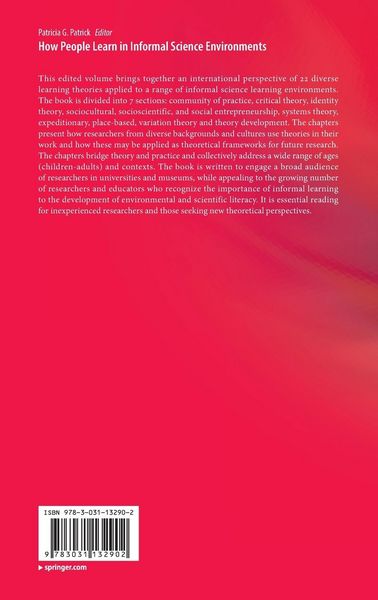
This edited volume brings together an international perspective of 22 diverse learning theories applied to a range of informal science learning environments. The book is divided into 7 sections: community of practice, critical theory, identity theory, sociocultural, socioscientific, and social entrepreneurship, systems theory, and theory development. The chapters present how researchers from diverse backgrounds and cultures use theories in their work and how these may be applied as theoretical frameworks for future research. The chapters bridge theory and practice and collectively address a wide range of ages (children-adults) and contexts. The book is written to engage a broad audience of researchers in universities and museums, while appealing to the growing number of researchers and educators who recognize the importance of informal learning to the development of environmental and scientific literacy. It is essential reading for inexperienced researchers and those seeking new theoretical perspectives.
Noch keine Bewertungen vorhanden
Verfassen Sie die erste Bewertung zu diesem Artikel
Helfen Sie anderen Kundinnen und Kunden durch Ihre Meinung.
Kurze Frage zu unserer Seite
Vielen Dank für dein Feedback
Wir nutzen dein Feedback, um unsere Produktseiten zu verbessern. Bitte habe Verständnis, dass wir dir keine Rückmeldung geben können. Falls du Kontakt mit uns aufnehmen möchtest, kannst du dich aber gerne an unseren Kund*innenservice wenden.
zum Kundenservice