Gutscheinbedingungen

**Gültig vom 07.09.2026 bis 09.09.2026 | Gültig für nicht preisgebundene fremdsprachige Bücher | Einzelne Artikel können ausgeschlossen sein | Online auf www.bücher.de einlösbar | Click & Collect nur mit Online-Zahlung (Paypal/Kreditkarte) vorab | Nicht kombinierbar mit anderen Gutscheinen oder Preisaktionen | Nur einmal pro Einkauf einlösbar | Gutschein wird auf max. 500€ Bestellwert angerechnet | Keine Barauszahlung | Nicht gültig für Versandkosten und Services

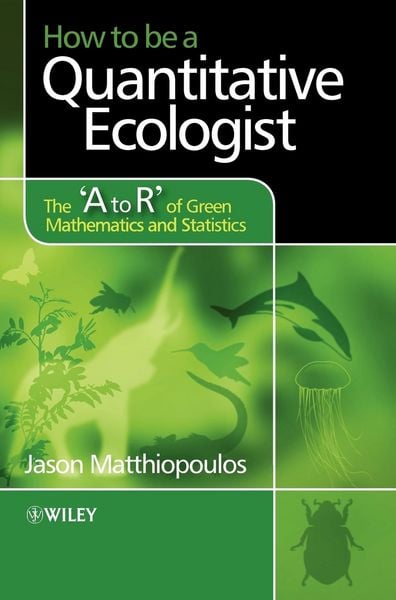
Produktbild: How to be a Quantitative Ecologist

How to be a Quantitative Ecologist The 'a to R' of Green Mathematics and Statistics

176,99 €

inkl. gesetzl. MwSt., Versandkostenfrei


Beschreibung

Produktdetails

Einband

Gebundene Ausgabe

Erscheinungsdatum

14.04.2011

Verlag

John Wiley & Sons Inc

Seitenzahl

496

Maße (L/B/H)

25/17,5/3,1 cm

Gewicht

1019 g

Auflage

1. Auflage

Sprache

Englisch

ISBN

978-0-470-69978-2

Beschreibung

Rezension

"For those looking through R books for something a bit more technical, this book will be an essential accomplice to mastering R." ( British Ecological Society , 1 April 2013)

"The book is written in a style that is easy to read and for which one quickly forgets that the examples are essentially mathematical in nature. If you are an ecologist who has shied away from quantitative ecology in the past then this may be the text to convince you that there is much to be learnt from quantitative ecology. I thoroughly recommend this book and trust that you enjoy reading it as much as I did." ( International Statistical Review , 2012)
"After a course of one or two semesters using this textbook, he says, students should have the absolute minimum of knowledge about quantitative research that ecologists need, but can provide a foundation for students who want to move further in that direction." (Book News, 1 August 2011)

Produktdetails

Einband

Gebundene Ausgabe

Erscheinungsdatum

14.04.2011

Verlag

John Wiley & Sons Inc

Seitenzahl

496

Maße (L/B/H)

25/17,5/3,1 cm

Gewicht

1019 g

Auflage

1. Auflage

Sprache

Englisch

ISBN

978-0-470-69978-2

Herstelleradresse

Libri GmbH
Europaallee 1
36244 Bad Hersfeld
DE

Email: gpsr@libri.de

Noch keine Bewertungen vorhanden

Verfassen Sie die erste Bewertung zu diesem Artikel

Helfen Sie anderen Kundinnen und Kunden durch Ihre Meinung.

Kundinnen und Kunden meinen

Bewertungen (0)

Die Leseprobe wird geladen.
  • Produktbild: How to be a Quantitative Ecologist
  • How I chose to write this book, and why you might choose to read it.
     
    Preface.
     
    0. How to start a meaningful relationship with your computer.
     
    Introduction to R.
     
    0.1 What is R?
     
    0.2 Why use R for this book?
     
    0.3 Computing with a scientific package like R.
     
    0.4 Installing and interacting with R.
     
    0.5 Style conventions.
     
    0.6 Valuable R accessories.
     
    0.7 Getting help.
     
    0.8 Basic R usage.
     
    0.9 Importing data from a spreadsheet.
     
    0.10 Storing data in data frames.
     
    0.11 Exporting data from R.
     
    0.12 Quitting R.
     
    1. How to make mathematical statements.
     
    Numbers, equations and functions.
     
    1.1 Qualitative and quantitative scales.
     
    1.2 Numbers.
     
    1.3 Symbols.
     
    1.4 Logical operations.
     
    1.5 Algebraic operations.
     
    1.6 Manipulating numbers.
     
    1.7 Manipulating units.
     
    1.8 Manipulating expressions.
     
    1.9 Polynomials.
     
    1.10 Equations.
     
    1.11 First order polynomial equations.
     
    1.12 Proportionality and scaling: a special kind of first order polynomial equation.
     
    1.13 Second and higher order polynomial equations.
     
    1.14 Systems of polynomial equations.
     
    1.15 Inequalities.
     
    1.16 Coordinate systems.
     
    1.17 Complex numbers.
     
    1.18 Relations and functions.
     
    1.19 The graph of a function.
     
    1.20 First order polynomial functions.
     
    1.21 Higher order polynomial functions.
     
    1.22 The relationship between equations and functions.
     
    1.23 Other useful functions.
     
    1.24 Inverse functions.
     
    1.25 Functions of more than one variable.
     
    2. How to describe regular shapes and patterns.
     
    Geometry and trigonometry.
     
    2.1 Primitive elements.
     
    2.2 Axioms of Euclidean geometry.
     
    2.3 Propositions.
     
    2.4 Distance between two points.
     
    2.5 Areas and volumes.
     
    2.6 Measuring angles.
     
    2.7 The trigonometric circle.
     
    2.8 Trigonometric functions.
     
    2.9 Polar coordinates.
     
    2.10 Graphs of trigonometric functions.
     
    2.11 Trigonometric identities.
     
    2.12 Inverses of trigonometric functions.
     
    2.13 Trigonometric equations.
     
    2.14 Modifying the basic trigonometric graphs.
     
    2.15 Superimposing trigonometric functions.
     
    2.16 Spectral analysis.
     
    2.17 Fractal geometry.
     
    3. How to change things, one step at a time.
     
    Sequences, difference equations and logarithms.
     
    3.1 Sequences.
     
    3.2 Difference equations.
     
    3.3 Higher order difference equations.
     
    3.4 Initial conditions and parameters.
     
    3.5 Solutions of a difference equation.
     
    3.6 Equilibrium solutions.
     
    3.7 Stable and unstable equilibria.
     
    3.8 Investigating stability.
     
    3.9 Chaos.
     
    3.10 Exponential function.
     
    3.11 Logarithmic function.
     
    3.12 Logarithmic equations.
     
    4. How to change things, continuously.
     
    Derivatives and their applications.
     
    4.1 Average rate of change.
     
    4.2 Instantaneous rate of change.
     
    4.3 Limits.
     
    4.4 The derivative of a function.
     
    4.5 Differentiating polynomials.
     
    4.6 Differentiating other functions.
     
    4.7 The chain rule.
     
    4.8 Higher order derivatives.
     
    4.9 Derivatives of functions of many variables.
     
    4.10 Optimisation.
     
    4.11 Local stability for difference equations.
     
    4.12 Series expansions.
    &n