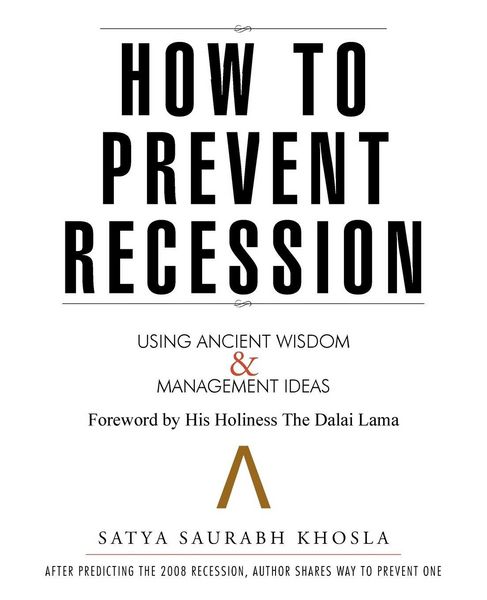
How to Prevent Recession Using Ancient Wisdom and Management Ideas
-
- Taschenbuch ausgewählt
- eBook
-
Sprache:Englisch
29,99 €
inkl. gesetzl. MwSt.,
Beschreibung
Produktdetails
Einband
Taschenbuch
Erscheinungsdatum
19.05.2015
Verlag
Partridge SingaporeSeitenzahl
454
Maße (L/B/H)
23,5/19,1/2,4 cm
Gewicht
841 g
Sprache
Englisch
ISBN
978-1-4828-2820-7
" ""...This is a very profound concept put in a very simple and beautiful format"" as written in the Foreword by His Holiness the Dalai Lama. In October 2007, author Satya Saurabh Khosla's article predicting the recession was published in Business Times, Singapore. Millions suffered despite its accurate warning. While analysing this later, he felt that preventing a recession will help society more. How to Prevent Recession seeks to rely on ethics in the strategy used for life and work. Values are a 'Strategy for living life'. These are applied at work to prevent recession. If profit becomes the only purpose of life, it disturbs the framework which sustains society. How to Prevent Recession uses the ancient framework of four goals of life. It applies these goals to business from a strategy of life. This book compares profit to the speed of a car. If personal and firm's profit is only maximised brakes are forgotten. Management Ideas given by Porter state that strategy is an 'optimisation effort'. Profit, too, should result from it. A car's speed is optimised when it considers criteria like bad roads to avoid jerks for passengers, fuel efficiency and reducing speed to prevent a crash. Ancient wisdom trains the human mind. Then, the Truth about optimum strategy emerges from within, as we drive the car of life to work. Strategy is a way of achieving a goal. So, ancient Indian wisdom of four goals of life are like a car's four wheels. An 'optimisation effort' balances the pressure. The wisdom of using righteous conduct prevents recession. ""The book makes the important point that any business strategy should emerge from a conception of a decent life rooted in spirituality."" Pradip Khandwalla, former Director, Indian Institute of Management, Ahmedabad. ""Excellent work. Brilliant in its integration of ancient Indian Truths with the concept of mangement"" Prof P.N. Sharma, Member, Governing Body, Library of Tibetan Works & Archives."
Noch keine Bewertungen vorhanden
Verfassen Sie die erste Bewertung zu diesem Artikel
Helfen Sie anderen Kundinnen und Kunden durch Ihre Meinung.
Kurze Frage zu unserer Seite
Vielen Dank für dein Feedback
Wir nutzen dein Feedback, um unsere Produktseiten zu verbessern. Bitte habe Verständnis, dass wir dir keine Rückmeldung geben können. Falls du Kontakt mit uns aufnehmen möchtest, kannst du dich aber gerne an unseren Kund*innenservice wenden.
zum Kundenservice