Gutscheinbedingungen

**Gültig vom 24.08.2026 bis 26.08.2026 | Gültig für nicht preisgebundene fremdsprachige Bücher | Einzelne Artikel können ausgeschlossen sein | Online auf www.bücher.de einlösbar | Click & Collect nur mit Online-Zahlung (Paypal/Kreditkarte) vorab | Nicht kombinierbar mit anderen Gutscheinen oder Preisaktionen | Nur einmal pro Einkauf einlösbar | Gutschein wird auf max. 500€ Bestellwert angerechnet | Keine Barauszahlung | Nicht gültig für Versandkosten und Services

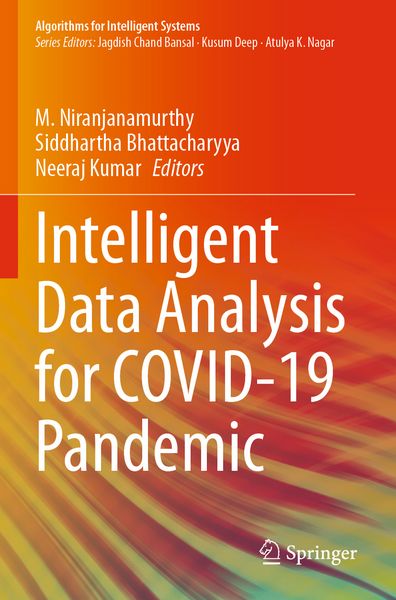
  • Produktbild: Intelligent Data Analysis for COVID-19 Pandemic
  • Produktbild: Intelligent Data Analysis for COVID-19 Pandemic
- 13%

Intelligent Data Analysis for COVID-19 Pandemic

13% sparen

157,99 € UVP 181,89 €

inkl. gesetzl. MwSt., Versandkostenfrei


Beschreibung

Produktdetails

Einband

Taschenbuch

Erscheinungsdatum

24.06.2022

Abbildungen

XIX, 370 p. 156 illus., 105 illus. in color.

Herausgeber

M. Niranjanamurthy + weitere

Verlag

Springer Singapore

Seitenzahl

370

Maße (L/B/H)

23,5/15,5/2,2 cm

Gewicht

593 g

Auflage

1st ed. 2021

Sprache

Englisch

ISBN

978-981-16-1576-4

Beschreibung

Rezension

“Each article is self-contained with a detailed description of each method, background information, statistics and mathematical details, theory, and application. Anyone looking for inspiration could find several examples and use cases of available data that can be used for insight generation. … The strength of this edited book is that the readers would become familiar with several data sources and demonstration of intelligent analysis of data that social scientist routinely collect.” (Enayet Raheem, ISCB News, iscb.info, June, 2022)

Portrait


Dr. Niranjanamurthy M is Assistant Professor, Department of Computer Applications, M S Ramaiah Institute of Technology, Bangalore, Karnataka, India. He completed Ph.D. in Computer Science at JJTU, Rajasthan (2016); M.Phil. in Computer Science at VMU, Salem (2009); Masters in Computer Applications at Visvesvaraiah Technological University, Belgaum, Karnataka (2007);   BCA from Kuvempu University 2004 with University 5th Rank. He has 10 years of teaching experience and 2 years of industry experience as Software Engineer. He has published books in Scholars Press Germany and CRC Press. He also published 56 research papers and filed 12 patents. Currently, he is guiding four Ph.D. research scholars in the areas of data science, edge computing, ML, and networking. He is Reviewer of 22 international journals and Series Editor in CRC Press and Scrivener Publishing. He has received best research journal reviewer and researcher awards. He is a member of IEEE, CSTA, IAENG, and INSC. His areas of interest are data science, ML, edge computing, software engineering, web services, cloud computing, and networking.


Dr. Siddhartha Bhattacharyya [LFOSI, LFISRD, FIET (UK), FIETE, FIE(I), SMIEEE, SMIETI, SMACM, LMCRSI, LMCSI, LMISTE, LMIUPRAI, LMCEGR, LMICCI, LMALI, MIRSS, MIAENG, MCSTA, MIAASSE, MIDES, MISSIP, MSDIWC] is currently serving as Professor in the Department of Computer Science and Engineering of Christ University, Bangalore. He is Co-Author of 5 books and Co-Editor of 75 books and has more than 300 research publications in international journals and conference proceedings to his credit. He has got two PCTs to his credit. He is Associate Editor of several reputed journals including Applied Soft Computing, IEEE Access, Evolutionary Intelligence, and IET Quantum Communications. He is Editor of International Journal of Pattern Recognition Research and  Founding Editor-in-Chief of International Journal of Hybrid Intelligence, Inderscience.His research interests include hybrid intelligence, pattern recognition, multimedia data processing, social networks, and quantum computing. 


Dr. Neeraj Kumar is currently engaged with the Department of Information Technology, Babasaheb Bhimrao Ambedkar University (A Central University), Lucknow (India). He has completed his Doctorate in Information Technology from BBAU, Lucknow, in March 2020. He has completed his basic education from Government Polytechnic, Budaun, and then graduation and PG from UPTU, Lucknow, and IIIT Allahabad in the year 2005 and 2010, respectively. After graduation, he was appointed as Lecturer in BSACET, Mathura, while after PG, appointed as Assistant Professor in various institutes of RTU and UPTU. He has published more than two dozen research articles in reputed international journals and conferences. He has published few patents related to computer science and disaster management. He has published few authored and edited books withthe publishers of national repute. He has research interests in topics related to real-life problem, including disaster management, IoT, big data, soft computing, cyber security, and quantum cryptography.

Produktdetails

Einband

Taschenbuch

Erscheinungsdatum

24.06.2022

Abbildungen

XIX, 370 p. 156 illus., 105 illus. in color.

Herausgeber

Verlag

Springer Singapore

Seitenzahl

370

Maße (L/B/H)

23,5/15,5/2,2 cm

Gewicht

593 g

Auflage

1st ed. 2021

Sprache

Englisch

ISBN

978-981-16-1576-4

Herstelleradresse

Springer-Verlag KG
Sachsenplatz 4-6
1201 Wien
AT

Email: ProductSafety@springernature.com

Noch keine Bewertungen vorhanden

Verfassen Sie die erste Bewertung zu diesem Artikel

Helfen Sie anderen Kundinnen und Kunden durch Ihre Meinung.

Kundinnen und Kunden meinen

Bewertungen (0)

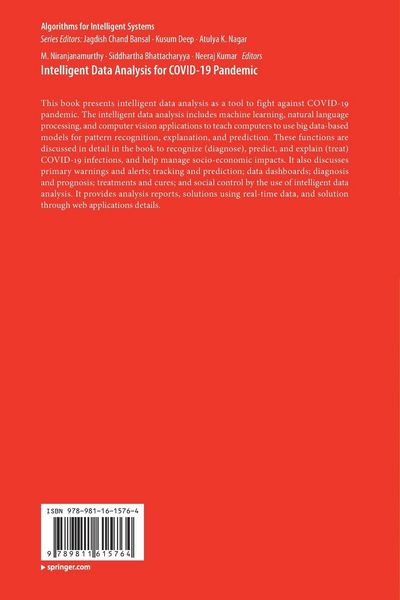
  • Produktbild: Intelligent Data Analysis for COVID-19 Pandemic
  • Produktbild: Intelligent Data Analysis for COVID-19 Pandemic

  • Chapter 1. Machine Learning Based Ensemble Approach for Predicting the Mortality Risk of Covid-19 Patients: A Case Study.- Chapter 2. The Role of Internet of Health Things (IoHTs) & Innovative Internet of  5G Medical Robotic Things (IIo-5GMRTs) in COVID-19 Global Health Risk Management and Logistics Planning.- Chapter 3. Battling COVID-19 with Process Model of Integrated Digital Technology: An Analysis of Qualitative Data.- Chapter 4. High-fidelity intelligence ventilator to help infect with Covid-19 based on artificial intelligence.- Chapter 5. Boon of Artificial Intelligence in Diagnosis of Covid-19.- Chapter 6. Artificial Intelligence and Big Data Solutions for COVID-19.- Chapter 7. Modeling the Transmition Dynamics of COVID-19 Virus Disease in Nigeria.- Chapter 8. Emerging Trends in Higher Education during Pandemic Covid-19: An impact study From West Bengal.- Chapter 9. COVID-19: Virology, Epidemiology, Diagnostics and Predictive modelling.- Chapter 10. Improved Estimation inLogistic Regression through Quadratic Bootstrap Approach: An Application in Indian Agricultural e-learning System during COVID-19 Pandemic.- Chapter 11. COVID-19 and Stock Markets: Deaths and Strict Policies.- Chapter 12. Artificial Intelligence Techniques in Medical Imaging for Detection of Corona Virus (COVID-19 / SARS-COV-2): A Brief Survey.- Chapter 13. A Travelling Disinfection-man Problem (TDP) for COVID-19: A Nonlinear Binary Constrained Gaining-Sharing knowledge-based Optimization Algorithm.- Chapter 14. COVID-19 Lock down Impact on Mental Health: A Cross-sectional Online Survey from Kerala, India.- Chapter 15. Analysis, Modelling and Prediction of COVID-19 Outbreaks using Machine Learning Algorithms.