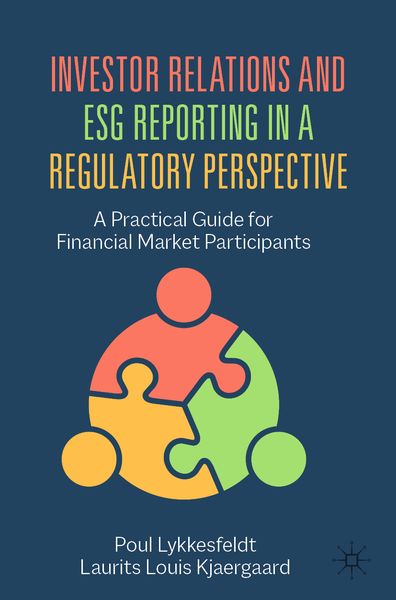

Investor Relations and ESG Reporting in a Regulatory Perspective A Practical Guide for Financial Market Participants
-
- Hardcover
- Taschenbuch ausgewählt
- eBook
-
Sprache:Englisch
58,99 €
inkl. gesetzl. MwSt.,
Beschreibung
Produktdetails
Einband
Taschenbuch
Erscheinungsdatum
17.08.2023
Abbildungen
XXX, 346 p. 92 illus., 91 illus. in color.
Verlag
SpringerSeitenzahl
346
Maße (L/B/H)
23,5/15,5/2,1 cm
Gewicht
575 g
Auflage
23001 Auflage 1st ed. 2022
Sprache
Englisch
ISBN
978-3-031-05802-8
Investor Relations and ESG Reporting in a Regulatory Perspective
is a comprehensive and detailed practical guide for financial market participants, focusing on the stock market, written for practitioners by practitioners. The main themes of the book include the challenging integration of investor relations (IR) and the non-financial reporting of environmental, social and governance (ESG). Further, the book provides a comprehensive overview of the complex regulatory framework of the European Union (EU) related to the financial markets, including the expected global trends in this area. This includes financial legislation such as MiFID II, MiFIR and MAR along with non-financial legislation like the EU’s taxonomy, CSRD and SFDR. In addition, this book explores the non-financial reporting standards of GRI, TCFD, CDSB, IBC, SASB, IRRC and the upcoming ISSB, and discusses the UN’s Sustainable Development Goals (SDGs). In addition, the book provides a practical guide regarding IR inspecial situations, e.g. in connection with takeover response manuals, M&A, investor activism, initial public offerings (IPOs), as well companies’ collaboration with e.g. investment banks and corporate finance advisers, financial PR and IR advisers in such situations. The suggested audience of the book includes board members and senior management of in particular listed companies, and companies considering an IPO; professionals working in the fields of IR, ESG and communications; institutional and retail investors; private equity executives; venture capitalists; investment bankers; legal practitioners; accountants and auditors; financial journalists; and politicians. Finally, university and business students may benefit from an insight into the dynamics of the financial markets and the direction they are moving, a possible inspiration for choosing a future career.
Noch keine Bewertungen vorhanden
Verfassen Sie die erste Bewertung zu diesem Artikel
Helfen Sie anderen Kundinnen und Kunden durch Ihre Meinung.
Kurze Frage zu unserer Seite
Vielen Dank für dein Feedback
Wir nutzen dein Feedback, um unsere Produktseiten zu verbessern. Bitte habe Verständnis, dass wir dir keine Rückmeldung geben können. Falls du Kontakt mit uns aufnehmen möchtest, kannst du dich aber gerne an unseren Kund*innenservice wenden.
zum Kundenservice