KI-Beratung Beta

Gutscheinbedingungen

**Gültig vom 23.11. bis 30.11.2026 | Gültig für nicht preisgebundene fremdsprachige Bücher | Einzelne Artikel können ausgeschlossen sein | Online auf www.bücher.de einlösbar | Click & Collect nur mit Online-Zahlung (Paypal/Kreditkarte) vorab | Nicht kombinierbar mit anderen Gutscheinen oder Preisaktionen | Nur einmal pro Einkauf einlösbar | Gutschein wird auf max. 500€ Bestellwert angerechnet | Keine Barauszahlung | Nicht gültig für Versandkosten und Services

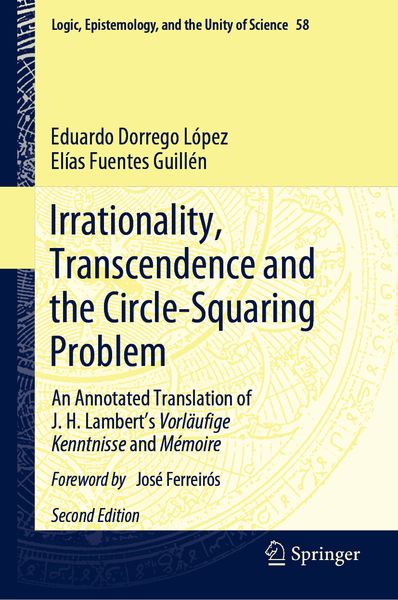
Produktbild: Irrationality, Transcendence and the Circle-Squaring Problem
Band 58 - 11%

Irrationality, Transcendence and the Circle-Squaring Problem An Annotated Translation of J. H. Lambert’s Vorläufige Kenntnisse and Mémoire

11% sparen

131,99 € UVP 149,79 €

inkl. gesetzl. MwSt., Versandkostenfrei


Beschreibung

This publication, now in its second edition, includes an unabridged and annotated translation of two works by Johann Heinrich Lambert (1728–1777) written in the 1760s:  Vorläufige Kenntnisse für die, so die Quadratur und Rectification des Circuls suchen and Mémoire sur quelques propriétés remarquables...

Beschreibung

This publication, now in its second edition, includes an unabridged and annotated translation of two works by Johann Heinrich Lambert (1728–1777) written in the 1760s: 
Vorläufige Kenntnisse für die, so die Quadratur und Rectification des Circuls suchen
and
Mémoire sur quelques propriétés remarquables des quantités transcendentes circulaires et logarithmiques
. The translations, as in the first edition, are accompanied by a contextualised study of each of these works and provide an overview of Lambert’s contributions, showing both the background and the influence of his work. In addition, by adopting a biographical approach, it allows readers to better get to know the scientist himself.

Lambert was a highly relevant scientist and polymath in his time, admired by the likes of Kant, who despite having made a wide variety of contributions to different branches of knowledge, later faded into an undeserved secondary place with respect to other scientists of the eighteenth century. In mathematics, in particular, he is famous for his research on non-Euclidean geometries, although he is likely best known for having been the first who proved the irrationality of pi. In his 
Mémoire
, he conducted one of the first studies on hyperbolic functions, offered a surprisingly rigorous proof of the irrationality of pi, established for the first time the modern distinction between algebraic and transcendental numbers, and based on such distinction, he conjectured the transcendence of pi and therefore the impossibility of squaring the circle.

Produktdetails

Einband

Gebundene Ausgabe

Erscheinungsdatum

03.05.2024

Abbildungen

XXI, 167 p. 13 illus., 7 illus. in color.

Verlag Springer

Produktdetails

Einband

Gebundene Ausgabe

Erscheinungsdatum

03.05.2024

Abbildungen

XXI, 167 p. 13 illus., 7 illus. in color.

Verlag Springer
Seitenzahl

167

Maße (L/B/H)

24,1/16/1,7 cm

Gewicht

407 g

Auflage

Second Edition 2024

Sprache

Englisch

ISBN

978-3-031-52222-2

Herstelleradresse

Springer-Verlag KG
Sachsenplatz 4-6
1201 Wien
AT

Email: ProductSafety@springernature.com

Noch keine Bewertungen vorhanden

Verfassen Sie die erste Bewertung zu diesem Artikel

Helfen Sie anderen Kundinnen und Kunden durch Ihre Meinung.

Kundinnen und Kunden meinen

Bewertungen (0)

  • Produktbild: Irrationality, Transcendence and the Circle-Squaring Problem
  • Part I: Antecedents.- Chapter 1.  From Geometry to Analysis.- Chapter 2. The situation in the first half of the 18th century. Euler and continued fractions.- Part II: Johann Heinrich Lambert (1728—1777).- Chapter 3. A biographical approach to Johann Heinrich Lambert.- Chapter 4. Outline of Lambert's Mémoire (1761/1768).- Chapter 5. An anotated translation of Lambert's Mémoire (1761/1768).- Chapter 6. Outine of Lambert's Vorläufige Kenntnisse (1766/1770).- Chapter 6. An anotated translation of Lambert's Vorläufige Kenntnisse (1766/1770).- Part III: The influence of Lambert's work and the development of irrational numbers.- Chapter 8. The state of irrationals until the turn of the century.- Chapter 9. Title to be set up.