Iterative Detection Adaptivity, Complexity Reduction, and Applications
-
- Hardcover
- Taschenbuch ausgewählt
-
Sprache:Englisch
48,99 €
inkl. gesetzl. MwSt.,
Beschreibung
Produktdetails
Einband
Taschenbuch
Erscheinungsdatum
23.10.2012
Abbildungen
XXVII, 359 p.
Verlag
Springer UsSeitenzahl
359
Maße (L/B/H)
23,5/15,5/2,2 cm
Gewicht
593 g
Auflage
Softcover reprint of the original 1st ed. 2001
Sprache
Englisch
ISBN
978-1-4613-5684-4
Iterative Detection: Adaptivity, Complexity Reduction, and
Applications
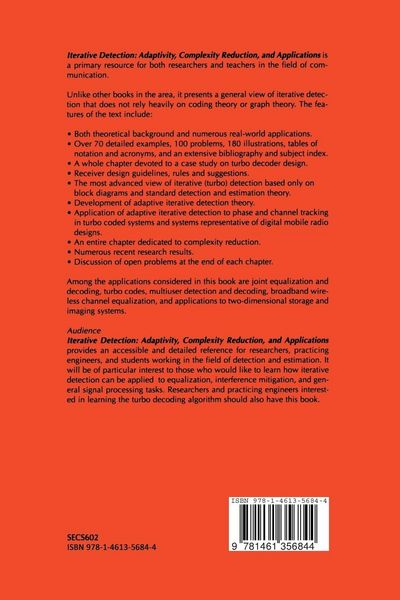
is a primary resource for both researchers and teachers in the field of communication.
Unlike other books in the area, it presents a general view of iterative detection that does not rely heavily on coding theory or graph theory. The features of the text include:
- Both theoretical background and numerous real-world applications.
- Over 70 detailed examples, 100 problems, 180 illustrations, tables of notation and acronyms, and an extensive bibliography and subject index.
- A whole chapter devoted to a case study on turbo decoder design.
- Receiver design guidelines, rules and suggestions.
- The most advanced view of iterative (turbo) detection based only on block diagrams and standard detection and estimation theory.
- Development of adaptive iterative detection theory.
- Application of adaptive iterative detection to phase and channel tracking in turbo coded systems and systems representative of digital mobile radio designs.
- An entire chapter dedicated to complexity reduction.
- Numerous recent research results.
- Discussion of open problems at the end of each chapter.
Among the applications considered in this book are joint equalization and decoding, turbo codes, multiuser detection and decoding, broadband wireless channel equalization, and applications to two-dimensional storage and imaging systems.
Audience: Iterative Detection: Adaptivity, Complexity Reduction, and
Applications
provides an accessible and detailed reference for researchers, practicing engineers, and students working in the field of detection and estimation. It will be of particular interest to those who would like to learn how iterative detection can be applied to equalization, interference mitigation, and general signal processing tasks. Researchers and practicing engineers interested in learning the turbo decoding algorithm should also have this book.
Noch keine Bewertungen vorhanden
Verfassen Sie die erste Bewertung zu diesem Artikel
Helfen Sie anderen Kundinnen und Kunden durch Ihre Meinung.
Kurze Frage zu unserer Seite
Vielen Dank für dein Feedback
Wir nutzen dein Feedback, um unsere Produktseiten zu verbessern. Bitte habe Verständnis, dass wir dir keine Rückmeldung geben können. Falls du Kontakt mit uns aufnehmen möchtest, kannst du dich aber gerne an unseren Kund*innenservice wenden.
zum Kundenservice