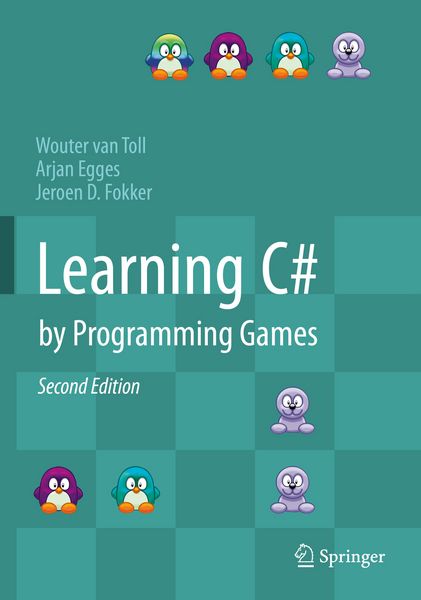
Learning C# by Programming Games
-
- Hardcover
- Taschenbuch ausgewählt
- eBook
-
Sprache:Englisch
54,99 €
inkl. gesetzl. MwSt.,
Beschreibung
Produktdetails
Einband
Taschenbuch
Erscheinungsdatum
12.12.2020
Abbildungen
XXVI, 512 p. 66 illus., 34 illus. in color.
Verlag
Springer BerlinSeitenzahl
512
Maße (L/B/H)
25,4/17,8/2,9 cm
Gewicht
1003 g
Auflage
Second Edition 2019
Sprache
Englisch
ISBN
978-3-662-59254-0
Contrary to most programming books, van Toll, Egges, and Fokker do not organize the presentation according to programming language constructs, but instead use the structure and elements of computer games as a framework. For instance, there are chapters on dealing with player input, game objects, game worlds, game states, levels, animation, physics, and intelligence. The reader will be guided through the development of four games showing the various aspects of game development. Starting with a simple shooting game, the authors move on to puzzle games consisting of multiple levels, and conclude the book by developing a full-fledged platform game with animation, game physics, and intelligent enemies. They show a number of commonly used techniques in games, such as drawing layers of sprites, rotating, scaling and animating sprites, dealing with physics, handling interaction between game objects, and creating pleasing visual effects. At the same time, they provide a thorough introduction to C# and object-oriented programming, introducing step by step important programming concepts such as loops, methods, classes, collections, and exception handling.
This second edition includes a few notable updates. First of all, the book and all example programs are now based on the library MonoGame 3.6, instead of the obsolete XNA Game Studio. Second, instead of explaining how the example programs work, the text now invites readers to write these programs themselves, with clearly marked reference points throughout the text. Third, the book now makes a clearer distinction between general (C#) programming concepts and concepts that are specific to game development. Fourth, the most important programming concepts are now summarized in convenient “Quick Reference” boxes, which replace the syntax diagrams of the first edition. Finally, the updated exercises are now grouped per chapter and can be found at the end of each chapter, allowing readers to test their knowledge more directly.
The book is also designed to be used as a basis for a game-oriented programming course. Supplementary materials for organizing such a course are available on an accompanying web site, which also includes all example programs, game sprites, sounds, and the solutions to all exercises.
Noch keine Bewertungen vorhanden
Verfassen Sie die erste Bewertung zu diesem Artikel
Helfen Sie anderen Kundinnen und Kunden durch Ihre Meinung.
Kurze Frage zu unserer Seite
Vielen Dank für dein Feedback
Wir nutzen dein Feedback, um unsere Produktseiten zu verbessern. Bitte habe Verständnis, dass wir dir keine Rückmeldung geben können. Falls du Kontakt mit uns aufnehmen möchtest, kannst du dich aber gerne an unseren Kund*innenservice wenden.
zum Kundenservice