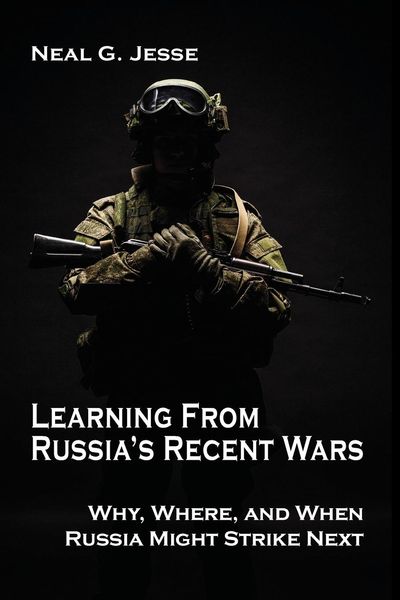
Learning From Russia's Recent Wars Why, Where, and When Russia Might Strike Next
-
- Englisch ausgewählt
46,99 €
inkl. gesetzl. MwSt.,
Beschreibung
Produktdetails
Einband
Taschenbuch
Erscheinungsdatum
25.03.2020
Verlag
Cambria PressSeitenzahl
244
Maße (L/B/H)
22,9/15,2/1,5 cm
Gewicht
402 g
Sprache
Englisch
ISBN
978-1-62196-541-1
*This book is in the Rapid Communications in Conflict and Security (RCCS) Series (General Editor: Geoffrey R.H. Burn). With the consolidation of the Russian state under the rule of Vladimir Putin, Russia has begun to assert itself on the international stage to a degree that has not been seen since the end of the Soviet Union. In particular, Russia has engaged in a number of aggressive actions against its neighbors (e.g., Georgia, Ukraine) while also re-asserting its interests in Eastern Europe, the Middle East, Central Asia, and more generally in global forums. Chief among this new assertiveness is the development of non-conventional assets of propaganda, information technology, communications, space-based assets, and cyber technology. While many have discussed the rise of asymmetrical warfare, Russian foreign policy, and Russia’s post-Soviet wars, what makes this book unique is how it puts these discussions together into a cogent analysis of contemporary Russian foreign policy alongside current international relations theories. This study examines Russia’s recent wars in the Caucasus and Eastern Europe and outlines the focus of Russian assertiveness in key regions central to their security interests. Further, it elucidates the threat that Russian conventional and unconventional warfare poses to populations in Eastern Europe, Central Asia, and elsewhere. In addition, the book highlights the propensity of Russian military thinkers to see a blurring of the line between peace and war, and how Russian capabilities are being used to take advantage of this blurred line. In the book’s conclusion, prescriptions are made as to how the Western powers, and especially the United States, can attempt to blunt Russian aggression, particularly against NATO nations. Among these prescriptions is that the West must rebut the current Russian information and propaganda campaigns in Europe and elsewhere. Further, the West must recognize the increased Russian flexibility to respond to unexpected and spontaneous events in nations around the globe with the development of its information, cyber, and propaganda assets. The conclusion asserts that defense of key Western allies such as the Baltic Republics requires not only a conventional presence (such as NATO forces) but also the development and deployment of asymmetrical assets to counter the Russian capabilities. Learning from Russia’s Recent Wars is an important book for Russian studies, international relations, and foreign policy collections.
Noch keine Bewertungen vorhanden
Verfassen Sie die erste Bewertung zu diesem Artikel
Helfen Sie anderen Kundinnen und Kunden durch Ihre Meinung.
Kurze Frage zu unserer Seite
Vielen Dank für dein Feedback
Wir nutzen dein Feedback, um unsere Produktseiten zu verbessern. Bitte habe Verständnis, dass wir dir keine Rückmeldung geben können. Falls du Kontakt mit uns aufnehmen möchtest, kannst du dich aber gerne an unseren Kund*innenservice wenden.
zum Kundenservice