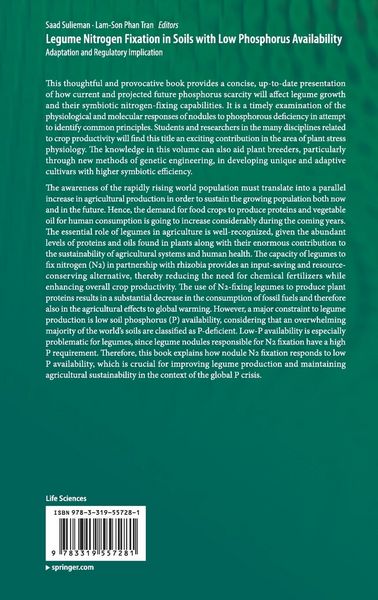
• Produktbild: Legume Nitrogen Fixation in Soils with Low Phosphorus Availability
  • Produktbild: Legume Nitrogen Fixation in Soils with Low Phosphorus Availability
- 10%

Legume Nitrogen Fixation in Soils with Low Phosphorus Availability Adaptation and Regulatory Implication

10% sparen

143,99 € UVP 160,49 €

inkl. MwSt, Versandkostenfrei

Lieferung nach Hause

Beschreibung

Details

Einband

Gebundene Ausgabe

Erscheinungsdatum

23.06.2017

Abbildungen

XIII, 41 illus., 38 illus. in color., farbige Illustrationen, schwarz-weiss Illustrationen

Herausgeber

Saad Sulieman + weitere

Verlag

Springer

Seitenzahl

287

Maße (L/B/H)

24,1/16/2,2 cm

Gewicht

5797 g

Auflage

1st ed. 2017

Sprache

Englisch

ISBN

978-3-319-55728-1

Beschreibung

Portrait

Dr. Lam-Son Phan Tran  is Head of the Signaling Pathway Research Unit at RIKEN Center for Sustainable Resource Science, Japan. He obtained his M.Sc. in Biotechnology in 1994 and Ph.D. in Biological Sciences in 1997, from Szent Istvan University, Hungary. After doing his postdoctoral research at the National Food Research Institute (1999-2000) and the Nara Institute of Science and Technology of Japan (2001), in October 2001, he joined the Japan International Research Center for Agricultural Sciences to work on the functional analyses of transcription factors and osmosensors in   Arabidopsis plants under environmental stresses. In August 2007, he moved to the University of Missouri-Columbia, USA as a Senior Research Scientist to coordinate a research team working to discover soybean genes to be used for genetic engineering of drought-tolerant soybean plants. His current research interests are elucidation of the roles of phytohormones and their interactions in abiotic stress responses, as well as translational genomics of legume crops with the aim to enhance crop productivity under adverse environmental conditions. He has published over 110 peer-reviewed papers with more than 80 research and 30 review articles, contributed 8 book chapters to various book editions published by Springer, Wiley-Blackwell, and American Society of Agronomy, Crop Science Society of America and Soil Science Society of America. He has also edited 7 book volumes for Springer, including this one.

Dr. Saad Sulieman graduated from the University of Khartoum in 1998 with distinction in Agronomy and was awarded many prizes for being the best graduate. He joined the Department of Agronomy, Faculty of Agriculture, University of Khartoum as a Teaching Assistant in 1999. Subsequently, he obtained a M.Sc. in Crop Sciences at the University of Khartoum (2002) and then a Ph.D. in Agricultural Chemistry (2009) at Georg-August University of Göttingen, Germany with a scholarship from the German Academic Exchange Service (DAAD). During his Ph.D. pursuit, he focused on investigating the physiological characterization of symbioses contrasting tolerance in nitrogen fixation to major soil limitations. After completing his Ph.D., he continued to work as a Research Assistant at the same institute for a year and a half. He also worked as a Postdoctoral Fellow at RIKEN Center for Sustainable Resource Science (CSRS), Yokohama, Japan for one year (2013) with a Postdoctoral Fellowship from the Japan Society for the Promotion of Science (JSPS). Recently, he has been awarded a Georg Forster Research Fellowship for experienced researchers from the Alexander von Humboldt (AvH) Foundation. Throughout his career, he has taught many students to the level of B.Sc. and M.Sc. Sulieman was promoted to Lecturer in 2005, Assistant Professor in 2009, and Associate Professor in 2013. Between 2014 and 2016, he held the position of Head of Department of Agronomy, University of Khartoum. Throughout the years of his research career, he has attended many domestic and international meetings, conferences, seminars and workshops. He has authored or co-authored more than 35 publications. The main focus of his research is the field of molecular plant physiology of abiotic stress.

Details

Einband

Gebundene Ausgabe

Erscheinungsdatum

23.06.2017

Abbildungen

XIII, 41 illus., 38 illus. in color., farbige Illustrationen, schwarz-weiss Illustrationen

Herausgeber

Verlag

Springer

Seitenzahl

287

Maße (L/B/H)

24,1/16/2,2 cm

Gewicht

5797 g

Auflage

1st ed. 2017

Sprache

Englisch

ISBN

978-3-319-55728-1

Herstelleradresse

Springer-Verlag GmbH
Tiergartenstr. 17
69121 Heidelberg
DE

Email: ProductSafety@springernature.com

Unsere Kundinnen und Kunden meinen

0 Bewertungen

Informationen zu Bewertungen

Zur Abgabe einer Bewertung ist eine Anmeldung im Konto notwendig. Die Authentizität der Bewertungen wird von uns nicht überprüft. Wir behalten uns vor, Bewertungstexte, die unseren Richtlinien widersprechen, entsprechend zu kürzen oder zu löschen.

Verfassen Sie die erste Bewertung zu diesem Artikel

Helfen Sie anderen Kund*innen durch Ihre Meinung

Unsere Kundinnen und Kunden meinen

0 Bewertungen filtern

  • Produktbild: Legume Nitrogen Fixation in Soils with Low Phosphorus Availability
  • Produktbild: Legume Nitrogen Fixation in Soils with Low Phosphorus Availability
  • Role of legume- Rhizobium symbiosis in sustainable agriculture.- P deficiency: A major limiting factor for rhizobial symbiosis.- The influence of phosphate deficiency on legume symbiotic N 2  fixation.- Metabolism and transport of carbon in legume nodules under P deficiency.- Oxygen and the regulation of N 2 fixation in legume nodules under P scarcity.- Transport and metabolism of nitrogen in legume nodules under phosphorus deficiency.- Examples of belowground mechanisms enabling legumes to mitigate phosphorus deficiency.- Role of plant hormones and small signaling moleculues in nodulation under P stress.- Molecular communication and nutrient transfer of the arbuscular mycorrhizal fungi, symbiotic nitrogen-fixing bacteria and host plant tripartite symbiosis.- Adaptation to phosphate stress by N 2 -fixing legumes: Lessons to learn from the model Medicago truncatula .- Physiological mechanisms and adaptation strategies in common bean ( Phaseolus vulgaris L.) under P deficiency.- Physiological and molecular mechanisms and adaptation strategies in soybean ( Glycine max ) under phosphate deficiency.- White lupin: A model system for understanding plant adaptation to low phosphorus availability.