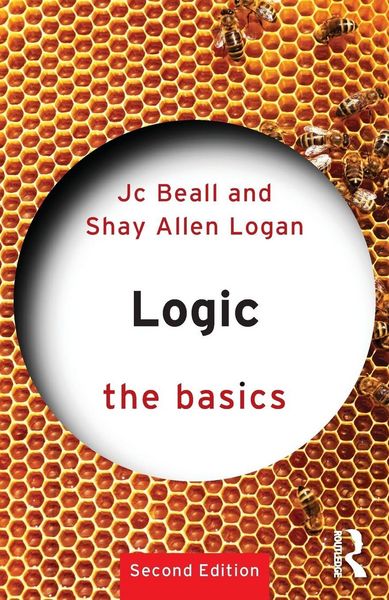
• Produktbild: Logic
  • Produktbild: Logic
- 25%

Logic The Basics

Aus der Reihe The Basics
25% sparen

29,99 € UVP 40,10 €

inkl. gesetzl. MwSt., Versandkostenfrei


Beschreibung

Produktdetails

Einband

Taschenbuch

Erscheinungsdatum

21.02.2017

Verlag

Taylor & Francis

Seitenzahl

314

Maße (L/B/H)

19,8/12,9/1,7 cm

Gewicht

336 g

Auflage

2. Auflage

Sprache

Englisch

ISBN

978-1-138-85227-3

Beschreibung

Rezension

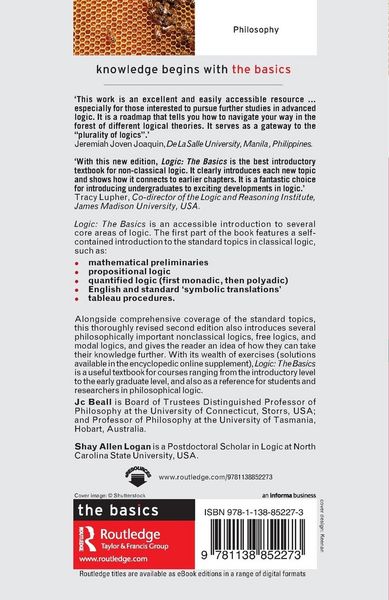
This work is an excellent and easily accessible resource material, especially for those interested to pursue further studies in advanced logic. It is a roadmap that tells you how to navigate your way in the forest of different logical theories. It serves as a gateway to the "plurality of logics". Jeremiah Joven Joaquin, De La Salle University, Manila.

With this new edition, Logic the basics is the best introductory textbook for non-classical logic. It clearly introduces each new topic and shows how it connects to earlier chapters. It is a fantastic choice for introducing undergraduates to exciting developments in logic. Tracy Lupher, Co-director of the Logic and Reasoning Institute, James Madison University, USA

Produktdetails

Einband

Taschenbuch

Erscheinungsdatum

21.02.2017

Verlag

Taylor & Francis

Seitenzahl

314

Maße (L/B/H)

19,8/12,9/1,7 cm

Gewicht

336 g

Auflage

2. Auflage

Sprache

Englisch

ISBN

978-1-138-85227-3

EU-Ansprechpartner

Taylor & Francis Verlag GmbH
Kaufingerstraße 24
80331 München
DE
GPSR@taylorandfrancis.com

Herstelleradresse

Taylor & Francis Group
5 Howick Place
SW1P 1WG London
UK
GPSR@taylorandfrancis.com

Noch keine Bewertungen vorhanden

Verfassen Sie die erste Bewertung zu diesem Artikel

Helfen Sie anderen Kundinnen und Kunden durch Ihre Meinung.

Kundinnen und Kunden meinen

Bewertungen (0)

Die Leseprobe wird geladen.
  • Produktbild: Logic
  • Produktbild: Logic
  • I BACKGROUND IDEAS

    1 Consequences

    1.1 Relations of support

    1.2 Logical consequence: the basic recipe

    1.3 Valid arguments and truth

    1.4 Summary, looking ahead, and reading

    2 Models, Modeled, and Modeling

    2.1 Models

    2.2 Models in science

    2.3 Logic as modeling

    2.4 A note on notation, metalanguages, etc.

    2.5 Summary, looking ahead, and reading

    3 Language, Form, and Logical Theories

    3.1 Language and formal languages

    3.2 Languages: syntax and semantics

    3.3 Atoms, connectives, and molecules

    3.4 Connectives and form

    3.5 Validity and form

    3.6 Logical theories: rivalry

    3.7 Summary, looking ahead, and reading

    4 Set-theoretic Tools

    4.1 Sets

    4.2 Ordered sets: pairs and n-tuples

    4.3 Relations

    4.4 Functions

    4.5 Sets as tools

    4.6 Summary and looking ahead

    II THE BASIC CLASSICAL THEORY

    5 Basic Classical Syntax and Semantics

    5.1 Cases: complete and consistent

    5.2 Classical 'truth conditions'

    5.3 Basic classical consequence

    5.4 Motivation: precision

    5.5 Formal picture

    5.6 Defined connectives

    5.7 Some notable valid forms

    5.8 Summary and looking ahead

    6 Basic Classical Tableaux

    6.1 What are tableaux?

    6.2 Tableaux for the Basic Classical Theory

    6.3 Summary and looking ahead

    7 Basic Classical Translations

    7.1 Atoms, Punctuation, and Connectives

    7.2 Syntax, altogether

    7.3 Semantics

    7.4 Consequence

    7.5 Summary and Looking Ahead

    III FIRST-ORDER CLASSICAL THEORY

    8 Atomic Innards: Unary

    8.1 Atomic innards: names and predicates

    8.2 Truth and falsity conditions for atomics

    8.3 Cases, domains, and interpretation functions

    8.4 Classicality

    8.5 A formal picture

    8.6 Summary and looking ahead

    9 Everything and Something

    9.1 Validity involving quantifiers

    9.2 Quantifiers: an informal sketch

    9.3 Truth and falsity conditions

    9.4 A formal picture

    9.5 Summary and looking ahead.

    10 First-Order Language with Any-Arity Innards

    10.1 Truth and falsity conditions for atomics

    10.2 Cases, domains, and interpretation functions

    10.3 Classicality

    10.4 A formal picture

    10.5 Summary and looking ahead

    11 Identity

    11.1 Logical expressions, forms, sentential forms

    11.2 Validity involving identity

    11.3 Identity: informal sketch

    11.4 Truth conditions: informal sketch

    11.5 Formal picture

    11.6 Summary and looking ahead

    12 Tableaux for First-Order Logic with Identity

    12.1 A Few Reminders

    12.2 Tableaux for Polyadic First-Order Logic

    12.3 Summary and looking ahead

    13 First-Order Translations

    13.1 Basic Classical Theory with Innards

    13.2 First-Order Classical Theory

    13.3 Polyadic Innards

    13.4 Examples in the polyadic language

    13.5 Adding Identity

    13.6 Summary and Looking Ahead

    IV NONCLASSICAL THEORIES

    14 Alternative Logical Theories

    14.1 Apparent unsettledness

    14.2 Apparent overdeterminacy

    14.3 Options

    14.4 Cases

    14.5 Truth and falsity conditions

    14.6 Logical Consequence

    14.7 Summary, looking ahead, and reading

    15 Nonclassical Sentential Logics

    15.1 Syntax

    15.2 Semantics, Broadly

    15.3 Defined connectives

    15.4 Some notable forms

    15.5 Summary and looking ahead

    16 Nonclassical First-order Theories

    16.1 An Informal Gloss

    16.2 A formal picture

    16.3 Summary and looking ahead

    17 Nonclassical Tableaux

    17.1 Closure Conditions

    17.2 Tableaux for Nonclassical First-Order Logics

    17.3 Summary and looking ahead

    18 Nonclassical Translations

    18.1 Syntax and Semantics

    18.2 Consequence

    18.3 Summary and looking ahead

    V FREEDOM, NECESSITY AND BEYOND

    19 Speaking Freely

    19.1 Speaking of non-existent 'things'

    19.2 Existential import

    19.3 Freeing our terms, expanding our domains

    19.4 Truth conditions: an informal sketch

    19.5 Formal picture

    19.6 Summary and looking ahead

    20 Possibilities

    20.1 Possibility and necessity

    20.2 Towards truth and falsity conditions

    20.3 Cases and consequence

    20.4 Formal picture

    20.5 Remark on going beyond possibility

    20.6 Summary and looking ahead

    21 Free and Modal Tableaux

    21.1 Free Tableaux

    21.2 Modal Tableaux

    21.3 Summary and looking ahead

    22 Glimpsing Different Logical Roads

    22.1 Other conditionals

    22.2 Other negations

    22.3 Other alethic modalities: actuality

    22.4 Same connectives, different truth conditions

    22.5 Another road to difference: consequence

    22.6 Summary and looking behind and ahead

    References