
Managing Urbanization, Climate Change and Disasters in South Asia
-
- Hardcover ausgewählt
- Taschenbuch
- eBook
-
Sprache:Englisch
103,99 €
UVP
117,69 €
inkl. gesetzl. MwSt.,
Beschreibung
Produktdetails
Einband
Gebundene Ausgabe
Erscheinungsdatum
21.07.2020
Abbildungen
XXXVII, 469 p. 135 illus., 132 illus. in color.
Verlag
Springer SingaporeSeitenzahl
469
Maße (L/B/H)
24,1/16/3,3 cm
Gewicht
922 g
Auflage
20001 Auflage 1st edition 2020
Sprache
Englisch
ISBN
978-981-15-2409-7
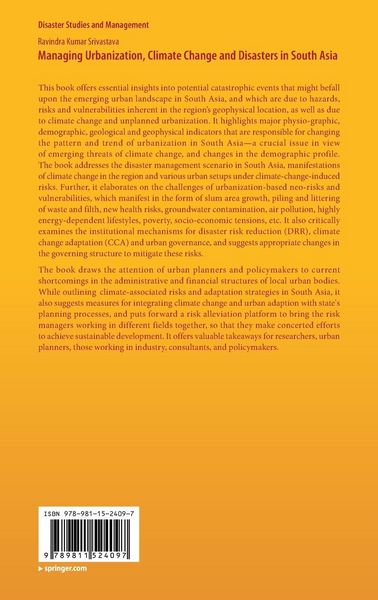
This book offers essential insights into potential catastrophic events that might befall upon the emerging urban landscape in South Asia, and which are due to hazards, risks and vulnerabilities inherent in the region’s geophysical location, as well as due to climate change and unplanned urbanization. It highlights major physio-graphic, demographic, geological and geophysical indicators that are responsible for changing the pattern and trend of urbanization in South Asia – a crucial issue in view of emerging threats of climate change, and changes in the demographic profile. The book addresses the disaster management scenario in South Asia, manifestations of climate change in the region and various urban setups under climate-change-induced risks. Further, it elaborates on the challenges of urbanization-based neo-risks and vulnerabilities, which manifest in the form of slum area growth, piling and littering of waste and filth, new health risks, groundwater contamination, air pollution,highly energy-dependent lifestyles, poverty, socio-economic tensions, etc. It also critically examines the institutional mechanisms for disaster risk reduction (DRR), climate change adaptation (CCA) and urban governance, and suggests appropriate changes in the governing structure to mitigate these risks.
The book draws the attention of urban planners and policymakers to current shortcomings in the administrative and financial structures of local urban bodies. While outliningclimate-associated risks and adaptation strategies in South Asia, it also suggests measures for integrating climate change and urban adaption with state's planning processes, and puts forward a risk alleviation platform to bring the risk managers working in different fields together, so that they make concerted efforts to achieve sustainable development. It offers valuable takeaways for researchers, urban planners, those working in industry, consultants, and policymakers.
Noch keine Bewertungen vorhanden
Verfassen Sie die erste Bewertung zu diesem Artikel
Helfen Sie anderen Kundinnen und Kunden durch Ihre Meinung.
Kurze Frage zu unserer Seite
Vielen Dank für dein Feedback
Wir nutzen dein Feedback, um unsere Produktseiten zu verbessern. Bitte habe Verständnis, dass wir dir keine Rückmeldung geben können. Falls du Kontakt mit uns aufnehmen möchtest, kannst du dich aber gerne an unseren Kund*innenservice wenden.
zum Kundenservice