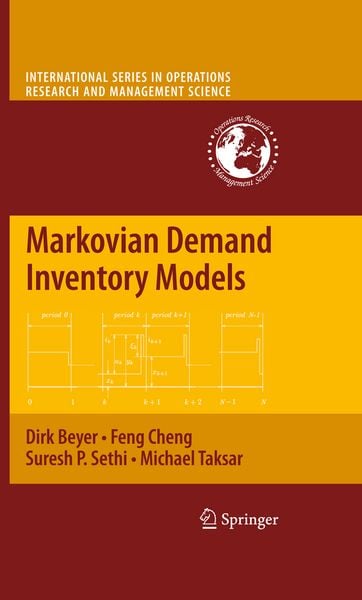

Markovian Demand Inventory Models
-
- Hardcover ausgewählt
- Taschenbuch
- eBook
-
Sprache:Englisch
111,99 €
UVP
128,39 €
inkl. gesetzl. MwSt.,
Beschreibung
Produktdetails
Einband
Gebundene Ausgabe
Erscheinungsdatum
16.10.2009
Abbildungen
XX, 255 p. 15 illus.
Verlag
Springer UsSeitenzahl
255
Maße (L/B/H)
24,3/16,4/2,8 cm
Gewicht
544 g
Auflage
2010 edition
Sprache
Englisch
ISBN
978-0-387-71603-9
Inventory management is concerned with matching supply with demand and a central problem in Operations Management. The problem is to find the amount to be produced or purchased in order to maximize the total expected profit or minimize the total expected cost. Over the past two decades, several variations of the formula appeared, mostly in trade journals written by and for inventory managers. A critical assumption in the inventory literature is that the demands in different periods are independent and identically distributed. However, in real life, demands may depend on environmental considerations or the events in the world such as the weather, the state of economy, etc. Moreover, these events are represented by stochastic processes - exogenous or controlled.
In Markovian Demand Inventory Models, the authors are concerned with inventory models where these world events are modeled by Markov processes. Their research on Markovian demand inventory models was carried out over a period of ten years beginning in the early nineties.
Noch keine Bewertungen vorhanden
Verfassen Sie die erste Bewertung zu diesem Artikel
Helfen Sie anderen Kundinnen und Kunden durch Ihre Meinung.
Kurze Frage zu unserer Seite
Vielen Dank für dein Feedback
Wir nutzen dein Feedback, um unsere Produktseiten zu verbessern. Bitte habe Verständnis, dass wir dir keine Rückmeldung geben können. Falls du Kontakt mit uns aufnehmen möchtest, kannst du dich aber gerne an unseren Kund*innenservice wenden.
zum Kundenservice