Gutscheinbedingungen

**Gültig vom 24.08.2026 bis 26.08.2026 | Gültig für nicht preisgebundene fremdsprachige Bücher | Einzelne Artikel können ausgeschlossen sein | Online auf www.bücher.de einlösbar | Click & Collect nur mit Online-Zahlung (Paypal/Kreditkarte) vorab | Nicht kombinierbar mit anderen Gutscheinen oder Preisaktionen | Nur einmal pro Einkauf einlösbar | Gutschein wird auf max. 500€ Bestellwert angerechnet | Keine Barauszahlung | Nicht gültig für Versandkosten und Services

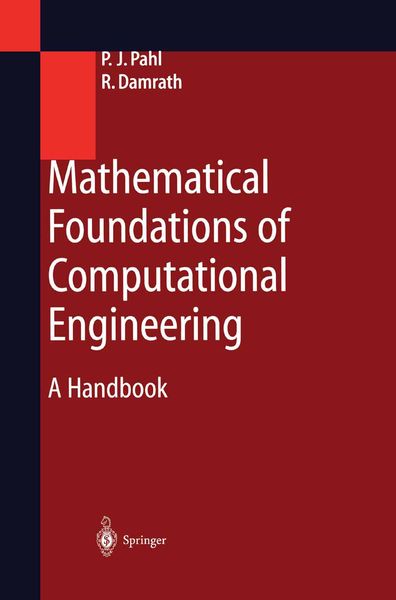
Produktbild: Mathematical Foundations of Computational Engineering
- 13%

Mathematical Foundations of Computational Engineering A Handbook

13% sparen

277,99 € UVP 320,99 €

inkl. gesetzl. MwSt., Versandkostenfrei


Beschreibung

Produktdetails

Einband

Set mit diversen Artikeln

Erscheinungsdatum

02.07.2001

Abbildungen

XXXVI, 1007 p. In 2 volumes, not available separately.

Verlag

Springer Berlin

Seitenzahl

1007

Maße (B/H)

15,5/23,5 cm

Gewicht

1521 g

Auflage

2001

Übersetzt von

F. Pahl

Sprache

Englisch

ISBN

978-3-540-67995-0

Beschreibung

Produktdetails

Einband

Set mit diversen Artikeln

Erscheinungsdatum

02.07.2001

Abbildungen

XXXVI, 1007 p. In 2 volumes, not available separately.

Verlag

Springer Berlin

Seitenzahl

1007

Maße (B/H)

15,5/23,5 cm

Gewicht

1521 g

Auflage

2001

Übersetzt von

F. Pahl

Sprache

Englisch

ISBN

978-3-540-67995-0

Herstelleradresse

Springer Nature Customer Service Center GmbH
Europaplatz 3
69115 Heidelberg
DE
ProductSafety@springernature.com

Noch keine Bewertungen vorhanden

Verfassen Sie die erste Bewertung zu diesem Artikel

Helfen Sie anderen Kundinnen und Kunden durch Ihre Meinung.

Kundinnen und Kunden meinen

Bewertungen (0)

  • Produktbild: Mathematical Foundations of Computational Engineering
  • Logic.- 1.1 Representation of Thought.- 1.2 Elementary Concepts.- 1.3 Propositional Logic.- 1.4 Predicate Logic.- 1.5 Proofs and Axioms.- Set Theory.- 2.1 Sets.- 2.2 Algebra of Sets.- 2.3 Relations.- 2.4 Types of Relations.- 2.5 Mappings.- 2.6 Types of Mappings.- 2.7 Cardinality and Countability.- 2.8 Structures.- Algebraic Structures.- 3.1 Introduction.- 3.2 Inner Operations.- 3.3 Sets with One Operation.- 3.4 Sets with Two Operations.- 3.5 Vector Spaces.- 3.6 Linear Mappings.- 3.7 Vector and Matrix Algebra.- Ordinal Structures.- 4.1 Introduction.- 4.2 Ordered Sets.- 4.3 Extreme Elements.- 4.4 Ordered Sets with Extremality Properties.- 4.5 Mappings of Ordered Sets.- 4.6 Properties of Ordered Sets.- 4.7 Ordered Cardinal Numbers.- Topological Structures.- 5.1 Introduction.- 5.2 Topological Spaces.- 5.3 Bases and Generating Sets.- 5.4 Metric Spaces.- 5.5 Point Sets in Topological Spaces.- 5.6 Topological Mappings.- 5.7 Construction of Topologies.- 5.8 Connectedness of Sets.- 5.9 Separation Properties.- 5.10 Convergence.- 5.11 Compactness.- 5.12 Continuity of Real Functions.- Number System.- 6.1 Introduction.- 6.2 Natural Numbers.- 6.3 Integers.- 6.4 Rational Numbers.- 6.5 Real Numbers.- 6.6 Complex Numbers.- 6.7 Quaternions.- Groups.- 7.1 Introduction.- 7.2 Groups and Subgroups.- 7.3 Types of Groups.- 7.4 Class Structure.- 7.5 Group Structure.- 7.6 Abelian Groups.- 7.7 Permutations.- 7.8 General Groups.- 7.9 Unique Decomposition of Abelian Groups.- Graphs.- 8.1 Introduction.- 8.2 Algebra of Relations.- 8.3 Classification of Graphs.- 8.4 Structure of Graphs.- 8.5 Paths in Networks.- 8.6 Network Flows.- Tensors.- 9.1 Introduction.- 9.2 Vector Algebra.- 9.3 Tensor Algebra.- 9.4 Tensor Analysis.- Stochastics.- 10.1 Introduction.- 10.2 Random Events.- 10.3 Random Variables.- 10.4 Random Vectors.- 10.5 Random Processes.