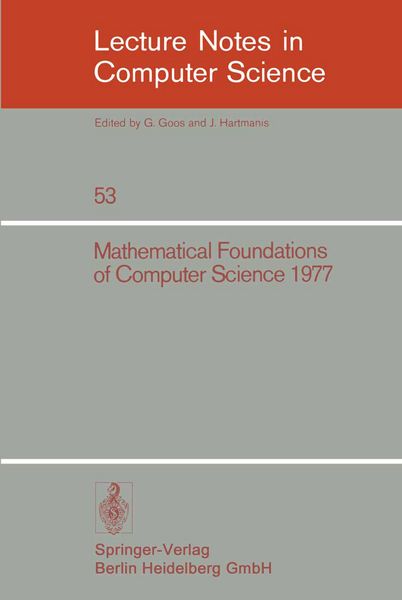
Mathematical Foundations of Computer Science 1977 6th Symposium, Tatranska Lomnica September 5-9, 1977. Proceedings
-
- Englisch ausgewählt
97,99 €
inkl. gesetzl. MwSt.,
Beschreibung
Produktdetails
Einband
Taschenbuch
Erscheinungsdatum
01.08.1977
Abbildungen
XIII, 599 p.
Herausgeber
J. GruskaVerlag
Springer BerlinSeitenzahl
599
Maße (L/B/H)
23,5/15,5/3,3 cm
Gewicht
914 g
Auflage
1977
Sprache
Englisch
ISBN
978-3-540-08353-5
On the structure and properties of NP-complete problems and their associated optimization problems.- A comparative review of some program verification methods.- Classification of the context-free languages.- Finite automaton from a flowchart scheme point of view.- A new type of models of computation.- Correctness of mixed computation in ALGOL-like programs.- Algebra and logic in theoretical computer science.- A survey of recent problems and results in analytic computational complexity.- Tree-structures for set manipulation problems.- Applied algorithmic logic.- Improved lower bounds on the number of multiplications/divisions which are necessary to evaluate polynomials.- Frequency algorithms and computations.- Graph-theoretic arguments in low-level complexity.- Properties of complexity classes a short survey.- A uniform approach to inductive posets and inductive closure.- Generalized probabilistic grammars.- Classes of structurally isomorphic np-optimization problems.- Pushdown-automata and families of languages generating cylinders.- Semantics of infinite processes using generalized trees.- Characterization of recognizable families by means of regular languages.- An algebraic approach to problem solution and problem semantics.- Complexity and minimality of context-free grammars and languages.- Comparison of the active visiting and the crossing complexities.- Arithmetical complexity of some problems in computer science.- Formal transformations and the development of programs.- Optimal rasp programs for arbitrarily complex 0-1 valued functions.- The expressive power of intensional logic in the semantics of programming languages.- On the complexity of equivalent transformations in programming languages.- Schematology in a MJ I/T I-language OPT imizer.- Decidability(undecidability) of equivalence of Minsky machines with components consisting of at most seven (eight) instructions.- A top-down no backtrack parsing of general context-free languages.- A probabilistic restriction of branching plans.- Reducing operators for normed general formal systems.- Invariant properties of informational bulks.- Two decidability results for deterministic pushdown automata.- On the logic of incomplete information.- Measures of ambiguity in the analysis of complex systems.- Two-level meta-controlled substitution grammars.- A calculus to build up correct programs.- Another approach for proving program correctness.- Cover results and normal forms.- On a deterministic subclass of context-free languages.- Exponential optimization for the LLP(k) parsing method.- The medial axis of a simple polygon.- Semantics and proof rules for coroutine hierarchies in block-structured programming languages.- Acceptors for iteration languages.- How good is the adversary lower bound ?.- Total correctness for procedures.- A model for retrieval systems and some mathematical problems behind.- Time and tape bounded auxiliary pushdown automata.- A fast non-commutative algorithm for matrix multiplication.- Fixed-points and algebras with infinitely long expressions, I.- On languages, accepted by machines in the category of sets.- Real time computations with restrictions on tape alphabet.- The bodnarchuk metric space of languages and the topology of the learning space.- Complexity hierarchies of oracles.- Determining processes by violations.- The influence of the machine model on the time complexity of context-free language recognition.- A generalized computability thesis.- Identification of formal languages.- Correctness of recursive flow diagram programs.
Noch keine Bewertungen vorhanden
Verfassen Sie die erste Bewertung zu diesem Artikel
Helfen Sie anderen Kundinnen und Kunden durch Ihre Meinung.
Kurze Frage zu unserer Seite
Vielen Dank für dein Feedback
Wir nutzen dein Feedback, um unsere Produktseiten zu verbessern. Bitte habe Verständnis, dass wir dir keine Rückmeldung geben können. Falls du Kontakt mit uns aufnehmen möchtest, kannst du dich aber gerne an unseren Kund*innenservice wenden.
zum Kundenservice