Beschreibung
Produktdetails
Einband
Taschenbuch
Erscheinungsdatum
25.03.2016
Verlag
MIT PressSeitenzahl
406
Maße (L/B/H)
22,9/15,2/2,2 cm
Gewicht
586 g
Sprache
Englisch
ISBN
978-0-262-52958-7
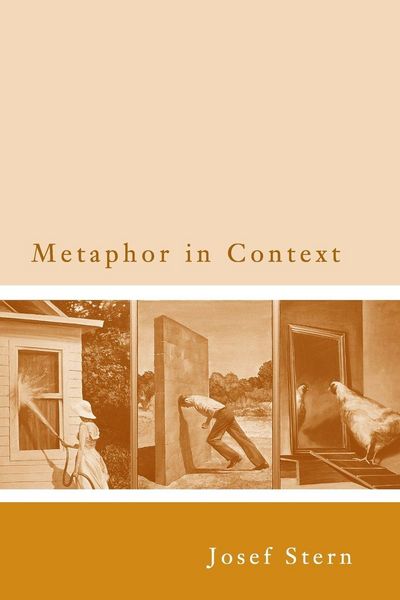
Josef Stern addresses the question: Given the received conception of the form and goals of semantic theory, does metaphorical interpretation, in whole or part, fall within its scope?
The many philosophers, linguists, and cognitive scientists writing on metaphor over the past two decades have generally taken for granted that metaphor lies outside, if not in opposition to, received conceptions of semantics and grammar. Assuming that metaphor cannot be explained by or within semantics, they claim that metaphor has little, if anything, to teach us about semantic theory. In this book Josef Stern challenges these assumptions. He is concerned primarily with the question: Given the received conception of the form and goals of semantic theory, does metaphorical interpretation, in whole or part, fall within its scope? Specifically, he asks, what (if anything) does a speaker-hearer know as part of her semantic competence when she knows the interpretation of a metaphor?
According to Stern, the answer to these questions lies in the systematic context-dependence of metaphorical interpretation. Drawing on a deep analogy between demonstratives, indexicals, and metaphors, Stern develops a formal theory of metaphorical meaning that underlies a speaker's ability to interpret a metaphor. With his semantics, he also addresses a variety of philosophical and linguistic issues raised by metaphor. These include the interpretive structure of complex extended metaphors, the cognitive significance of metaphors and their literal paraphrasability, the pictorial character of metaphors, the role of similarity and exemplification in metaphorical interpretation, metaphor-networks, dead metaphors, the relation of metaphors to other figures, and the dependence of metaphors on literal meanings. Unlike most metaphor theorists, however, who take these problems to be sui generis to metaphor, Stern subsumes them under the same rubric as other semantic facts that hold for nonmetaphorical language.
Noch keine Bewertungen vorhanden
Verfassen Sie die erste Bewertung zu diesem Artikel
Helfen Sie anderen Kundinnen und Kunden durch Ihre Meinung.
Kurze Frage zu unserer Seite
Vielen Dank für dein Feedback
Wir nutzen dein Feedback, um unsere Produktseiten zu verbessern. Bitte habe Verständnis, dass wir dir keine Rückmeldung geben können. Falls du Kontakt mit uns aufnehmen möchtest, kannst du dich aber gerne an unseren Kund*innenservice wenden.
zum Kundenservice