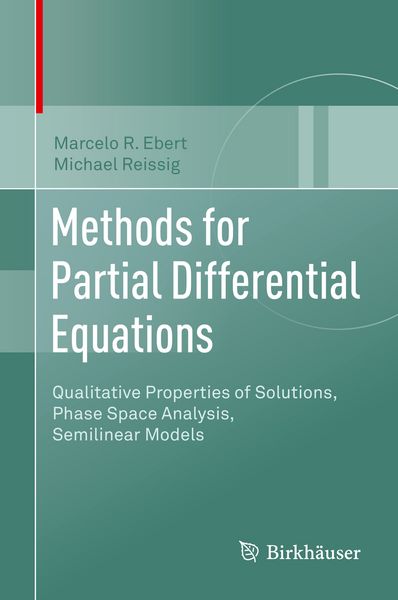
Methods for Partial Differential Equations Qualitative Properties of Solutions, Phase Space Analysis, Semilinear Models
-
- Hardcover ausgewählt
- Taschenbuch
- eBook
-
Sprache:Englisch
86,99 €
inkl. gesetzl. MwSt.,
Beschreibung
Produktdetails
Einband
Gebundene Ausgabe
Erscheinungsdatum
06.03.2018
Abbildungen
XVI, 456 p. 1 illus.
Verlag
SpringerSeitenzahl
456
Maße (L/B/H)
24,1/16/3,3 cm
Gewicht
910 g
Auflage
1st ed. 2018
Sprache
Englisch
ISBN
978-3-319-66455-2
This book provides an overview of different topics related to the theory of partial differential equations. Selected exercises are included at the end of each chapter to prepare readers for the “research project for beginners” proposed at the end of the book. It is a valuable resource for advanced graduates and undergraduate students who are interested in specializing in this area.
The book is organized in five parts:
In Part 1 the authors review the basics and the mathematical prerequisites, presenting two of the most fundamental results in the theory of partial differential equations: the Cauchy-Kovalevskaja theorem and Holmgren's uniqueness theorem in its classical and abstract form. It also introduces the method of characteristics in detail and applies this method to the study of Burger's equation.
Part 2 focuses on qualitative properties of solutions to basic partial differential equations, explaining the usual properties of solutions to elliptic, parabolic and hyperbolic equations for the archetypes Laplace equation, heat equation and wave equation as well as the different features of each theory. It also discusses the notion of energy of solutions, a highly effective tool for the treatment of non-stationary or evolution models and shows how to define energies for different models.
Part 3 demonstrates how phase space analysis and interpolation techniques are used to prove decay estimates for solutions on and away from the conjugate line. It also examines how terms of lower order (mass or dissipation) or additional regularity of the data may influence expected results.
Part 4 addresses semilinear models with power type non-linearity of source and absorbing type in order to determine critical exponents: two well-known critical exponents, the Fujita exponent and the Strauss exponent come into play. Depending on concrete models these critical exponents divide the range of admissible powers in classes which make it possible toprove quite different qualitative properties of solutions, for example, the stability of the zero solution or blow-up behavior of local (in time) solutions.
The last part features selected research projects and general background material.
Noch keine Bewertungen vorhanden
Verfassen Sie die erste Bewertung zu diesem Artikel
Helfen Sie anderen Kundinnen und Kunden durch Ihre Meinung.
Kurze Frage zu unserer Seite
Vielen Dank für dein Feedback
Wir nutzen dein Feedback, um unsere Produktseiten zu verbessern. Bitte habe Verständnis, dass wir dir keine Rückmeldung geben können. Falls du Kontakt mit uns aufnehmen möchtest, kannst du dich aber gerne an unseren Kund*innenservice wenden.
zum Kundenservice