
• Produktbild: Methods in Membrane Lipids
  • Produktbild: Methods in Membrane Lipids
Band 400 - 12%

Methods in Membrane Lipids

12% sparen

139,99 € UVP 160,49 €

inkl. gesetzl. MwSt., Versandkostenfrei


Beschreibung

Produktdetails

Einband

Gebundene Ausgabe

Erscheinungsdatum

30.08.2007

Abbildungen

XVI, 621 p.

Herausgeber

Alex Dopico

Verlag

Humana Press

Seitenzahl

621

Maße (L/B/H)

26/18,3/3,9 cm

Gewicht

1390 g

Sprache

Englisch

ISBN

978-1-58829-662-7

Beschreibung

Rezension

From the reviews:


"A compilation of protocols that addresses the … analysis of membrane lipid structure to polymorphism, lipid domains and (macro-) molecular interactions. It is a timely addition to the series on a topic that begs attention. It is a valuable reference material for researchers in lipidology and practitioners whose work involves understanding membrane structure and function. … a valuable compilation of biophysical methodologies employed in the study of membrane lipids that will no doubt be useful to anyone with an interest in membrane structure and function." (Dr Seetharaman Vaidyanathan, Molecular Biotechnology, March, 2008)


"The book deals with the membrane models and biophysical approaches used to study them. It is a compendium of various experimental and theoretical methods for investigating lipids, lipid aggregates, and, to some extent, membrane proteins. … The book is not only a collection of methods, but a textbook that can be recommended for scientists and students with a deeper interest in lipid biochemistry and biophysics. … it can be highly recommended." (Thomas Kolter, ChemBioChem, Issue 9, 2008)

Produktdetails

Einband

Gebundene Ausgabe

Erscheinungsdatum

30.08.2007

Abbildungen

XVI, 621 p.

Herausgeber

Alex Dopico

Verlag

Humana Press

Seitenzahl

621

Maße (L/B/H)

26/18,3/3,9 cm

Gewicht

1390 g

Sprache

Englisch

ISBN

978-1-58829-662-7

Herstelleradresse

Springer-Verlag GmbH
Tiergartenstr. 17
69121 Heidelberg
DE

Email: GPSR Kontakt

Noch keine Bewertungen vorhanden

Verfassen Sie die erste Bewertung zu diesem Artikel

Helfen Sie anderen Kundinnen und Kunden durch Ihre Meinung.

Kundinnen und Kunden meinen

Bewertungen (0)

  • Produktbild: Methods in Membrane Lipids
  • Produktbild: Methods in Membrane Lipids
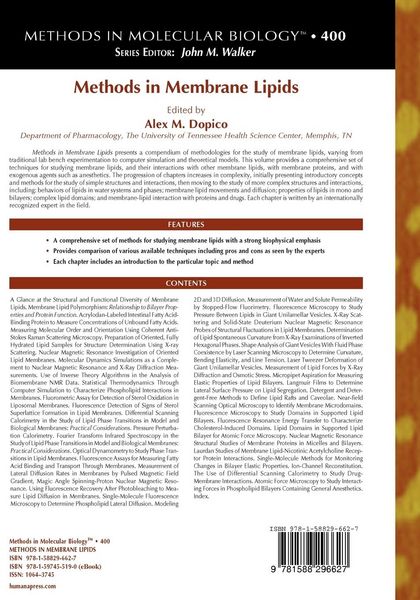
  • A Glance at the Structural and Functional Diversity of Membrane Lipids.- Membrane Lipid Polymorphism.- Acrylodan-Labeled Intestinal Fatty Acid-Binding Protein to Measure Concentrations of Unbound Fatty Acids.- Measuring Molecular Order and Orientation Using Coherent Anti-Stokes Raman Scattering Microscopy.- Preparation of Oriented, Fully Hydrated Lipid Samples for Structure Determination Using X-Ray Scattering.- Nuclear Magnetic Resonance Investigation of Oriented Lipid Membranes.- Molecular Dynamics Simulations as a Complement to Nuclear Magnetic Resonance and X-Ray Diffraction Measurements.- Use of Inverse Theory Algorithms in the Analysis of Biomembrane NMR Data.- Statistical Thermodynamics Through Computer Simulation to Characterize Phospholipid Interactions in Membranes.- Fluorometric Assay for Detection of Sterol Oxidation in Liposomal Membranes.- Fluorescence Detection of Signs of Sterol Superlattice Formation in Lipid Membranes.- Differential Scanning Calorimetry in the Study of Lipid Phase Transitions in Model and Biological Membranes.- Pressure Perturbation Calorimetry.- Fourier Transform Infrared Spectroscopy in the Study of Lipid Phase Transitions in Model and Biological Membranes.- Optical Dynamometry to Study Phase Transitions in Lipid Membranes.- Fluorescence Assays for Measuring Fatty Acid Binding and Transport Through Membranes.- Measurement of Lateral Diffusion Rates in Membranes by Pulsed Magnetic Field Gradient, Magic Angle Spinning-Proton Nuclear Magnetic Resonance.- Using Fluorescence Recovery After Photobleaching to Measure Lipid Diffusion in Membranes.- Single-Molecule Fluorescence Microscopy to Determine Phospholipid Lateral Diffusion.- Modeling 2D and 3D Diffusion.- Measurement of Water and Solute Permeability by Stopped-Flow Fluorimetry.- Fluorescence Microscopy to Study Pressure Between Lipids in Giant Unilamellar Vesicles.- X-Ray Scattering and Solid-State Deuterium Nuclear Magnetic Resonance Probes of Structural Fluctuations in Lipid Membranes.- Determination of Lipid Spontaneous Curvature From X-Ray Examinations of Inverted Hexagonal Phases.- Shape Analysis of Giant Vesicles With Fluid Phase Coexistence by Laser Scanning Microscopy to Determine Curvature, Bending Elasticity, and Line Tension.- Laser Tweezer Deformation of Giant Unilamellar Vesicles.- Measurement of Lipid Forces by X-Ray Diffraction and Osmotic Stress.- Micropipet Aspiration for Measuring Elastic Properties of Lipid Bilayers.- Langmuir Films to Determine Lateral Surface Pressure on Lipid Segregation.- Detergent and Detergent-Free Methods to Define Lipid Rafts and Caveolae.- Near-Field Scanning Optical Microscopy to Identify Membrane Microdomains.- Fluorescence Microscopy to Study Domains in Supported Lipid Bilayers.- Fluorescence Resonance Energy Transfer to Characterize Cholesterol-Induced Domains.- Lipid Domains in Supported Lipid Bilayer for Atomic Force Microscopy.- Nuclear Magnetic Resonance Structural Studies of Membrane Proteins in Micelles and Bilayers.- Laurdan Studies of Membrane Lipid-Nicotinic Acetylcholine Receptor Protein Interactions.- Single-Molecule Methods for Monitoring Changes in Bilayer Elastic Properties.- Ion-Channel Reconstitution.- The Use of Differential Scanning Calorimetry to Study Drug-Membrane Interactions.- Atomic Force Microscopy to Study Interacting Forces in Phospholipid Bilayers Containing General Anesthetics.