
Migration, Recognition and Critical Theory
-
- Hardcover ausgewählt
- Taschenbuch
- eBook
-
Sprache:Englisch
143,99 €
UVP
160,49 €
inkl. gesetzl. MwSt.,
Beschreibung
Produktdetails
Einband
Gebundene Ausgabe
Erscheinungsdatum
08.07.2021
Abbildungen
XI, 331 p. 1 illus.
Herausgeber
Gottfried SchweigerVerlag
SpringerSeitenzahl
331
Maße (L/B/H)
24,1/16/2,5 cm
Gewicht
682 g
Auflage
21001 Auflage 1st edition 2021
Sprache
Englisch
ISBN
978-3-030-72731-4
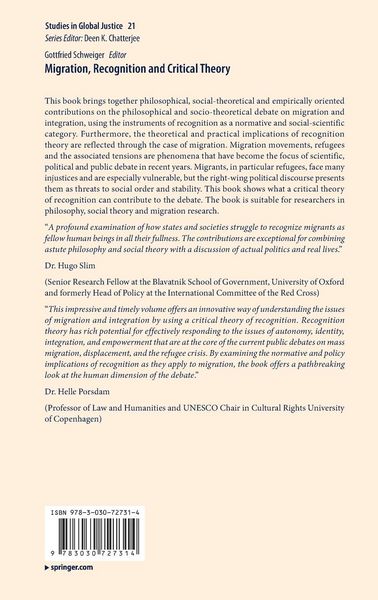
This book brings together philosophical, social-theoretical and empirically oriented contributions on the philosophical and socio-theoretical debate on migration and integration, using the instruments of recognition as a normative and social-scientific category. Furthermore, the theoretical and practical implications of recognition theory are reflected through the case of migration. Migration movements, refugees and the associated tensions are phenomena that have become the focus of scientific, political and public debate in recent years. Migrants, in particular refugees, face many injustices and are especially vulnerable, but the right-wing political discourse presents them as threats to social order and stability. This book shows what a critical theory of recognition can contribute to the debate. The book is suitable for researchers in philosophy, social theory and migration research.
"
A profound examination of how states and societies struggle to recognize migrants as fellow human beings in all their fullness. The contributions are exceptional for combining astute philosophy and social theory with a discussion of actual politics and real lives
."
Dr. Hugo Slim
(Senior Research Fellow at the Blavatnik School of Government, University of Oxford and formerly Head of Policy at the International Committee of the Red Cross)
“
This impressive and timely volume offers an innovative way of understanding the issues of migration and integration by using a critical theory of recognition. Recognition theory has rich potential for effectively responding to the issues of autonomy, identity, integration, and empowerment that are at the core of the current public debates on mass migration, displacement, and the refugee crisis. By examining the normative and policy implications of recognition as they apply to migration, the book offers a pathbreaking look at the human dimension of the debate
.”
Dr. Helle Porsdam
(Professor of Law and Humanities and UNESCO Chair in Cultural Rights University of Copenhagen)
Noch keine Bewertungen vorhanden
Verfassen Sie die erste Bewertung zu diesem Artikel
Helfen Sie anderen Kundinnen und Kunden durch Ihre Meinung.
Kurze Frage zu unserer Seite
Vielen Dank für dein Feedback
Wir nutzen dein Feedback, um unsere Produktseiten zu verbessern. Bitte habe Verständnis, dass wir dir keine Rückmeldung geben können. Falls du Kontakt mit uns aufnehmen möchtest, kannst du dich aber gerne an unseren Kund*innenservice wenden.
zum Kundenservice