
• Produktbild: Modeling and Simulation in Medicine and the Life Sciences
  • Produktbild: Modeling and Simulation in Medicine and the Life Sciences
Band 10

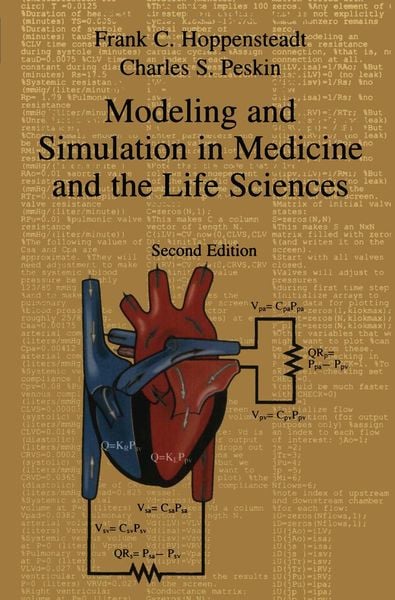
Modeling and Simulation in Medicine and the Life Sciences

62,99 €

inkl. gesetzl. MwSt., Versandkostenfrei


Beschreibung

Produktdetails

Einband

Taschenbuch

Erscheinungsdatum

01.12.2010

Abbildungen

XIV, 355 p.

Verlag

Springer Us

Seitenzahl

355

Maße (L/B/H)

23,5/15,5/2,1 cm

Gewicht

563 g

Auflage

Second Edition 2002

Sprache

Englisch

ISBN

978-1-4419-2871-9

Beschreibung

Rezension

"This is an introductory book on mathematical modeling in the bio-sciences. It is written for mathematicians as well as for life scientists. Simple models are presented, and previous knowledge of biology is not required for understanding the book. All the essential biological background is given in the text, while basic mathematical knowledge is sufficient for reading a large part of the book.


In each chapter, the material is organized in increasing order of complexity followed by exercises. Some of the exercises deal with the material of that chapter, while others are projects that extend the preceding material. Many chapters contain sections with suggestions for computing projects. Simulations are done in Matlab and computer code is included in the text...."  (Miljenko Marusic, Mathematical Reviews)


Produktdetails

Einband

Taschenbuch

Erscheinungsdatum

01.12.2010

Abbildungen

XIV, 355 p.

Verlag

Springer Us

Seitenzahl

355

Maße (L/B/H)

23,5/15,5/2,1 cm

Gewicht

563 g

Auflage

Second Edition 2002

Sprache

Englisch

ISBN

978-1-4419-2871-9

Herstelleradresse

Springer-Verlag KG
Sachsenplatz 4-6
1201 Wien
AT

Email: ProductSafety@springernature.com

Noch keine Bewertungen vorhanden

Verfassen Sie die erste Bewertung zu diesem Artikel

Helfen Sie anderen Kundinnen und Kunden durch Ihre Meinung.

Kundinnen und Kunden meinen

Bewertungen (0)

  • Produktbild: Modeling and Simulation in Medicine and the Life Sciences
  • Produktbild: Modeling and Simulation in Medicine and the Life Sciences
  • 1 The Heart and Circulation.- 1.1 Plan of the Circulation.- 1.2 Volume, Flow, and Pressure.- 1.3 Resistance and Compliance Vessels.- 1.4 The Heart as a Pair of Pumps.- 1.5 Mathematical Model of the Uncontrolled Circulation.- 1.6 Balancing the Two Sides of the Heart and the Two Circulations.- 1.7 The Need for External Circulatory Control Mechanisms.- 1.8 Neural Control: The Baroreceptor Loop.- 1.9 Autoregulation.- 2 Gas Exchange in the Lungs.- 2.1 The Ideal Gas Law and the Solubility of Gases.- 2.2 The Equations of Gas Transport in One Alveolus.- 2.3 Gas Transport in the Lung.- 2.4 Optimal Gas Transport.- 2.5 Mean Alveolar and Arterial Partial Pressures.- 2.6 Transport of O2.- 2.7 Computer Solution of the Equations for O2 Transport in the Lung.- 2.8 Computing Projects Concerning Oxygen Transport by the Lung.- 2.9 Annotated References.- Exercises.- 3 Control of Cell Volume and Electrical Properties of Cell Membranes.- 3.1 Osmotic Pressure and the Work of Concentration.- 3.2 A Simple Model of Cell Volume Control.- 3.3 The Movement of Ions Across Cell Membranes.- 3.4 The Interaction of Electrical and Osmotic Effects.- 3.5 The Hodgkin-Huxley Equations for the Nerve Action Potential.- 3.6 Computer Simulation of the Nerve Action Potential.- 3.7 Suggestions for Computing Projects Concerning the Nerve Impulse.- 3.8 Annotated References.- Exercises.- 4 The Renal Countercurrent Mechanism.- 4.1 The Nephron.- 4.2 Dynamics of Na+ and H2O: Transport along the Renal Tubules.- 4.3 The Loop of Henle.- 4.4 The Juxtaglomerular Apparatus and the Renin-Angiotensin System.- 4.5 The Distal Tubule and Collecting Duct: Concentrating and Diluting Modes.- 4.6 Remarks on the Significance of the Juxtaglomerular Apparatus.- 4.7 How Nephrons Do Better Than a Factor of e.- 4.8 Computing Project on theInteracting Nephron Population Model.- 4.9 Annotated References.- Exercises.- 5 Muscle Mechanics.- 5.1 The Force-Velocity Curve.- 5.2 Crossbridge Dynamics.- 5.3 Computer Simulation of Crossbridge Attachment and Detachment.- 5.4 Suggested Computing Projects on Crossbridge Dynamics.- 5.5 Annotated References.- Exercises.- 6 Neural Systems.- 6.1 Guttman’s Experiments on Phase Locking.- 6.2 Biological Rhythms.- 6.3 Model Neural Networks.- 6.4 Annotated References.- Exercises.- 7 Population Dynamics.- 7.1 Bacterial Cultures.- 7.2 Age Structures.- 7.3 Microbial Ecology.- 7.4 Nonlinear Reproduction Curves.- 7.5 Controlling Populations.- 7.6 Annotated References.- Exercises.- 8 Genetics.- 8.1 Population Genetics.- 8.2 Biotechnology.- 8.3 Annotated References.- Exercises.- 9 A Theory of Epidemics.- 9.1 Spread of Infection Within a Family.- 9.2 The Threshold of an Epidemic.- 9.3 Predicting the Severity of an Epidemic.- 9.4 Annotated References.- Exercises.- 10 Patterns of Population Growth and Dispersal.- 10.1 Random Walks and the Process of Diffusion.- 10.2 Bacterial Growth on a Petri Plate.- 10.3 Concluding Remarks.- 10.4 Annotated References.- Exercises.- Appendix A Getting Started with Matrices and Matlab.- Appendix B Background on Random Processes.