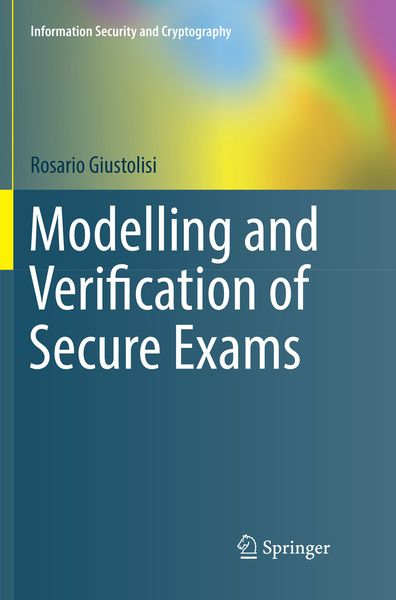
Modelling and Verification of Secure Exams
-
- Hardcover
- Taschenbuch ausgewählt
- eBook
-
Sprache:Englisch
49,99 €
inkl. gesetzl. MwSt.,
Beschreibung
Produktdetails
Einband
Taschenbuch
Erscheinungsdatum
04.01.2019
Abbildungen
X, 133 p.
Verlag
SpringerSeitenzahl
133
Maße (L/B/H)
23,5/15,5/0,9 cm
Gewicht
242 g
Auflage
1oftcover reprint of the origi
Sprache
Englisch
ISBN
978-3-030-09789-9
In this book the author introduces a novel approach to securing exam systems. He provides an in-depth understanding, useful for studying the security of exams and similar systems, such as public tenders, personnel selections, project reviews, and conference management systems.
After a short chapter that explains the context and objectives of the book, in Chap. 2 the author introduces terminology for exams and the foundations required to formulate their security requirements. He describes the tasks that occur during an exam, taking account of the levels of detail and abstraction of an exam specification and the threats that arise out of the different exam roles. He also presents a taxonomy that classifies exams by types and categories. Chapter 3 contains formal definitions of the authentication, privacy, and verifiability requirements for exams, a framework based on the applied pi-calculus for the specification of authentication and privacy, and a more abstract approach based on set-theory that enables the specification of verifiability. Chapter 4 describes the Huszti-Pethő protocol in detail and proposes a security enhancement. In Chap. 5 the author details Remark!, a protocol for Internet-based exams, discussing its cryptographic building blocks and some security considerations. Chapter 6 focuses on WATA, a family of computer-assisted exams that employ computer assistance while keeping face-to-face testing. The chapter also introduces formal definitions of accountability requirements and details the analysis of a WATA protocol against such definitions. In Chaps. 4, 5, and 6 the author uses the cryptographic protocol verifier ProVerif for the formal analyses. Finally, the author outlines future work in Chap. 7.
The book is valuable for researchers and graduate students in the areas of information security, in particular for people engaged with exams or protocols.
Noch keine Bewertungen vorhanden
Verfassen Sie die erste Bewertung zu diesem Artikel
Helfen Sie anderen Kundinnen und Kunden durch Ihre Meinung.
Kurze Frage zu unserer Seite
Vielen Dank für dein Feedback
Wir nutzen dein Feedback, um unsere Produktseiten zu verbessern. Bitte habe Verständnis, dass wir dir keine Rückmeldung geben können. Falls du Kontakt mit uns aufnehmen möchtest, kannst du dich aber gerne an unseren Kund*innenservice wenden.
zum Kundenservice