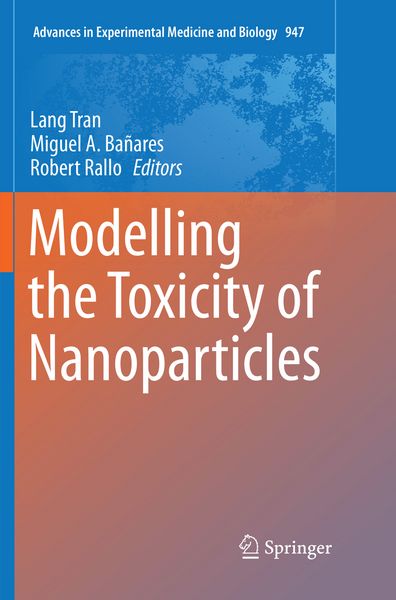
Produktbild: Modelling the Toxicity of Nanoparticles
Band 947

Modelling the Toxicity of Nanoparticles

144,99 €

inkl. gesetzl. MwSt., Versandkostenfrei


Beschreibung

Produktdetails

Einband

Taschenbuch

Erscheinungsdatum

13.07.2018

Abbildungen

XVII, 352 p. 102 illus., 83 illus. in color.

Herausgeber

Lang Tran + weitere

Verlag

Springer

Seitenzahl

352

Maße (L/B/H)

23,5/15,5/1,9 cm

Gewicht

631 g

Auflage

1oftcover reprint of the origi

Sprache

Englisch

ISBN

978-3-319-83814-4

Beschreibung

Portrait

Dr Lang Tran is the Principal Toxicologist at the Institute of Occupational Medicine. Lang has contributed considerably on the toxicology of inhaled particles and fibres. His early work was in the mathematical modelling of the retention and clearance of man-made mineral fibres and mineral dusts.  He has led the investigation and the risk assessment of inhaled poorly soluble particles which helped NIOSH in establishing the control limit for fine and ultrafine TiO2 aerosol.From his experience with particle toxicology Lang has contributed also in many European Research Projects through the Framework 6 and 7 Programmes. Most notable are the project FP7 ENPRA (Risk Assessment of Engineered Nanoparticles) and FP7 MARINA (Managing Risks of Nanoparticles). Lang is currently the chairman of the COST Action TD1204 MODENA on Modelling the toxicity of nanoparticles. Lang is an editor of the NANOTOXICOLOGY and PARTICLE and FIBRE TOXICOLOGY journals.  He also contributesin the organisation of the NANOTOXICOLOGY Symposium series. Miguel A. Bañares (PhD in Chemistry, University of Salamanca, 1992) is Full Research Professor at ICP Institute for Catalysis, CSIC (Spanish National Research Council), where he joined in 1996 and Associate Editor for Catalysis Today. Was postdoctoral fellow at Lehigh University, PA, and at the University of Notre Dame, IN. Bañares has recently been distinguished by the “Otto Mønsted" Visiting Professorship at DTU University, Denmark (2014) and the FEDER-Region Base de Normandie, “chaire d’excellence” at CNRS Caen, France, during (2013-2015).              He has been Deputy Vice-President of CSIC, Spanish National Research Council (2014-2015), chairman of the Management Committee of COST Action D36 (Molecular structure-performance relationships at the surface of functional materials), 2006-2011 and is Vice-Chairman of the Management Committee of COST Action TD1404 MODENA (Modeling Nanomaterial Toxicity), on toxicity of nanoparticles (2012-2016). He is co-founder of Advanced Dispersed Particles in 2011, a CSIC spin-off company, in 2011                         Bañares research focuses on understanding structure-property relationships at a molecular scale at the surface of functional materials for catalysis and toxicity by combining in situ and operando analyses with computational description of the structure, spectra and reactivity of functional materials. He has more than 190 publications in international journals and  an “h” factor or 37 with more than 27 plenary/keynote lectures. Bañares research stands on the use of real-time Raman spectroscopy during catalysis combining in situ spectroscopic characterization of functional materials with simultaneous performance measurement. He coined the term “operando” to identify this advanced in situ spectroscopy. 

Dr. Robert Rallo , Associate Professor of Computer Science and Artificial Intelligence in the Departament d’Enginyeria Informàtica i Matemàtiques at Universitat Rovira i Virgili, Tarragona, Catalunya. In 2007 and 2009 he was a visiting professor at the University of California Los Angeles where he is also faculty member of the Center for Environmental Implications of Nanotechnology. Since 2013 he serves as Chair for the Modeling WG in the EU NanoSafety Cluster. From 2013 to 2015 he was the EU co-chair of the US-EU Nano-Dialogue Community of Research on Predictive Modeling and Human Health. His research focuses on multi-scale modeling of complex systems of industrial or environmental relevance. Dr. Rallo serves regularly as reviewer for high-ranked scientific journals and international research organizations.

Produktdetails

Einband

Taschenbuch

Erscheinungsdatum

13.07.2018

Abbildungen

XVII, 352 p. 102 illus., 83 illus. in color.

Herausgeber

Verlag

Springer

Seitenzahl

352

Maße (L/B/H)

23,5/15,5/1,9 cm

Gewicht

631 g

Auflage

1oftcover reprint of the origi

Sprache

Englisch

ISBN

978-3-319-83814-4

Herstelleradresse

Springer-Verlag KG
Sachsenplatz 4-6
1201 Wien
AT

Email: ProductSafety@springernature.com

Noch keine Bewertungen vorhanden

Verfassen Sie die erste Bewertung zu diesem Artikel

Helfen Sie anderen Kundinnen und Kunden durch Ihre Meinung.

Kundinnen und Kunden meinen

Bewertungen (0)

  • Produktbild: Modelling the Toxicity of Nanoparticles
  • Engineered Nanoparticles – Their physico-chemical characteristics and how to measure them.- Measurement .- The Life-Cycle of Engineered Nanoparticles.- From Dose to Response – In vivo Nanoparticle Processing and Potential Toxicity.- From Dose to Response – Literature review od (Q)SAR Modelling of Nanomaterial Toxicity.- Systems biology to support nanomaterial grouping.- Multiscale modelling of bionano interface.- Biological Surface Adsorption Index of Nanomaterials - Modeling Surface Interactions of Nanomaterials with Biomolecules.- Case study I - An integrated data-driven strategy for safe-by-design nanoparticles: The FP7 MODERN Project.- Case study II  - Compilation of Data and Modeling of Nanoparticle Interactions and Toxicity and in the European NanoPUZZLES Project.- Case study III – The construction of a nanotoxicity database: the MOD-ENP-TOX experience.