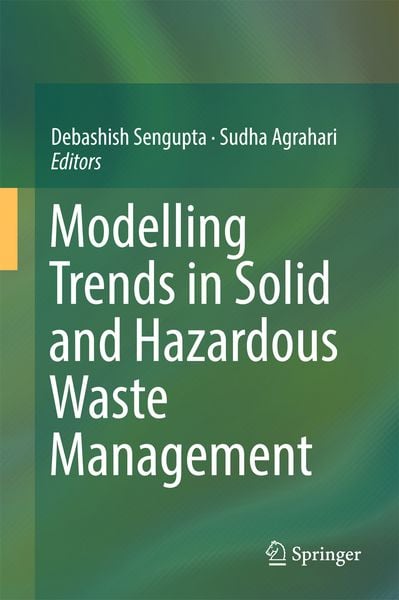
Modelling Trends in Solid and Hazardous Waste Management
-
- Hardcover ausgewählt
- Taschenbuch
- eBook
-
Sprache:Englisch
79,99 €
UVP
106,99 €
inkl. gesetzl. MwSt.,
Beschreibung
Produktdetails
Einband
Gebundene Ausgabe
Erscheinungsdatum
20.01.2017
Abbildungen
XI, 171 p. 41 illus.
Herausgeber
Debashish Sengupta + weitereVerlag
Springer SingaporeSeitenzahl
171
Maße (L/B/H)
24,1/16/1,6 cm
Gewicht
448 g
Auflage
1st ed. 2017
Sprache
Englisch
ISBN
978-981-10-2409-2
This book explores state-of-art techniques based on methodological and modeling aspects of solid and hazardous waste management, specifically focusing on the recent trends in data acquisition and robust modeling of the results obtained. In addition to an in-depth description of the recent regulatory paradigm for solid waste disposal and revealing insights into solid waste management models, the book also addresses significant case history and remediation methodologies for sustainable development in emerging economies like India, China and Brazil.
The main emphasis is on a suitable regulatory framework with site-specific baseline calibration and aimed at the robust modeling of contaminant transport and its remediation. This is based on instructive case history in various locations/regions worldwide. The focus on recent modeling and quantification methods is the backbone of the book. One of the major aspects discussed is the application of non-invasive methods for studies related to the Earth's interior, which are increasingly preferred over invasive techniques thanks to their economic utility, as well as robust techniques for the interpretation of geophysical data. The increasing demand for groundwater and energy resources, especially for rapidly emerging countries with large populations like India and China, has made it vital to derive safe utilization approaches for our resources, including suitable waste disposal and remediation methodologies that can be adopted for 'contaminated sites.'
Noch keine Bewertungen vorhanden
Verfassen Sie die erste Bewertung zu diesem Artikel
Helfen Sie anderen Kundinnen und Kunden durch Ihre Meinung.
Kurze Frage zu unserer Seite
Vielen Dank für dein Feedback
Wir nutzen dein Feedback, um unsere Produktseiten zu verbessern. Bitte habe Verständnis, dass wir dir keine Rückmeldung geben können. Falls du Kontakt mit uns aufnehmen möchtest, kannst du dich aber gerne an unseren Kund*innenservice wenden.
zum Kundenservice