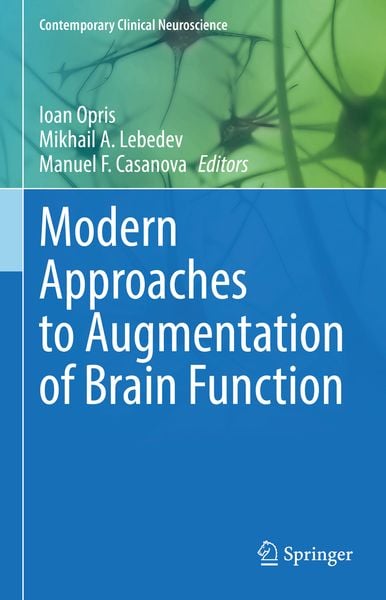
Modern Approaches to Augmentation of Brain Function
-
- Hardcover ausgewählt
- Taschenbuch
- eBook
-
Sprache:Englisch
223,99 €
inkl. gesetzl. MwSt.,
Beschreibung
Produktdetails
Einband
Gebundene Ausgabe
Erscheinungsdatum
26.08.2021
Abbildungen
XXII, 747 p. 189 illus., 153 illus. in color.
Herausgeber
Ioan Opris + weitereVerlag
SpringerSeitenzahl
747
Maße (L/B/H)
24,1/16/4,7 cm
Gewicht
1308 g
Auflage
21001 Auflage 1st edition 2021
Sprache
Englisch
ISBN
978-3-030-54563-5
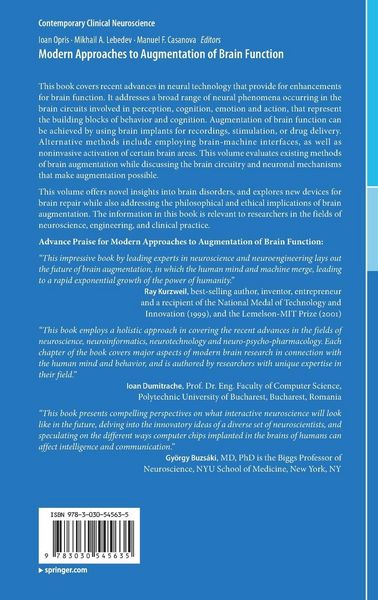
This book covers recent advances in neural technology that provide for enhancements for brain function. It addresses a broad range of neural phenomena occurring in the brain circuits involved in perception, cognition, emotion and action, that represent the building blocks of behavior and cognition. Augmentation of brain function can be achieved by using brain implants for recordings, stimulation, or drug delivery. Alternative methods include employing brain-machine interfaces, as well as noninvasive activation of certain brain areas. This volume evaluates existing methods of brain augmentation while discussing the brain circuitry and neuronal mechanisms that make augmentation possible.
This volume offers novel insights into brain disorders, and explores new devices for brain repair while also addressing the philosophical and ethical implications of brain augmentation. The information in this book is relevant to researchers in the fields of neuroscience, engineering, and clinical practice.
Advance Praise for Modern Approaches to Augmentation of Brain Function
:
“
This impressive book by leading experts in neuroscience and neuroengineering lays out the future of brain augmentation, in which the human mind and machine merge, leading to a rapid exponential growth of the power of humanity
.”
Ray Kurzweil
,
best-selling author, inventor, entrepreneur and a recipient of the National Medal of Technology and Innovation (1999), and the Lemelson-MIT Prize (2001)
"
This book employs a holistic approach in covering the recent advances in the fields of neuroscience, neuroinformatics, neurotechnology and neuro-psycho-pharmacology. Each chapter of the book covers major aspects of modern brain research in connection with the human mind and behavior, and is authored by researchers with unique expertise in their field
. "
Ioan Dumitrache
, Prof. Dr. Eng. Faculty of Computer Science, Polytechnic University of Bucharest, Bucharest, Romania
“This book presents compelling perspectives on what interactive neuroscience will look like in the future, delving into the innovatory ideas of a diverse set of neuroscientists, and speculating on the different ways computer chips implanted in the brains of humans can effect intelligence and communication
.”
György Buzsáki
, MD, PhD is the Biggs Professor of Neuroscience, NYU School of Medicine, New York, NY
Noch keine Bewertungen vorhanden
Verfassen Sie die erste Bewertung zu diesem Artikel
Helfen Sie anderen Kundinnen und Kunden durch Ihre Meinung.
Kurze Frage zu unserer Seite
Vielen Dank für dein Feedback
Wir nutzen dein Feedback, um unsere Produktseiten zu verbessern. Bitte habe Verständnis, dass wir dir keine Rückmeldung geben können. Falls du Kontakt mit uns aufnehmen möchtest, kannst du dich aber gerne an unseren Kund*innenservice wenden.
zum Kundenservice