• Produktbild: Neural Networks in Robotics
  • Produktbild: Neural Networks in Robotics
Band 202 - 12%

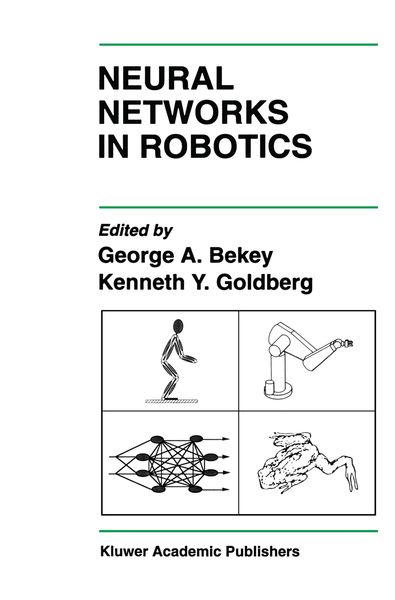
Neural Networks in Robotics

12% sparen

187,99 € UVP 213,99 €

inkl. gesetzl. MwSt., Versandkostenfrei

Lieferung nach Hause

Beschreibung

Produktdetails

Einband

Gebundene Ausgabe

Erscheinungsdatum

30.11.1992

Herausgeber

George A. Bekey + weitere

Verlag

Springer Us

Seitenzahl

563

Maße (L/B/H)

24,1/16/3,6 cm

Gewicht

1027 g

Auflage

Repr. d. Ausg. v. 1992

Sprache

Englisch

ISBN

978-0-7923-9268-2

Beschreibung

Rezension

`
Given the potential of neural networks to reduce the design complexity of control systems through learning, this book is essential for those involved in the research and development of robotic control systems.
'

University Computing, Vol.15/4, 1993

Produktdetails

Einband

Gebundene Ausgabe

Erscheinungsdatum

30.11.1992

Herausgeber

Verlag

Springer Us

Seitenzahl

563

Maße (L/B/H)

24,1/16/3,6 cm

Gewicht

1027 g

Auflage

Repr. d. Ausg. v. 1992

Sprache

Englisch

ISBN

978-0-7923-9268-2

Herstelleradresse

Springer-Verlag KG
Sachsenplatz 4-6
1201 Wien
AT

Email: ProductSafety@springernature.com

Kundinnen und Kunden meinen

0 Bewertungen

Informationen zu Bewertungen

Zur Abgabe einer Bewertung ist eine Anmeldung im Konto notwendig. Die Authentizität der Bewertungen wird von uns nicht überprüft. Wir behalten uns vor, Bewertungstexte, die unseren Richtlinien widersprechen, entsprechend zu kürzen oder zu löschen.

Die Bewertungen sind nach Format, Anzahl Sterne und Datum sortiert.

Verfassen Sie die erste Bewertung zu diesem Artikel

Helfen Sie anderen Kund*innen durch Ihre Meinung

Kundinnen und Kunden meinen

0 Bewertungen filtern

  • Produktbild: Neural Networks in Robotics
  • Produktbild: Neural Networks in Robotics
  • Section I Trajectory Generation.- 1. Learning Global Topological Properties of Robot Kinematic Mappings for Neural Network-based Configuration Control.- 2. A One-eyed Self Learning Robot Manipulator.- 3. A CMAC Neural Network for the Kinematic Control of Walking Machine.- 4. Neurocontroller Selective Learning from Man-in-the-Loop Feedback Control Actions.- 5. Application of Self-Organizing Neural Networks for Mobile Robot Environment.- 6. A Neural Network Based Inverse Kinematics Solution in Robotics.- 7. Hopefield Net Generation and Encoding of Trajectories in Contained Environment.- Section II - Recurrent Networks.- 8. Some Preliminary Comparisons Between a Neural Adaptive Controller and a Model Reference Adaptive Controller.- 9. Stable Nonlinear System Identification Using Neural Network Models.- 10. Modeling of Robot Dynamics by Neural Networks with Dynamic Neurons.- 11. Neural Networks Learning Rules for Control: Uniform Dynamic Backpropagation, and the Heavy Adaptive Learning Rule.- 12. Parameter Learning and Compliance Control Using Neural Networks.- 13. Generalisation and Extension of Motor Programs for a Sequential Recurrent Network.- 14. Temporally Continuous vs. Clocked Networks.- Section III - Hybrid Controllers.- 15. Fast Sensorimotor Skill Acquisition Based on Rule-Based Training of Neural Nets.- 16. Control of Grasping in Robot Hands by Neural Networks and Expert Systems.- 17. Robot Task Planning Using a Connectionist/Symbolic System.- Section IV - Sensing.- 18. Senses, Skills, Reactions and Reflexes Learning Automatic Behaviors in Multi-sensory Robotic Systems.- 19. A New Neural Net Approach to Robot 3D Perception and VisuoMotion Coordination.- 20. Connectivity Graphs for Space-Variant Active Vision.- 21. Competitive Learning for Color Space Division.- 22. Learning to Understand and Control in a World of Events.- 23. Self-selection of Input Stimuli for Improving Performance.- Section V - Biological Systems.- 24. A biologically-Inspired Architecture for Reactive Motor Control.- 25. Equilibria Dynamics of a Neural Network Model for Opponent Muscle Control.- 26. Developmental Robotics’- A New Approach to the Specification of Robot Programs.- 27. A Kinematics and Dynamics Robot Control System Based on Cerbro-cerebellar Interaction Modelling.- 28. What Frogs’ Brains Tell Robots’ Schemas.- 29. Modulation of Robotic Motor Synergies Using Reinforcement Learning Optimization.- 30. Using Optimal Control to Model Trajectory Formation and Perturbation Response in a Prehension Task.