
• Produktbild: Optical Properties of Metals and Intermolecular Interactions / Opticheskie Svoistva Metallov / Mezhmolekulyarnoe Vzaimodeistvie / /
  • Produktbild: Optical Properties of Metals and Intermolecular Interactions / Opticheskie Svoistva Metallov / Mezhmolekulyarnoe Vzaimodeistvie / /
Band 55

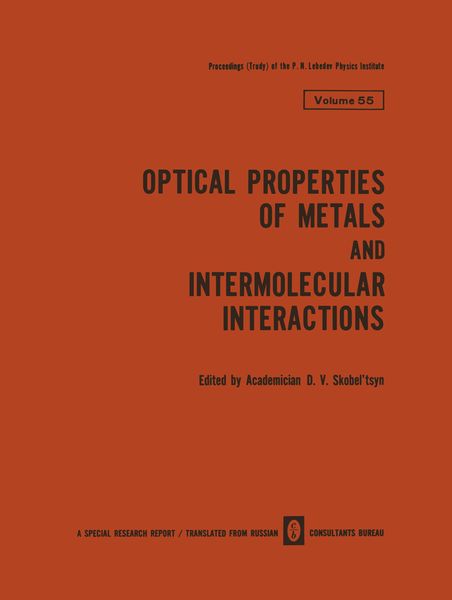
Optical Properties of Metals and Intermolecular Interactions / Opticheskie Svoistva Metallov / Mezhmolekulyarnoe Vzaimodeistvie / /

48,99 €

inkl. MwSt, Versandkostenfrei

Lieferung nach Hause

Beschreibung

Details

Einband

Taschenbuch

Erscheinungsdatum

30.04.2012

Herausgeber

D. V. Skobel tsyn

Verlag

Springer Us

Seitenzahl

227

Maße (L/B/H)

27,9/21/1,4 cm

Gewicht

596 g

Auflage

1973 edition

Sprache

Englisch

ISBN

978-1-4684-8374-1

Beschreibung

Details

Einband

Taschenbuch

Erscheinungsdatum

30.04.2012

Herausgeber

D. V. Skobel tsyn

Verlag

Springer Us

Seitenzahl

227

Maße (L/B/H)

27,9/21/1,4 cm

Gewicht

596 g

Auflage

1973 edition

Sprache

Englisch

ISBN

978-1-4684-8374-1

Herstelleradresse

Libri GmbH
Europaallee 1
36244 Bad Hersfeld
DE

Email: gpsr@libri.de

Weitere Bände von The Lebedev Physics Institute Series

Weitere Bände von The Lebedev Physics Institute Series

Unsere Kundinnen und Kunden meinen

0 Bewertungen

Informationen zu Bewertungen

Zur Abgabe einer Bewertung ist eine Anmeldung im Konto notwendig. Die Authentizität der Bewertungen wird von uns nicht überprüft. Wir behalten uns vor, Bewertungstexte, die unseren Richtlinien widersprechen, entsprechend zu kürzen oder zu löschen.

Verfassen Sie die erste Bewertung zu diesem Artikel

Helfen Sie anderen Kund*innen durch Ihre Meinung

Unsere Kundinnen und Kunden meinen

0 Bewertungen filtern

  • Produktbild: Optical Properties of Metals and Intermolecular Interactions / Opticheskie Svoistva Metallov / Mezhmolekulyarnoe Vzaimodeistvie / /
  • Produktbild: Optical Properties of Metals and Intermolecular Interactions / Opticheskie Svoistva Metallov / Mezhmolekulyarnoe Vzaimodeistvie / /
  • Optical Properties of Nontransition Metals.- I. Method of the Kinetic Equation in Metal Optics.-
    1. Kinetic equation for the infrared part of the spectrum.-
    2. Anomalous skin effect.-
    3. Normal skin effect.-
    4. Weakly anomalous skin effect.- II. Effect of the Periodic Potential of the Lattice on the Optical Properties of Metals.-
    1. Use of the pseudopotential concept.-
    2. Effect of one Bragg plane on the energy and velocity of an electron and on the shape of the Fermi surface.-
    3. Influence of the Fourier components of the pseudopotential on N, SF‹VF›, and (dY/dE)F.-
    4. Face-centered cubic lattice.-
    5. Body-centered cubic lattice.-
    6. Cubic lattice of the diamond type.-
    7. Some metals with a tetragonal lattice.-
    8. Interband transitions associated with the Bragg energy splitting, without allowing for relaxation processes.-
    9. Interband transitions associated with the Bragg energy splitting, allowing for relaxation.-
    10. Temperature dependence of the conduction-electron concentration.- III. Measuring Methods and Experimental Apparatus.-
    1. Methods of measuring the optical constants of metals.-
    2. First apparatus.-
    3. Second apparatus.-
    4. Measurements in the visible part of the spectrum.-
    5. Sequence of measurements.-
    6. Characteristics of individual parts of systems 1 and 2.-
    7. Preparation of the mirror layers to be studied.-
    8. Measurement of the static characteristics of the metal layers under examination.- IV. Experimental Results.-
    1. Indium.-
    2. Aluminum.-
    3. Lead.-
    4. Tin.-
    5. Gold.- V. Analysis of the Results of the Measurements in the Long-Wave Part of the Spectral Range Studied.-
    1. Analysis of the experimental values of n and ? in the infrared region for metals with different types of skin effect.-
    2. Application of the foregoing scheme of analyzing the experimental values of n and ? for the weakly anomalous skin effect to the optical constants of the metals studied in the present investigation.-
    3. Results of the analysis of the experimental data in the infrared region.- VI. Analysis of Experimental Results in the Short-Wave Part of the Spectral Range Studied.-
    1. Determination of the Fourier components of pseudopotential from optical measurements.-
    2. Application of the scheme for analyzing the optical constants in the short-wave region to the metals of present interest.-
    3. Indium.-
    4. Aluminum.-
    5. Lead.-
    6. Tin.- VII. Discussion of the Results Obtained.-
    1. Characteristics of the conduction electrons of metals obtained from measurements in the long-wave region.-
    2. Determination of the Fourier components of pseudopotential from optical measurements.-
    3. Shape of the bands of interband conductivity and absolute values of $${{\tilde \sigma }_g}$$.-
    4. Effective collision frequencies of the conduction electrons and electrons taking part in interband transitions.-
    5. Comparison of the values of N obtained from measurements in the long-wave region with those calculated from the Fourier components of the pseudopotential.-
    6. Temperature dependence of the concentration of conduction electrons in metals.-
    7. Area of the Fermi surface and mean velocity of the electrons on the latter.-
    8. Density of states of the electrons on the Fermi surface.-
    9. Temperature dependence of the electron—photon collision frequency.-
    10. Indirect interband transitions of electrons in lead.-
    11. Effect of the periodic lattice potential on the optical properties and Hall constant of gold.- Conclusions.- Literature Cited.- Experimental Studies of Intermolecular Forces by Spectroscopic Methods and the Development of Spectral Apparatus.- I. Study of the Hydrogen Bond by Spectroscopic Methods.-
    1. Determination of the energy of the hydrogen bond by the spectroscopic method.-
    2. Study of the effects of the steric factor.-
    3. Study of the intramolecular hydrogen bond in substances with molecules containing two hydroxyl groups.-
    4. Study of the hydrogen bond near the critical point.-
    5. Role of the hydrogen bond in the broadening of the rotational lines in gas mixtures.-
    6. Study of the true absorption of water in the drop phase (in a water cloud).-
    7. Study of the hydrogen bond in hydrogen halides.- II. Manifestation of Ordinary Intermolecular Interactions — Van der Waals Forces.-
    1. Dependence of the width of the rotational components of the P, R, and Q branches of the methane molecule on the pressure and the nature of the extraneous gas.-
    2. Dependence of the parameters of the infrared absorption bands on viscosity.-
    3. Broadening of the emission lines of thallium atoms by molecular hydrogen.- III. Development of Spectral Apparatus.-
    1. Double-beam automatic infrared spectrophotometer.-
    2. A double-beam vacuum diffraction spectrophotometer for the infrared region.-
    3. Vacuum spectrophotometer for the far infrared part of the spectrum.-
    4. Use of the echelette at large diffraction angles.-
    5. Methods of increasing the linear dispersion of prismatic spectral instruments.- Literature Cited.