
Poverty, Inequality and the Critical Theory of Recognition
-
- Hardcover ausgewählt
- Taschenbuch
- eBook
-
Sprache:Englisch
97,99 €
inkl. gesetzl. MwSt.,
Beschreibung
Produktdetails
Einband
Gebundene Ausgabe
Erscheinungsdatum
21.07.2020
Abbildungen
IX, 321 p. 1 illus.
Herausgeber
Gottfried SchweigerVerlag
SpringerSeitenzahl
321
Maße (L/B/H)
24,1/16/2,4 cm
Gewicht
664 g
Auflage
20001 Auflage 1st edition 2020
Sprache
Englisch
ISBN
978-3-030-45794-5
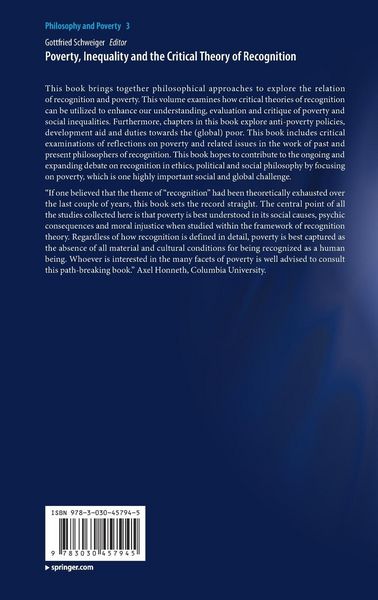
This book brings together philosophical approaches to explore the relation of recognition and poverty. This volume examines how critical theories of recognition can be utilized to enhance our understanding, evaluation and critique of poverty and social inequalities. Furthermore, chapters in this book explore anti-poverty policies, development aid and duties towards the (global) poor. This book includes critical examinations of reflections on poverty and related issues in the work of past and present philosophers of recognition. This book hopes to contribute to the ongoing and expanding debate on recognition in ethics, political and social philosophy by focusing on poverty, which is one highly important social and global challenge.
“If one believed that the theme of “recognition” had been theoretically exhausted over the last couple of years, this book sets the record straight. The central point of all the studies collected here is that poverty is best understood in its socialcauses, psychic consequences and moral injustice when studied within the framework of recognition theory. Regardless of how recognition is defined in detail, poverty is best captured as the absence of all material and cultural conditions for being recognized as a human being. Whoever is interested in the many facets of poverty is well advised to consult this path-breaking book.” Axel Honneth, Columbia University.
Noch keine Bewertungen vorhanden
Verfassen Sie die erste Bewertung zu diesem Artikel
Helfen Sie anderen Kundinnen und Kunden durch Ihre Meinung.
Kurze Frage zu unserer Seite
Vielen Dank für dein Feedback
Wir nutzen dein Feedback, um unsere Produktseiten zu verbessern. Bitte habe Verständnis, dass wir dir keine Rückmeldung geben können. Falls du Kontakt mit uns aufnehmen möchtest, kannst du dich aber gerne an unseren Kund*innenservice wenden.
zum Kundenservice