• Produktbild: Practical UML Statecharts in C/C++
  • Produktbild: Practical UML Statecharts in C/C++

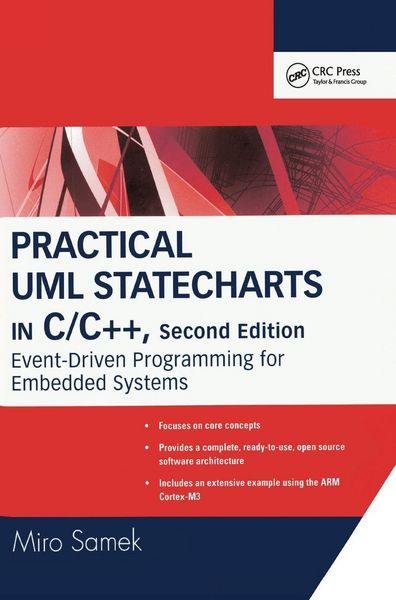
Practical UML Statecharts in C/C++ Event-Driven Programming for Embedded Systems

281,99 €

inkl. gesetzl. MwSt., Versandkostenfrei

Lieferung nach Hause

Beschreibung

Produktdetails

Einband

Gebundene Ausgabe

Erscheinungsdatum

04.04.2018

Verlag

Taylor and Francis

Seitenzahl

744

Maße (L/B/H)

25/17,5/4,4 cm

Gewicht

1496 g

Auflage

2. Auflage

Sprache

Englisch

ISBN

978-1-138-43638-1

Beschreibung

Produktdetails

Einband

Gebundene Ausgabe

Erscheinungsdatum

04.04.2018

Verlag

Taylor and Francis

Seitenzahl

744

Maße (L/B/H)

25/17,5/4,4 cm

Gewicht

1496 g

Auflage

2. Auflage

Sprache

Englisch

ISBN

978-1-138-43638-1

Herstelleradresse

Libri GmbH
Europaallee 1
36244 Bad Hersfeld
DE

Email: gpsr@libri.de

Kundinnen und Kunden meinen

0 Bewertungen

Informationen zu Bewertungen

Zur Abgabe einer Bewertung ist eine Anmeldung im Konto notwendig. Die Authentizität der Bewertungen wird von uns nicht überprüft. Wir behalten uns vor, Bewertungstexte, die unseren Richtlinien widersprechen, entsprechend zu kürzen oder zu löschen.

Die Bewertungen sind nach Format, Anzahl Sterne und Datum sortiert.

Verfassen Sie die erste Bewertung zu diesem Artikel

Helfen Sie anderen Kund*innen durch Ihre Meinung

Kundinnen und Kunden meinen

0 Bewertungen filtern

Die Leseprobe wird geladen.
  • Produktbild: Practical UML Statecharts in C/C++
  • Produktbild: Practical UML Statecharts in C/C++
  • Preface PART I STATECHARTS Chapter 1 Whirlwind Tour of Programming with Statecharts1.1 Why Bother?1.2 The Traditional Event-Action Paradigm1.3 State Machines ? A Better Way of Programming1.3.1 The Time Bomb Example1.3.2 The Calculator Example1.5 Object-Oriented Analogy1.6 The Event-driven Framework1.6 SummaryChapter 2 A Crash Course in Statecharts 2.1 The Essence of Finite State Machines2.2 The Essence of UML Statecharts2.3 Examples of State Models2.4 SummaryChapter 3 Standard State Machine Implementations3.1 State Machine Interface3.2 Nested switch Statement3.3 State Table3.4 State Design Pattern3.5 Optimal FSM Implementation3.6 State Machines and C++ Exception Handling 3.7 Role of Pointer-to-Member Functions3.8 Implementing Guards, Junctions, and Choice Points3.9 Implementing Entry and Exit Actions3.10 Dealing with State Hierarchy3.11 SummaryChapter 4 QEP: A Minimal Hierarchical Event Processor4.1 General Structure of the QEP Event Processor4.2 An Annotated Example (QHsm)4.3 QEP Structure4.3.1 QEP Source Code Structure4.3.2 Internal Representation of a State Machine4.3.3 Initialization of a State Machine4.3.4 Dispatching Events to a FSM4.3.5 Executing a Transition in a FSM4.3.6 Dispatching Events to a HSM4.3.7 Executing a Transition in a HSM4.3.8 Static Transition Optimization in a HSM4.4 Porting and Configuring QEP4.5 Caveats4.6 Su