• Produktbild: Probabilistic Cellular Automata
  • Produktbild: Probabilistic Cellular Automata
Band 27

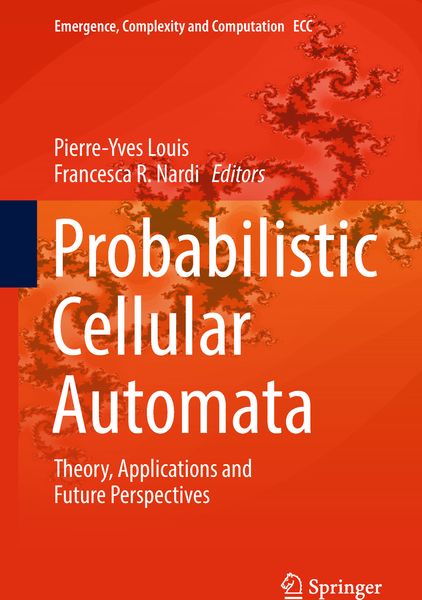
Probabilistic Cellular Automata Theory, Applications and Future Perspectives

145,99 €

inkl. gesetzl. MwSt., Versandkostenfrei


Beschreibung

Produktdetails

Einband

Gebundene Ausgabe

Erscheinungsdatum

01.03.2018

Abbildungen

XVIII, 344 p. 89 illus., 67 illus. in color.

Herausgeber

Pierre-Yves Louis + weitere

Verlag

Springer

Seitenzahl

344

Maße (L/B/H)

24,1/16/2,6 cm

Gewicht

711 g

Auflage

1st ed. 2018

Sprache

Englisch

ISBN

978-3-319-65556-7

Beschreibung

Portrait

Pierre-Yves Louis is an associate professor at the 'Laboratoire de Mathématiques et Applications' (University of Poitiers and CNRS, UMR 7348, France), where he teaches applied probability, statistics and stochastic modeling. His research interests include interacting systems of stochastic processes and algorithms, and stochastic models from mathematical, statistical, computational and applied perspectives (in particular in biology and medicine). He holds a PhD in mathematics from Université Lille 1 (France) and Politecnico di Milano (Italy), and his dissertation focused on a study of probabilistic cellular automata from a stochastic processes and statistical mechanics viewpoint. He previously served as an assistant at the University of Potsdam and post-doc fellow at the TU Berlin (Germany). He was trained both in pure mathematics and physics at the University Lille 1. While he was visiting scholar at Eurandom (TU Eindhoven and CNRS-UMI 3022), he was main organizer of a workshop dedicated to PCA. P.-Y. Louis is a regularly invited researcher in the Netherlands, Germany and Italy, where he maintains several ongoing research collaborations. He supervises master students and PhD candidates.

Francesca R. Nardi is an associate professor at the University of Florence’s Department of Mathematics and Computer Science since 2016. Previously, she had a tenure track position (2006-2016) in the Stochastics Section of the Department of Mathematics and Computer Science at Eindhoven University of Technology (the Netherlands). She received her MSc degree (1995) and PhD degree (2001) in mathematics from the University of Rome "Tor Vergata", Italy, and subsequently held post-doc and teaching positions at Eurandom (Eindhoven University of Technology, 2000–2003), the University of Rome "La Sapienza" (2003–2005), and the University of Rome "Roma tre" (2005–2006). Her main research interests are in probability theory, statistical mechanics, and mathematical physics. Applicationsthat motivate her research are statistical physics of equilibrium: phase diagrams and phase transitions; the statistical physics of non-equilibrium: meta-stability; the spread of epidemics over networks for moving populations; random walks in random environments; cut-off phenomena and random graphs. Francesca was the recipient (as PI) of a STAR grant (2011) and an Aspasia grant (2011) from the Netherlands Organization for Scientific Research (NWO). Francesca is regularly visiting The Netherlands where she has several ongoing projects and research collaboration.  Francesca has more than 15 years experience teaching courses in basic probability, stochastic processes, large deviations , metastability and random graphs. She supervised and coached master students, PhD students and post docs.

Produktdetails

Einband

Gebundene Ausgabe

Erscheinungsdatum

01.03.2018

Abbildungen

XVIII, 344 p. 89 illus., 67 illus. in color.

Herausgeber

Verlag

Springer

Seitenzahl

344

Maße (L/B/H)

24,1/16/2,6 cm

Gewicht

711 g

Auflage

1st ed. 2018

Sprache

Englisch

ISBN

978-3-319-65556-7

Herstelleradresse

Springer-Verlag KG
Sachsenplatz 4-6
1201 Wien
AT

Email: ProductSafety@springernature.com

Noch keine Bewertungen vorhanden

Verfassen Sie die erste Bewertung zu diesem Artikel

Helfen Sie anderen Kundinnen und Kunden durch Ihre Meinung.

Kundinnen und Kunden meinen

Bewertungen (0)

  • Produktbild: Probabilistic Cellular Automata
  • Produktbild: Probabilistic Cellular Automata
  • Preface.- Acknowledgements.- 1 Overview: PCA models and issues.- 2 Probabilistic Cellular Automata in Art.- Part I Probability and statistical mechanics.- 3 Basic ideas to approach metastability in Probabilistic Cellular Automata.- 4 Strategic Interaction in Interacting Particle Systems.- 5 Scaling and inverse scaling in anisotropic bootstrap percolation.- 6 The sandpile cellular automaton.- 7 Ising Model on the Torus and PCA Dynamics: reversibility, irreversibility, and fast tunneling.- 8 Synchronization in Interacting Reinforced Stochastic Processes.- 9 Nonequilibrium physics aspects of Probabilistic Cellular Automata.- Part II Computer science and discrete dynamical systems.- 10 An example of computation of the density of ones in Probabilistic Cellular Automata by direct recursion.- 11 Statistical equilibrium in deterministic Cellular Automata.- 12 Epidemic automaton and the Eden model: various aspects of robustness.- 13 Convergence time of Probabilistic Cellular Automata on the torus.- 14 Percolation operators and related models.- 15 Phase transitions of Cellular Automata.-  Part III Applications to natural sciences and computational (cell) biology.- 16 A trade-off between simplicity and robustness? Illustration on a lattice-gas model of swarming.- 17 PCA modelling of multi-species cell clusters: ganglion development in the gastrointestinal nervous system.- 18 Cellular Potts model: applications to vasculogenesis and angiogenesis.- 19 Cellular Potts Models for interacting cell populations: mathematical foundation, challenges and future prospects.- 20 Cellular Automata for clouds and convection.- Participants of the 2013 Eindhoven meeting.