
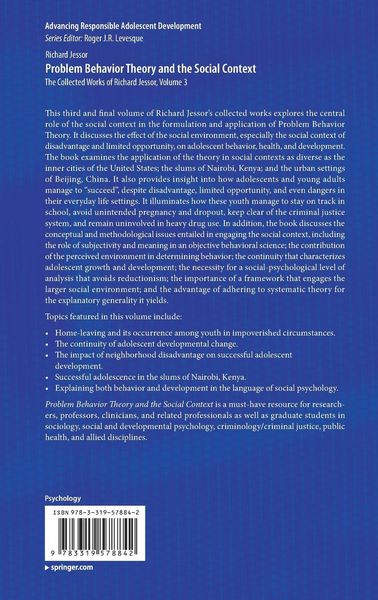
Problem Behavior Theory and the Social Context The Collected Works of Richard Jessor, Volume 3
-
- Hardcover ausgewählt
- Taschenbuch
- eBook
-
Sprache:Englisch
49,99 €
inkl. gesetzl. MwSt.,
Beschreibung
Produktdetails
Einband
Gebundene Ausgabe
Erscheinungsdatum
03.07.2017
Abbildungen
XI, 286 p. 32 illus.
Verlag
SpringerSeitenzahl
286
Maße (L/B/H)
24,1/16/2,2 cm
Gewicht
617 g
Auflage
1st ed. 2017
Sprache
Englisch
ISBN
978-3-319-57884-2
Topics featured in this volume include:
- Home-leaving and its occurrence among youth in impoverished circumstances.
- The continuity of adolescent developmental change.
- The impact of neighborhood disadvantage on successful adolescent development.
- Successful adolescence in the slums of Nairobi, Kenya.
- Explaining both behavior and development in the language of social psychology.
Problem Behavior Theory and the Social Context is a must-have resource for researchers, professors, clinicians, and related professionals as well as graduate students in sociology, social and developmental psychology, criminology/criminal justice, public health, and allied disciplines.
Noch keine Bewertungen vorhanden
Verfassen Sie die erste Bewertung zu diesem Artikel
Helfen Sie anderen Kundinnen und Kunden durch Ihre Meinung.
Kurze Frage zu unserer Seite
Vielen Dank für dein Feedback
Wir nutzen dein Feedback, um unsere Produktseiten zu verbessern. Bitte habe Verständnis, dass wir dir keine Rückmeldung geben können. Falls du Kontakt mit uns aufnehmen möchtest, kannst du dich aber gerne an unseren Kund*innenservice wenden.
zum Kundenservice