Gutscheinbedingungen

**Gültig vom 15.06.2026 bis 17.06.2026 | Gültig für nicht preisgebundene fremdsprachige Bücher | Einzelne Artikel können ausgeschlossen sein | Maximaler rabattfähiger Warenkorbwert 500 € | Nicht kombinierbar mit weiteren Aktionen | Nur einmal pro Person einlösbar | Nur solange der Vorrat reicht

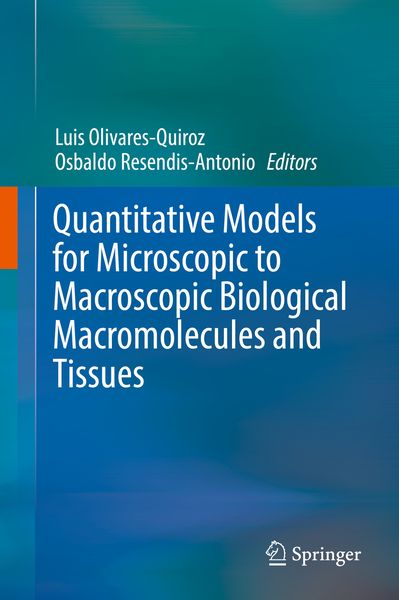
  • Produktbild: Quantitative Models for Microscopic to Macroscopic Biological Macromolecules and Tissues
  • Produktbild: Quantitative Models for Microscopic to Macroscopic Biological Macromolecules and Tissues

Quantitative Models for Microscopic to Macroscopic Biological Macromolecules and Tissues

97,99 €

inkl. gesetzl. MwSt., Versandkostenfrei

Lieferung nach Hause

Beschreibung

Produktdetails

Einband

Gebundene Ausgabe

Erscheinungsdatum

07.03.2018

Herausgeber

Luis Olivares-Quiroz + weitere

Verlag

Springer

Seitenzahl

226

Maße (L/B/H)

24,1/16/1,9 cm

Gewicht

518 g

Auflage

1st ed. 2018

Sprache

Englisch

ISBN

978-3-319-73974-8

Beschreibung

Portrait

Luis Olivares-Quiroz is currently full-time physics professor, researcher, and lecturer at Universidad Autonoma de la Ciudad de Mexico (UACM). He obtained his PhD in 2007 with a thesis on the statistical mechanics of protein folding and its connection to the glass transition. After receiving his PhD, he has been involved actively in research at the interface of physics and molecular biology, particularly on the application of statistical physics, stochastic process, complex networks, and genetic algorithms (GAs) to the analysis of protein folding and unfolding, peptide and protein translocation across membranes, identification of active sites in biological macromolecules as well as computer simulations of interacting potentials for protein folding using GAs. He has been invited to different research institutions both in Mexico and abroad: Department of Biochemistry, University of Arizona, Tucson (USA); Forschungszentrum (Germany); Faculté des Sciences, University of Nantes (France); Department of Physics, Georgia Tech at Atlanta (USA); and the Biophysical Sciences Institute at Durham University (UK). In Mexico, he has been an active and intense promoter of research in biological physics. In 2009 he was granted the National Prize for Science Dissemination for the publishing of a book on the quantum physics of ultracold liquids and gases. He has been also editor-in-chief of Physical Biology of Proteins and Peptides: Theory, Experiment, and Simulation published by Springer in 2015.


Osbaldo Resendis-Antonio is professor of systems biology at the National Institute of Genome Medicine (INMEGEN) and the Research Support Network (RAIUNAM) at the National Institute of Medical Sciences and Nutrition Salvador Zubirán, both in México City. After receiving a Ph.D. in physics in 2003, he switched the emphasis of his research to systems biology, first as a postdoctoral fellow in the Institute Henry Poincare (France), the Center for Nitrogen Fixation-UNAM (México); and the Department of Systems Biology at the University of California San Diego (USA); and then as a principal researcher at the Center for Genomic Sciences-UNAM, México, in 2008. He has been visiting professor in the Systems Biology Department at Harvard Medical School (USA), the group of Bioinformatics and Systems Biology at the University of Rostock (Germany), and the Institute for Systems Biology at Seattle, Washington (USA). His research interest is focused to survey the metabolic pathway alterations associated with multifactorial diseases, such as cancer, through the integrative description among genome-scale metabolic reconstructions, high-throughput data, and the development of constraint based modeling.


Produktdetails

Einband

Gebundene Ausgabe

Erscheinungsdatum

07.03.2018

Herausgeber

Verlag

Springer

Seitenzahl

226

Maße (L/B/H)

24,1/16/1,9 cm

Gewicht

518 g

Auflage

1st ed. 2018

Sprache

Englisch

ISBN

978-3-319-73974-8

Herstelleradresse

Springer-Verlag GmbH
Tiergartenstr. 17
69121 Heidelberg
DE

Email: ProductSafety@springernature.com

Kundinnen und Kunden meinen

0 Bewertungen

Informationen zu Bewertungen

Zur Abgabe einer Bewertung ist eine Anmeldung im Konto notwendig. Die Authentizität der Bewertungen wird von uns nicht überprüft. Wir behalten uns vor, Bewertungstexte, die unseren Richtlinien widersprechen, entsprechend zu kürzen oder zu löschen.

Die Bewertungen sind nach Format, Anzahl Sterne und Datum sortiert.

Verfassen Sie die erste Bewertung zu diesem Artikel

Helfen Sie anderen Kund*innen durch Ihre Meinung

Kundinnen und Kunden meinen

0 Bewertungen filtern

  • Produktbild: Quantitative Models for Microscopic to Macroscopic Biological Macromolecules and Tissues
  • Produktbild: Quantitative Models for Microscopic to Macroscopic Biological Macromolecules and Tissues
  • Diverse protein-folding pathways and functions of beta-hairpins and beta-sheets.- MicroRNAs, gene's regulator in prostate cáncer.- Subdiffusive Transport in Heterogeneous Patchy Environments.- Molecular assembling of the bacterial injectisome: a nanomachine used to inject effector proteins.- Pressure-driven DNA denaturation: state of the art and perspectives.- In silico identification and gene expression analysis of CDF-like genes from Trichomonas vaginalis in response to Zinc.- Dynamical features of a biochemical interaction in a plant root hair cell; a long story short.- Homeostasis from a time-series perspective: An intuitive interpretation of the variability of physiological variables.- Looking for biomarkers in physiological time series.- Systems Biology, Metabolomics and Breast Cancer: Where we are and which is the possible destination in the clinic.- Local effective temperatures for the patterns of motion of active particles.