KI-Beratung Beta

  • Produktbild: Random Signals Estimation and Identification
  • Produktbild: Random Signals Estimation and Identification

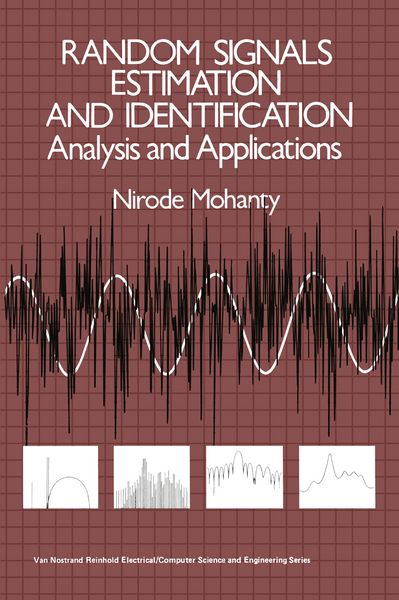
Random Signals Estimation and Identification Analysis and Applications

48,99 €

inkl. gesetzl. MwSt., Versandkostenfrei


Beschreibung

Produktdetails

Einband

Taschenbuch

Erscheinungsdatum

14.03.2012

Abbildungen

XII, 626 p.

Verlag

Springer Netherland

Seitenzahl

626

Maße (L/B/H)

22,9/15,2/3,5 cm

Gewicht

912 g

Auflage

Softcover reprint of the original 1st ed. 1986

Sprache

Englisch

ISBN

978-94-011-7043-7

Beschreibung

Produktdetails

Einband

Taschenbuch

Erscheinungsdatum

14.03.2012

Abbildungen

XII, 626 p.

Verlag

Springer Netherland

Seitenzahl

626

Maße (L/B/H)

22,9/15,2/3,5 cm

Gewicht

912 g

Auflage

Softcover reprint of the original 1st ed. 1986

Sprache

Englisch

ISBN

978-94-011-7043-7

Herstelleradresse

Springer-Verlag KG
Sachsenplatz 4-6
1201 Wien
AT

Email: ProductSafety@springernature.com

Noch keine Bewertungen vorhanden

Verfassen Sie die erste Bewertung zu diesem Artikel

Helfen Sie anderen Kundinnen und Kunden durch Ihre Meinung.

Kundinnen und Kunden meinen

Bewertungen (0)

  • Produktbild: Random Signals Estimation and Identification
  • Produktbild: Random Signals Estimation and Identification
  • 1 Random Signals.- 1.0 Introduction.- 1.1 Characterization and Classification.- 1.2 Correlation and Covariance Functions.- 1.3 Gaussian Processes and Wiener Processes.- 1.4 Poisson Process.- 1.5 Mean Square Calculus.- 1.6 Markov Process.- 1.7 Renewal Process.- 1.8 Bibliographical Notes.- Exercises.- 2 Stationary Random Signals.- 2.1 Introduction.- 2.2 Linear Systems with Random Signal Input.- 2.3 Cross Covariance and Coherence.- 2.4 Narrowband Noise Process.- 2.5 Orthogonal Expansion and Sampling.- 2.6 Ergodicity and Entropy.- 2.7 Zero Crossing Detectors.- 2.8 Nonlinear Systems.- 2.9 Bibliographical Notes.- Exercises.- 3 Estimation, Optimization, and Detection.- 3.0 Introduction.- 3.1 Sampling Distribution.- 3.2 Estimation of Parameter: Point Estimation.- 3.3 Estimation Criteria.- 3.4 Maximum Likelihood Estimation.- 3.5 Linear Mean Square Estimation.- 3.6 Method of Least Squares: Regression Models.- 3.7 Interval Estimation: Confidence Interval.- 3.8 Cramer-Rao Inequality.- 3.9 Estimation in Colored Noise.- 3.10 Optimum Linear Filters.- 3.11 Signal Detection.- 3.12 Bibliographical Notes.- Exercises.- 4 Spectral Analysis.- 4.0 Introduction.- 4.1 The Periodogram Approach.- 4.2 Spectral Windows.- 4.3 Autoregressive Method.- 4.4 The Maximum Entropy Method.- 4.5 Maximum Likelihood Estimator.- 4.6 Pisarenko and Prony Methods.- 4.7 Adaptive Lattices Method.- 4.8 Cross Spectral Estimation.- 4.9 Bibliographical Notes.- Exercises.- 5 Prediction, Filtering, and Identification.- 5.0 Introduction.- 5.1 State Space Representation.- 5.2 The Innovation Process.- 5.3 Linear Prediction and Kalman Filtering.- 5.4 Smoothing.- 5.5 Extended Kalman Filtering.- 5.6 System Identification.- 5.7 Bibliographical Notes.- Exercises.- Appendix 1. Linear Systems Analysis.- Appendix 2. Probability.- Appendix 3. Stochastic Integrals.- Appendix 4. Hilbert Space.