• Produktbild: Simulating Social Phenomena
  • Produktbild: Simulating Social Phenomena
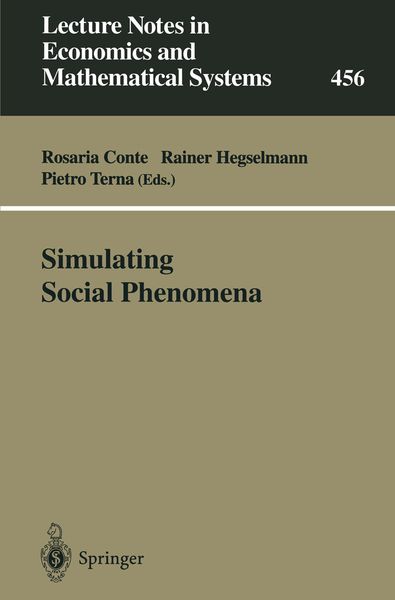
Band 456

Simulating Social Phenomena

97,99 €

inkl. gesetzl. MwSt., Versandkostenfrei

Lieferung nach Hause

Beschreibung

Produktdetails

Einband

Taschenbuch

Erscheinungsdatum

19.08.1997

Herausgeber

Rosaria Conte + weitere

Verlag

Springer Berlin

Seitenzahl

536

Maße (L/B/H)

23,5/15,5/3 cm

Gewicht

820 g

Sprache

Englisch

ISBN

978-3-540-63329-7

Beschreibung

Produktdetails

Einband

Taschenbuch

Erscheinungsdatum

19.08.1997

Herausgeber

Verlag

Springer Berlin

Seitenzahl

536

Maße (L/B/H)

23,5/15,5/3 cm

Gewicht

820 g

Sprache

Englisch

ISBN

978-3-540-63329-7

Herstelleradresse

Springer-Verlag KG
Sachsenplatz 4-6
1201 Wien
AT

Email: ProductSafety@springernature.com

Kundinnen und Kunden meinen

0 Bewertungen

Informationen zu Bewertungen

Zur Abgabe einer Bewertung ist eine Anmeldung im Konto notwendig. Die Authentizität der Bewertungen wird von uns nicht überprüft. Wir behalten uns vor, Bewertungstexte, die unseren Richtlinien widersprechen, entsprechend zu kürzen oder zu löschen.

Die Bewertungen sind nach Format, Anzahl Sterne und Datum sortiert.

Verfassen Sie die erste Bewertung zu diesem Artikel

Helfen Sie anderen Kund*innen durch Ihre Meinung

Kundinnen und Kunden meinen

0 Bewertungen filtern

  • Produktbild: Simulating Social Phenomena
  • Produktbild: Simulating Social Phenomena
  • Introduction: R. Conte, R. Hegselmann, P. Terna, Social Simulation - A New Disciplinary Synthesis.- Simulating in the Social Sciences: History, Problems, and Perspectives: R. Axelrod, Advancing the Art of Simulation in the Social Sciences; K.G. Troitzsch, Social Science Simulation - Origins, Prospects, Purposes; K.-H. Brassel, M. Möhring, E. Schumacher, K.G. Troitzsch, Can Agents Cover all the World?; P. Terna, A Laboratory for Agent Based Computational Economics: The Self-development of Consistency in Agents' Behaviour; E. Bruderer, M. Maiers, From the Margin to the Mainstream: An Agenda for Computer Simulations in the Social Sciences; C. Jacobsen, R. Bronson, Computer Simulated Empirical Tests of Social Theory: Lessons from 15 Years' Experience; F.M. Brazier, P.A. v. Eck, J. Treur, Modelling a Society of Simple Agents: From Conceptual Specification to Experimentation.- Cooperation, Exchange, and Coalitions: K. Binmore, M. Piccione, L. Samuelson, Bargaining Between Automata; D. Parisi, What to Do with a Surplus; T.B. Klos, Spatially Coevolving Automata Play the Repeated Prisoner's Dilemma; S. Majeski, G. Linden, C. Linden, A. Spitzer, A Spatial Iterated Prisoner's Dilemma Game Simultion with Movement; A. Rossi, M. Warglien, E. Zaninotto, Cooperation as Illusory Hill-Climbing: Co-adaption and Search in Social Dilemmas; G.M. Werner, J.N. Davis, Cooperation Without Memory; R. Conte, M. Paolucci, Tributes or Norms? The Context-dependent Rationality of Social Control; R. Pedone, D. Parisi, In What Kinds of Social Groups Can 'Altruistic' Behaviors Evolve?; G. Pistolesi, V. Veneziano, C. Castelfranchi, Global vs. Local Social Search in the Formation of Coalitions; M. Achterkamp, Exchange and Challenge in Collective Decision Making.- Markets, Organisations, and EconomicDynamics: G. Weisbuch, A. Kirman, D. Herreiner, Market Organisation; O. Guenther, T. Hogg, B.A. Huberman, Market Organizations for Controlling Smart Matter; G. Ballot, M-P. Merlateau, D. Meurs, Personnel Policies, Long Term Unemployment and Growth. An Evolutionary Model; C. Bruun, Agent-Based Keynesian Economics; E.S. Andersen, An Evolutionary Approach to Structural Economic Dynamics; S. Zambelli, Macroeconomic Intedependence and Frequency Locking; H. van den Broek, H.W. Gazendam, Organizational Actors and the Need for a Flexible World Representation; L. Marengo, C. Pasquali, Concurrency and the Logic of Economic Organization; L. Papini, G.A. Rabino, An Evolutionary Urban Cellular Automata: The Model and Some First Simulations; B. Lomborg, Simulating Multiparty Systems.- Learning and Adaption: M. Egidi, M. Ricottili, Co-ordination and Specialisation; D. Hales, Modelling Meta-Memes; S.E. Phelan, Innovation and Imitation as Competitive Strategies; E. Chattoe, N. Gilbert, A Simulation of Adaption Mechanisms in Budgetary Decision Making; P.M. Todd, Searching for the Next Best Mate; X. Vilà, Adaptive Artificial Agents Play a Finitely Repeated Discrete Principal-Agent Game; J. Doran, Foreknowledge in Artificial Societies; S.-H. Chen, Would and Should Government Lie about Economic Statistics: Understanding Opinion Formation Processes through Evolutionary Cellular Automata.- Statistics: T. Snijders, M. van Duijn, Simulation for Statistical Inference in Dynamic Network Models; L. Barabesi, L. Fattorini, Permutation Techniques for Testing Homogeneity of Social Groups form Questionnaire Results; M.C. Wolfson, New Goods and the Measurement of Real Economic Growth: Summary Results Using the XEcon Experimental Economy; M.C. Wolfson, Sketsching Life Paths: A New