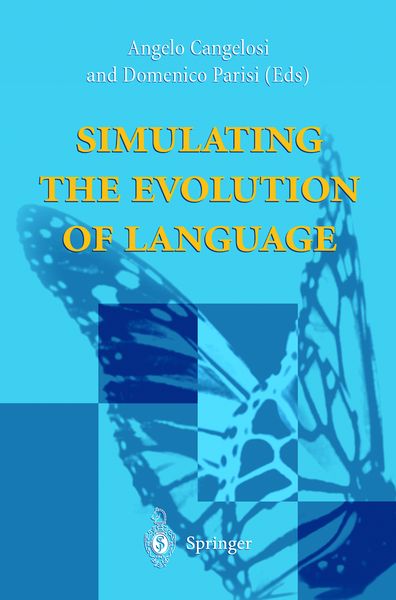
Simulating the Evolution of Language
-
- Taschenbuch ausgewählt
- eBook
-
Sprache:Englisch
97,99 €
inkl. gesetzl. MwSt.,
Beschreibung
Produktdetails
Einband
Taschenbuch
Erscheinungsdatum
14.11.2001
Abbildungen
XII, 355 p. 13 illus.
Herausgeber
Angelo Cangelosi + weitereVerlag
Springer LondonSeitenzahl
355
Maße (L/B/H)
23,5/15,5/2 cm
Gewicht
557 g
Auflage
Softcover reprint of the original 1st edition 2002
Sprache
Englisch
ISBN
978-1-85233-428-4
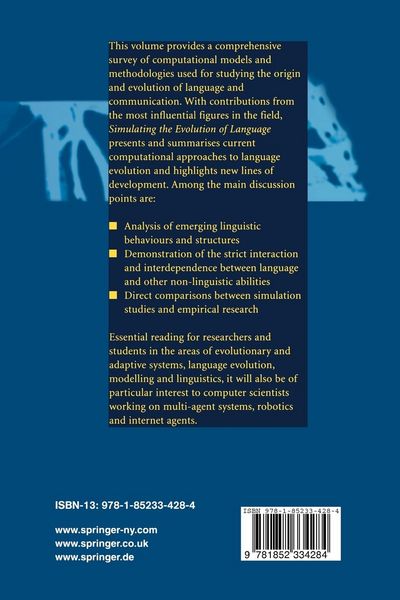
This book is the first to provide a comprehensive survey of the computational models and methodologies used for studying the evolution and origin of language and communication. Comprising contributions from the most influential figures in the field, it presents and summarises the state-of-the-art in computational approaches to language evolution, and highlights new lines of development.
Essential reading for researchers and students in the fields of evolutionary and adaptive systems, language evolution modelling and linguistics, it will also be of interest to researchers working on applications of neural networks to language problems. Furthermore, due to the fact that language evolution models use multi-agent methodologies, it will also be of great interest to computer scientists working on multi-agent systems, robotics and internet agents.
Noch keine Bewertungen vorhanden
Verfassen Sie die erste Bewertung zu diesem Artikel
Helfen Sie anderen Kundinnen und Kunden durch Ihre Meinung.
Kurze Frage zu unserer Seite
Vielen Dank für dein Feedback
Wir nutzen dein Feedback, um unsere Produktseiten zu verbessern. Bitte habe Verständnis, dass wir dir keine Rückmeldung geben können. Falls du Kontakt mit uns aufnehmen möchtest, kannst du dich aber gerne an unseren Kund*innenservice wenden.
zum Kundenservice