KI-Beratung Beta

Gutscheinbedingungen

**Gültig vom 23.11. bis 30.11.2026 | Gültig für nicht preisgebundene fremdsprachige Bücher | Einzelne Artikel können ausgeschlossen sein | Online auf www.bücher.de einlösbar | Click & Collect nur mit Online-Zahlung (Paypal/Kreditkarte) vorab | Nicht kombinierbar mit anderen Gutscheinen oder Preisaktionen | Nur einmal pro Einkauf einlösbar | Gutschein wird auf max. 500€ Bestellwert angerechnet | Keine Barauszahlung | Nicht gültig für Versandkosten und Services

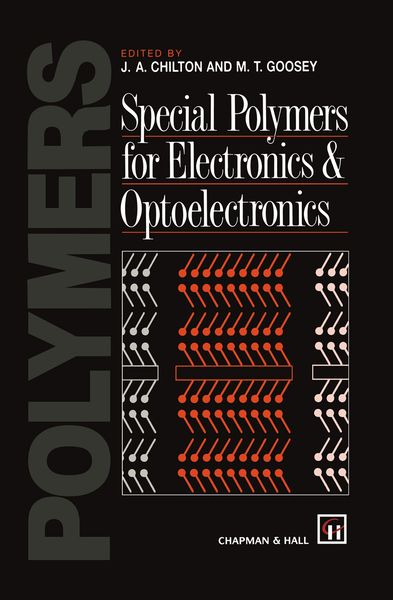
  • Produktbild: Special Polymers for Electronics and Optoelectronics
  • Produktbild: Special Polymers for Electronics and Optoelectronics
- 12%

Special Polymers for Electronics and Optoelectronics

12% sparen

139,99 € UVP 160,49 €

inkl. gesetzl. MwSt., Versandkostenfrei


Beschreibung

Commercially successful fully synthetic polymeric materials were pro duced in the early years of this century, the first example being Bakelite. This was made from phenol and formaldehyde by Leo Bakeland in 1909. Before the end of the 1920s, a large number of other synthetic polymers had been created,...

Beschreibung

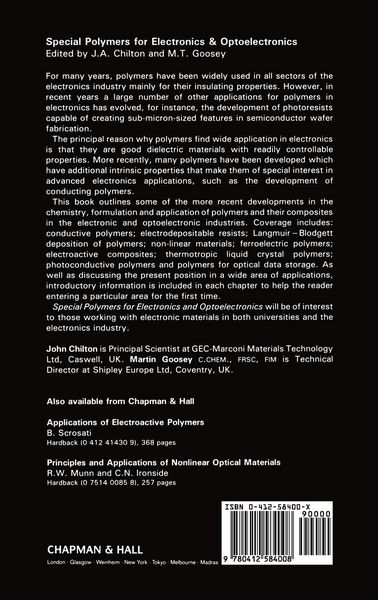
Commercially successful fully synthetic polymeric materials were pro duced in the early years of this century, the first example being Bakelite. This was made from phenol and formaldehyde by Leo Bakeland in 1909. Before the end of the 1920s, a large number of other synthetic polymers had been created, including polyvinyl chloride and urea-formaldehyde. Today, there are literally hundreds of synthetic polymers commercially available with ranges of properties making them suitable for applications in many industrial sectors, including the electrical and electronics industries. In many instances the driving force behind the development of new materials actually came from the electronics industry, and today's advanced electronics would be inconceivable without these materials. For many years polymers have been widely used in all sectors of the electronics industry. From the early days of the semiconductor industry to the current state of the art, polymers have provided the enabling technologies that have fuelled the inexorable and rapid development of advanced electronic and optoelectronic devices.

Rezension

...this book is an excellent introduction to the applications of polymer science in the opto-electronic industry...I recommend the book for entry-level researchers or specialists desiring expansion into a new field - Trends in Polymer Science; This book is very timely and brings together, concisely, an authoritative discussion of topics. - Polymer International; This is a fascinating book...each page contains a large amount of information which is presented in a very clear and logical way. This means that although the book is written by a number of different authors, that the book has a coherent style. The text is also well illustrated...this book will be of great interest to those working in the electronics industry and/or, those studying/researching electronics. - Engineering Plastics

Produktdetails

Einband

Gebundene Ausgabe

Erscheinungsdatum

28.02.1995

Abbildungen

XXIV, 351 p.

Herausgeber J.A. Chilton + weitere

Produktdetails

Einband

Gebundene Ausgabe

Erscheinungsdatum

28.02.1995

Abbildungen

XXIV, 351 p.

Herausgeber
Verlag Springer Netherland
Seitenzahl

351

Maße (L/B/H)

24,1/16/2,6 cm

Gewicht

683 g

Auflage

1995

Sprache

Englisch

ISBN

978-0-412-58400-8

Herstelleradresse

Springer-Verlag GmbH
Europaplatz 3
69115 Heidelberg
DE

Email: ProductSafety@springernature.com

Noch keine Bewertungen vorhanden

Verfassen Sie die erste Bewertung zu diesem Artikel

Helfen Sie anderen Kundinnen und Kunden durch Ihre Meinung.

Kundinnen und Kunden meinen

Bewertungen (0)

  • Produktbild: Special Polymers for Electronics and Optoelectronics
  • Produktbild: Special Polymers for Electronics and Optoelectronics
  • 1 Conductive polymers.- 1.1 Introduction.- 1.2 Traditional routes to conductive polymers.- 1.3 Conduction mechanisms.- 1.4 Conducting polymers.- 1.5 Applications.- 1.6 Conclusions and commercial prospects.- References.- 2 Electrodepositable resists.- 2.1 Introduction.- 2.2 Principles of electrodeposition.- 2.3 Polymers for electrodepositable resists.- 2.4 Electrodepositable resist formulation.- 2.5 Applications of electrodepositable resists.- 2.6 Summary and conclusions.- References.- 3 Polymeric Langmuir—Blodgett films.- 3.1 Introduction.- 3.2 Polymerization of Langmuir—Blodgett materials.- 3.3 Electrical properties.- 3.4 Optical properties.- 3.5 Concluding remarks.- References.- 4 Nonlinear materials.- 4.1 Introduction.- 4.2 Characterization.- 4.3 ?2 polymers.- 4.4 ?2 polymers.- 4.5 Polymeric devices.- References.- 5 Ferroelectric polymers.- 5.1 Introduction.- 5.2 Ferroelectric polymer materials.- 5.3 Properties of ferroelectric polymers.- 5.4 Applications of ferroelectric polymers.- 5.5 Conclusions.- References.- 6 Electroactive composites.- 6.1 Introduction.- 6.2 Composite designs.- 6.3 Diphasic models.- 6.4 Preparation and characterization.- 6.5 Composite poling.- 6.6 Applications.- References.- 7 Thermotropic liquid crystal polymers.- 7.1 Introduction.- 7.2 Liquid crystal polymer fundamentals.- 7.3 Processing.- 7.4 Property profiles.- 7.5 Applications.- 7.6 Outlook.- References.- 8 Photoconductive polymers.- 8.1 Introduction.- 8.2 General background.- 8.3 Materials.- 8.4 Experimental techniques.- 8.5 Applications.- References.- 9 Polymers for optical data storage.- 9.1 Introduction: the need for optical storage.- 9.2 The principles of optical storage.- 9.3 Polymers in the recording layer.- 9.4 Polymers in the manufacture of optical media.- 9.5 Polymers foroptical heads.- 9.6 Polymers for cartridges.- 9.7 Other forms of optical storage.- 9.8 The future for polymers in optical data storage.- References.