Gutscheinbedingungen

**Gültig vom 07.09.2026 bis 09.09.2026 | Gültig für nicht preisgebundene fremdsprachige Bücher | Einzelne Artikel können ausgeschlossen sein | Online auf www.bücher.de einlösbar | Click & Collect nur mit Online-Zahlung (Paypal/Kreditkarte) vorab | Nicht kombinierbar mit anderen Gutscheinen oder Preisaktionen | Nur einmal pro Einkauf einlösbar | Gutschein wird auf max. 500€ Bestellwert angerechnet | Keine Barauszahlung | Nicht gültig für Versandkosten und Services

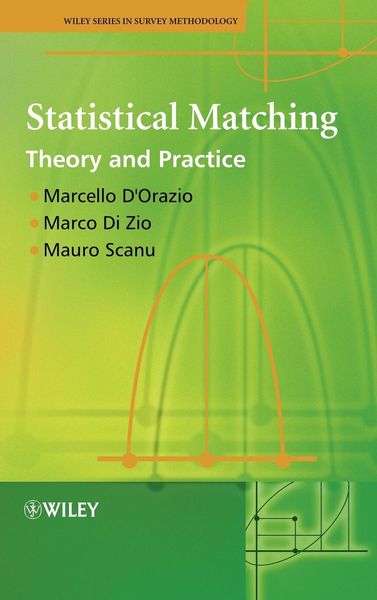
  • Produktbild: Statistical Matching
  • Produktbild: Statistical Matching

Statistical Matching Theory and Practice

159,99 €

inkl. gesetzl. MwSt., Versandkostenfrei


Beschreibung

Produktdetails

Einband

Gebundene Ausgabe

Erscheinungsdatum

04.05.2006

Verlag

John Wiley & Sons Inc

Seitenzahl

272

Maße (L/B/H)

23,5/15,7/2,1 cm

Gewicht

595 g

Auflage

1. Auflage

Sprache

Englisch

ISBN

978-0-470-02353-2

Beschreibung

Rezension

"Those interested in statistical matching will find this book very useful." ( Technometrics , August 2007) "My compliments to the authors for making these (seemingly) arcane ideas available to a whole new generation of statisticians and economists." ( Journal of the American Statistical Association , September 2007)

Produktdetails

Einband

Gebundene Ausgabe

Erscheinungsdatum

04.05.2006

Verlag

John Wiley & Sons Inc

Seitenzahl

272

Maße (L/B/H)

23,5/15,7/2,1 cm

Gewicht

595 g

Auflage

1. Auflage

Sprache

Englisch

ISBN

978-0-470-02353-2

Herstelleradresse

Libri GmbH
Europaallee 1
36244 Bad Hersfeld
DE

Email: gpsr@libri.de

Noch keine Bewertungen vorhanden

Verfassen Sie die erste Bewertung zu diesem Artikel

Helfen Sie anderen Kundinnen und Kunden durch Ihre Meinung.

Kundinnen und Kunden meinen

Bewertungen (0)

Die Leseprobe wird geladen.
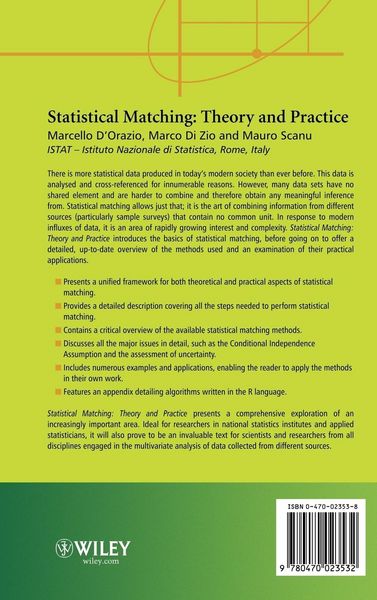
  • Produktbild: Statistical Matching
  • Produktbild: Statistical Matching
  • Preface.
     
    1 The Statistical Matching Problem.
     
    1.1 Introduction.
     
    1.2 The Statistical Framework.
     
    1.3 The Missing Data Mechanism in the Statistical Matching Problem.
     
    1.4 Accuracy of a Statistical Matching Procedure.
     
    1.5 Outline of the Book.
     
    2 The Conditional Independence Assumption.
     
    2.1 The Macro Approach in a Parametric Setting.
     
    2.2 The Micro (Predictive) Approach in the Parametric Framework.
     
    2.3 Nonparametric Macro Methods.
     
    2.4 The Nonparametric Micro Approach.
     
    2.5 Mixed Methods.
     
    2.6 Comparison of Some Statistical Matching Procedures under the CIA.
     
    2.7 The Bayesian Approach.
     
    2.8 Other IdentifiableModels.
     
    3 Auxiliary Information.
     
    3.1 Different Kinds of Auxiliary Information.
     
    3.2 Parametric Macro Methods.
     
    3.3 Parametric Predictive Approaches.
     
    3.4 Nonparametric Macro Methods.
     
    3.5 The Nonparametric Micro Approach with Auxiliary Information.
     
    3.6 Mixed Methods.
     
    3.7 Categorical Constrained Techniques.
     
    3.8 The Bayesian Approach.
     
    4 Uncertainty in Statistical Matching.
     
    4.1 Introduction.
     
    4.2 A Formal Definition of Uncertainty.
     
    4.3 Measures of Uncertainty.
     
    4.4 Estimation of Uncertainty.
     
    4.5 Reduction of Uncertainty: Use of Parameter Constraints.
     
    4.6 Further Aspects of Maximum Likelihood Estimation of Uncertainty.
     
    4.7 An Example with Real Data.
     
    4.8 Other Approaches to the Assessment of Uncertainty.
     
    5 Statistical Matching and Finite Populations.
     
    5.1 Matching Two Archives.
     
    5.2 Statistical Matching and Sampling from a Finite Population.
     
    5.3 Parametric Methods under the CIA.
     
    5.4 Parametric Methods when Auxiliary Information is Available.
     
    5.5 File Concatenation.
     
    5.6 Nonparametric Methods.
     
    6 Issues in Preparing for Statistical Matching.
     
    6.1 Reconciliation of Concepts and Definitions of Two Sources.
     
    6.2 How to Choose the Matching Variables.
     
    7 Applications.
     
    7.1 Introduction.
     
    7.2 Case Study: The Social Accounting Matrix.
     
    A Statistical Methods for Partially Observed Data.
     
    A.1 Maximum Likelihood Estimation with Missing Data.
     
    A.2 Bayesian Inference withMissing Data.
     
    B Loglinear Models.
     
    B.1 Maximum Likelihood Estimation of the Parameters.
     
    C Distance Functions.
     
    D Finite Population Sampling.
     
    E R Code.
     
    E.1 The R Environment.
     
    E.2 R Code for Nonparametric Methods.
     
    E.3 R Code for Parametric and Mixed Methods.
     
    E.4 R Code for the Study of Uncertainty.
     
    E.5 Other R Functions.
     
    References.
     
    Index.