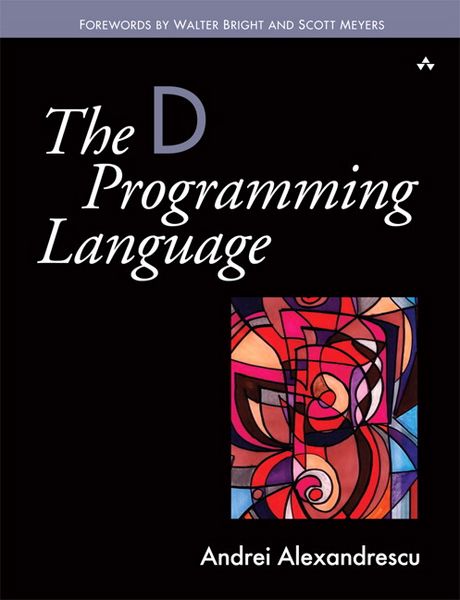
Produktbild: The D Programming Language
- 13%

The D Programming Language

13% sparen

38,99 € UVP 44,99 €

inkl. gesetzl. MwSt., Versandkostenfrei


Beschreibung

Produktdetails

Einband

Taschenbuch

Erscheinungsdatum

02.06.2010

Verlag

Pearson Studium

Seitenzahl

496

Maße (L/B/H)

23,5/17,8/2,7 cm

Gewicht

771 g

Auflage

1

Sprache

Englisch

ISBN

978-0-321-63536-5

Beschreibung

Produktdetails

Einband

Taschenbuch

Erscheinungsdatum

02.06.2010

Verlag

Pearson Studium

Seitenzahl

496

Maße (L/B/H)

23,5/17,8/2,7 cm

Gewicht

771 g

Auflage

1

Sprache

Englisch

ISBN

978-0-321-63536-5

Herstelleradresse


Email: GPSR Kontakt

Noch keine Bewertungen vorhanden

Verfassen Sie die erste Bewertung zu diesem Artikel

Helfen Sie anderen Kundinnen und Kunden durch Ihre Meinung.

Kundinnen und Kunden meinen

Bewertungen (0)

Die Leseprobe wird geladen.
  • Produktbild: The D Programming Language

  • Foreword by Walter Bright xv

    Foreword by Scott Meyers xix

    Preface xxiii

    Chapter 1: “D”iving In 1

    1.1 Numbers and Expressions 3

    1.2 Statements 5

    1.3 Function Basics 6

    1.4 Arrays and Associative Arrays 7

    1.5 Basic Data Structures 14

    1.6 Interfaces and Classes 20

    1.7 Values versus References 25

    1.8 Summary 27

    Chapter 2: Basic Types. Expressions 29

    2.1 Symbols 30

    2.2 Literals 32

    2.3 Operators 42

    2.4 Summary and Quick Reference 61

    Chapter 3: Statements 65

    3.1 The Expression Statement 65

    3.2 The Compound Statement 66

    3.3 The if Statement 67

    3.4 The static if Statement 68

    3.5 The switch Statement 71

    3.6 The final switch Statement 72

    3.7 Looping Statements 73

    3.8 The goto Statement 78

    3.9 The with Statement 80

    3.10 The return Statement 81

    3.11 The throw and try Statements 81

    3.12 The mixin Statement 82

    3.13 The scope Statement 84

    3.14 The synchronized Statement 88

    3.15 The asm Statement 89

    3.16 Summary and Quick Reference 89

    Chapter 4: Arrays, Associative Arrays, and Strings 93

    4.1 Dynamic Arrays 93

    4.2 Fixed-Size Arrays 107

    4.3 Multidimensional Arrays 111

    4.4 Associative Arrays 114

    4.5 Strings 118

    4.6 Arrays’ Maverick Cousin: The Pointer 124

    4.7 Summary and Quick Reference 126

    Chapter 5: Data and Functions. Functional Style 131

    5.1 Writing and unittesting a Simple Function 131

    5.2 Passing Conventions and Storage Classes 134

    5.3 Type Parameters 138

    5.4 Signature Constraints 140

    5.5 Overloading 142

    5.6 Higher-Order Functions. Function Literals 148

    5.7 Nested Functions 150

    5.8 Closures 152

    5.9 Beyond Arrays. Ranges. Pseudo Members 154

    5.10 Variadic Functions 159

    5.11 Function Attributes 165

    5.12 Compile-Time Evaluation 169

    Chapter 6: Classes. Object-Oriented Style 175

    6.1 Classes 175

    6.2 Object Names Are References 177

    6.3 It’s an Object’s Life 181

    6.4 Methods and Inheritance 190

    6.5 Class-Level Encapsulation with static Members 196

    6.6 Curbing Extensibility with final Methods 197

    6.7 Encapsulation 199

    6.8 One Root to Rule Them All 203

    6.9 Interfaces 212

    6.10 Abstract Classes 218

    6.11 Nested Classes 222

    6.12 Multiple Inheritance 226

    6.13 Multiple Subtyping 230

    6.14 Parameterized Classes and Interfaces 233

    6.15 Summary 237

    Chapter 7: Other User-Defined Types 239

    7.1 structs 240

    7.2 unions 270

    7.3 Enumerated Values 272

    7.4 alias 276

    7.5 Parameterized Scopes with template 278

    7.6 Injecting Code with mixin templates 282

    7.7 Summary and Reference 285

    Chapter 8: Type Qualifiers 287

    8.1 The immutable Qualifier 288

    8.2 Composing with immutable 291

    8.3 immutable Parameters and Methods 292

    8.4 immutable Constructors 293

    8.5 Conversions involving immutable 295

    8.6 The const Qualifier 297

    8.7 Interaction between const and immutable 298

    8.8 Propagating a Qualifier from Parameter to Result 299

    8.9 Summary 300

    Chapter 9: Error Handling 301

    9.1 throwing and catching 301

    9.2 Types 302

    9.3 finally clauses 306

    9.4 nothrow Functions and the Special Nature of Throwable 307

    9.5 Collateral Exceptions 307

    9.6 Stack Unwinding and Exception-Safe Code 309

    9.7 Uncaught Exceptions 312

    Chapter 10: Contract Programming 313

    10.1 Contracts 314

    10.2 Assertions 316

    10.3 Preconditions 317

    10.4 Postconditions 319

    10.5 Invariants 321

    10.6 Skipping Contract Checks. Release Builds 324

    10.7 Contracts: Not for Scrubbing Input 327

    10.8 Contracts and Inheritance 329

    10.9 Contracts in Interfaces 334

    Chapter 11: Scaling Up 337

    11.1 Packages and Modules 337

    11.2 Safety 353

    11.3 Module Constructors and Destructors 356

    11.4 Documentation Comments 358

    11.5 Interfacing with C and C++ 359

    11.6 deprecated 359

    11.7 version Declarations 360

    11.8 debug Declarations 361

    11.9 D’s Standard Library 361

    Chapter 12: Operator Overloading 365

    12.1 Overloading Operators 366

    12.2 Overloading Unary Operators 367

    12.3 Overloading Binary Operators 371

    12.4 Overloading Comparison Operators 375

    12.5 Overloading Assignment Operators 376

    12.6 Overloading Indexing Operators 377

    12.7 Overloading Slicing Operators 379

    12.8 The $ Operator 379

    12.9 Overloading foreach 380

    12.10 Defining Overloaded Operators in Classes 383

    12.11 And Now for Something Completely Different: opDispatch 384

    12.12 Summary and Quick Reference 388

    Chapter 13: Concurrency 391

    13.1 Concurrentgate 392

    13.2 A Brief History of Data Sharing 394

    13.3 Look, Ma, No (Default) Sharing 397

    13.4 Starting a Thread 399

    13.5 Exchanging Messages between Threads 401

    13.6 Pattern Matching with receive 403

    13.7 File Copying—with a Twist 406

    13.8 Thread Termination 407

    13.9 Out-of-Band Communication 409

    13.10 Mailbox Crowding 410

    13.11 The shared Type Qualifier 411

    13.12 Operations with shared Data and Their Effects 413

    13.13 Lock-Based Synchronization with synchronized classes 414

    13.14 Field Typing in synchronized classes 419

    13.15 Deadlocks and the synchronized Statement 424

    13.16 Lock-Free Coding with shared classes 426

    13.17 Summary 431

    Bibliography 433

    Index 439