
The EU Accession to the ECHR Between Luxembourg’s Search for Autonomy and Strasbourg’s Credibility on Human Rights Protection
-
- Hardcover ausgewählt
- Taschenbuch
- eBook
-
Sprache:Englisch
95,99 €
UVP
106,99 €
inkl. gesetzl. MwSt.,
Beschreibung
Produktdetails
Einband
Gebundene Ausgabe
Erscheinungsdatum
03.09.2015
Abbildungen
XIX, 471 p. 6 illus., 5 illus. in color.
Verlag
SpringerSeitenzahl
471
Maße (L/B/H)
24,1/16/3,2 cm
Gewicht
898 g
Auflage
1st ed. 2015
Sprache
Englisch
ISBN
978-3-319-21758-1
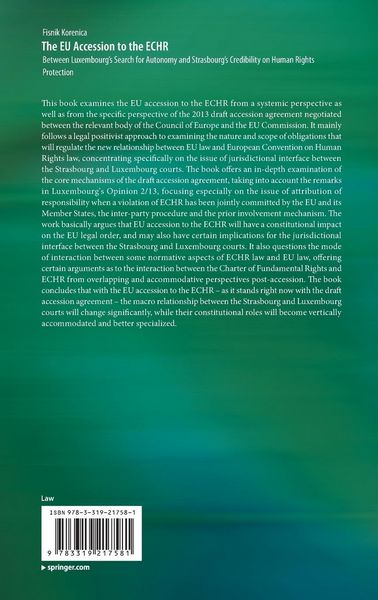
This book examines the EU accession to the ECHR from a systemic perspective as well as from the specific perspective of the 2013 draft accession agreement negotiated between the relevant body of the Council of Europe and the EU Commission. It mainly follows a legal positivist approach to examining the nature and scope of obligations that will regulate the new relationship between EU law and European Convention on Human Rights law, concentrating specifically on the issue of jurisdictional interface between the Strasbourg and Luxembourg courts. The book offers an in-depth examination of the core mechanisms of the draft accession agreement, taking into account the remarks in Luxembourg's Opinion 2/13, focusing especially on the issue of attribution of responsibility when a violation of ECHR has been jointly committed by the EU and its Member States, the inter-party procedure and the prior involvement mechanism. The work basically argues that EU accession to the ECHR will have a constitutional impact on the EU legal order, and may also have certain implications for the jurisdictional interface between the Strasbourg and Luxembourg courts. It also questions the mode of interaction between some normative aspects of ECHR law and EU law, offering certain arguments as to the interaction between the Charter of Fundamental Rights and ECHR from overlapping and accommodative perspectives post-accession. The book concludes that with the EU accession to the ECHR – as it stands right now with the draft accession agreement – the macro relationship between the Strasbourg and Luxembourg courts will change significantly, while their constitutional roles will become vertically accommodated and better specialized.
Noch keine Bewertungen vorhanden
Verfassen Sie die erste Bewertung zu diesem Artikel
Helfen Sie anderen Kundinnen und Kunden durch Ihre Meinung.
Kurze Frage zu unserer Seite
Vielen Dank für dein Feedback
Wir nutzen dein Feedback, um unsere Produktseiten zu verbessern. Bitte habe Verständnis, dass wir dir keine Rückmeldung geben können. Falls du Kontakt mit uns aufnehmen möchtest, kannst du dich aber gerne an unseren Kund*innenservice wenden.
zum Kundenservice