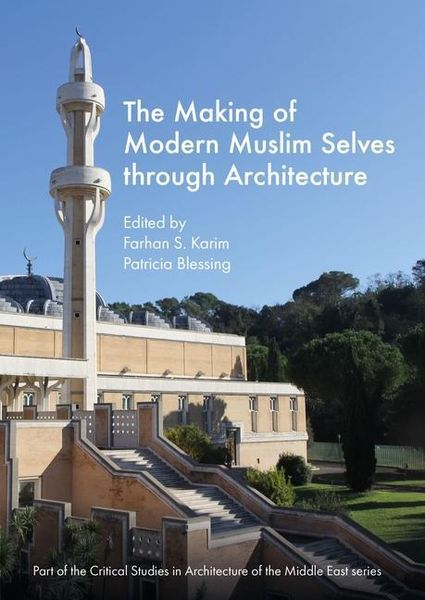
The Making of Modern Muslim Selves through Architecture
149,99 €
inkl. gesetzl. MwSt.,
Beschreibung
Produktdetails
Einband
Gebundene Ausgabe
Erscheinungsdatum
26.01.2024
Abbildungen
167 b/w figures (though 126 of them will be colour in ebook), Raster,schwarz-weiss
Herausgeber
Farhan S. Karim + weitereVerlag
Ingram Publishers ServicesSeitenzahl
390
Maße (L/B/H)
17,6/23,8/2,5 cm
Gewicht
986 g
Sprache
Englisch
ISBN
978-1-78938-851-0
This collection seeks to explore alternative definitions of bounded identities, facilitating new approaches to spatial and architectural forms. Taking as its starting point the emergence of a new sense of 'boundary' emerged from the post-19th century dissolution of large, heterogeneous empires into a mosaic of nation-states in the Islamic world. This new sense of boundaries has not only determined the ways in which we imagine and construct the idea of modern citizenship, but also redefines relationships between the nation, citizenship, cities and architecture. It brings critical perspectives to our understanding of the interrelation between the accumulated flows and the evolving concepts of boundary in predominantly Muslim societies and within the global Muslim diaspora. Essays in this book seeks to investigate how architecture mediates the creation and deployment of boundaries and boundedness that have been devised to define, enable, obstruct, accumulate and/or control flows able to disrupt bounded territories or identities. More generally, the book explores how architecture might be considered as a means to understand the relationship between flows and boundaries and its implication of defining modern self. The essays in this volume collectively address how the construction of self is primarily a spatial event and operated within the crucial nexus of power-knowledge-space. Contributors investigate how architecture mediates the creation and deployment of boundaries and boundedness, how architecture might be considered as a means to understand the relationship between flows and boundaries and its implications for how we define the modern self. Part of the Critical Studies in Architecture of the Middle East series.
Noch keine Bewertungen vorhanden
Verfassen Sie die erste Bewertung zu diesem Artikel
Helfen Sie anderen Kundinnen und Kunden durch Ihre Meinung.
Kurze Frage zu unserer Seite
Vielen Dank für dein Feedback
Wir nutzen dein Feedback, um unsere Produktseiten zu verbessern. Bitte habe Verständnis, dass wir dir keine Rückmeldung geben können. Falls du Kontakt mit uns aufnehmen möchtest, kannst du dich aber gerne an unseren Kund*innenservice wenden.
zum Kundenservice