The Mathematics of Urban Morphology
-
- Hardcover ausgewählt
- Taschenbuch
- eBook
-
Sprache:Englisch
126,99 €
inkl. gesetzl. MwSt.,
Beschreibung
Produktdetails
Einband
Gebundene Ausgabe
Erscheinungsdatum
02.04.2019
Abbildungen
XIII, 564 p. 156 illus., 101 illus. in color.
Herausgeber
Luca D'AcciVerlag
SpringerSeitenzahl
564
Maße (L/B/H)
24,1/16/3,7 cm
Gewicht
1027 g
Auflage
1st ed. 2019
Sprache
Englisch
ISBN
978-3-030-12380-2
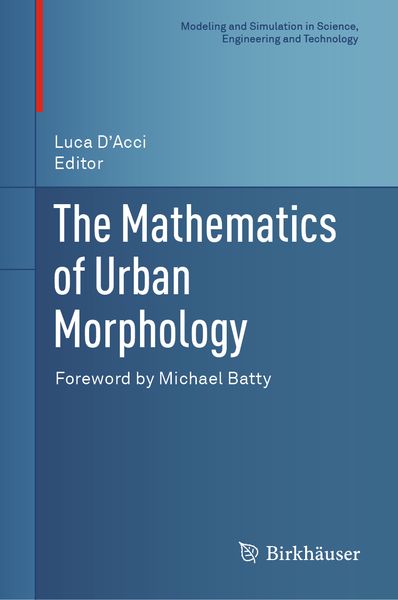
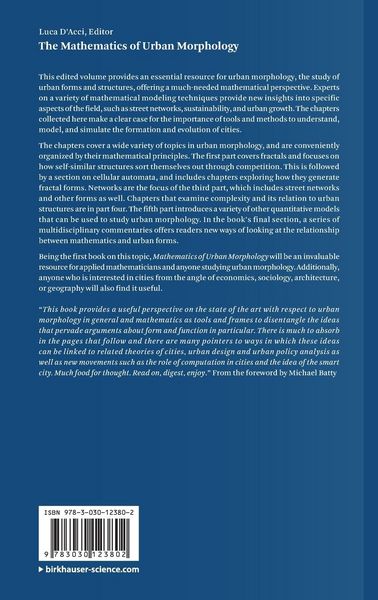
This edited volume provides an essential resource for urban morphology, the study of urban forms and structures, offering a much-needed mathematical perspective. Experts on a variety of mathematical modeling techniques provide new insights into specific aspects of the field, such as street networks, sustainability, and urban growth. The chapters collected here make a clear case for the importance of tools and methods to understand, model, and simulate the formation and evolution of cities.
The chapters cover a wide variety of topics in urban morphology, and are conveniently organized by their mathematical principles. The first part covers fractals and focuses on how self-similar structures sort themselves out through competition. This is followed by a section on cellular automata, and includes chapters exploring how they generate fractal forms. Networks are the focus of the third part, which includes street networks and other forms as well. Chapters that examine complexity and its relation to urban structures are in part four.The fifth part introduces a variety of other quantitative models that can be used to study urban morphology. In the book’s final section, a series of multidisciplinary commentaries offers readers new ways of looking at the relationship between mathematics and urban forms.
Being the first book on this topic,
Mathematics of Urban Morphology
will be an invaluable resource for applied mathematicians and anyone studying urban morphology. Additionally, anyone who is interested in cities from the angle of economics, sociology, architecture, or geography will also find it useful.
"
This book provides a useful perspective on the state of the art with respect to urban morphology in general and mathematics as tools and frames to disentangle the ideas that pervade arguments about form and function in particular. There is much to absorb in the pages that follow and thereare many pointers to ways in which these ideas can be linked to related theories of cities, urban design and urban policy analysis as well as new movements such as the role of computation in cities and the idea of the smart city. Much food for thought. Read on, digest, enjoy.
" From the foreword by Michael Batty
Noch keine Bewertungen vorhanden
Verfassen Sie die erste Bewertung zu diesem Artikel
Helfen Sie anderen Kundinnen und Kunden durch Ihre Meinung.
Kurze Frage zu unserer Seite
Vielen Dank für dein Feedback
Wir nutzen dein Feedback, um unsere Produktseiten zu verbessern. Bitte habe Verständnis, dass wir dir keine Rückmeldung geben können. Falls du Kontakt mit uns aufnehmen möchtest, kannst du dich aber gerne an unseren Kund*innenservice wenden.
zum Kundenservice