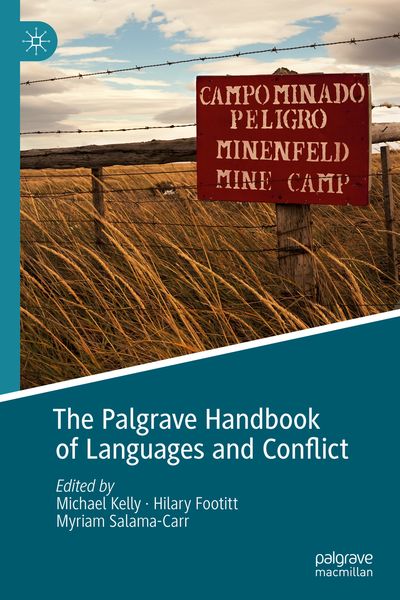
Produktbild: The Palgrave Handbook of Languages and Conflict

The Palgrave Handbook of Languages and Conflict

164,99 €

inkl. gesetzl. MwSt., Versandkostenfrei

Lieferung nach Hause

Beschreibung

Produktdetails

Einband

Gebundene Ausgabe

Erscheinungsdatum

28.02.2019

Herausgeber

Michael Kelly + weitere

Verlag

Springer

Seitenzahl

527

Maße (L/B/H)

24,1/16/3,5 cm

Gewicht

953 g

Auflage

1st ed. 2019

Sprache

Englisch

ISBN

978-3-030-04824-2

Beschreibung

Rezension

“This volume is a valuable contribution to the literature on the subject and its inclusion in course curricula as a reference book would be commendable, not only for students of translation and interpreting but also for those in fields dealing with war studies, history, sociology of conflicts or security studies.” (Vedrana Čemerin, LSE Review of Books, blogs.lse.ac.uk, September 30, 2019)

Portrait

Michael Kelly is Emeritus Professor of French at the University of Southampton, UK, and Editor of the European Journal of Language Policy. He was co-author of Interpreting the Peace: Peace Operations, Conflict and Language in Bosnia-Herzegovina (2013).

Hilary Footitt is Senior Research Fellow in the University of Reading, UK. She was Principal Investigator for the AHRC project Languages at War , and co-author of WarTalk: Foreign Languages and the British War effort in Europe, 1940-47 (2013).

Myriam Salama-Carr is Honorary Research Fellow at the Centre for Translation and Intercultural Studies, University of Manchester, UK. She has published widely in the history of translation and was editor of Translating and Interpreting Conflict (2007).

Produktdetails

Einband

Gebundene Ausgabe

Erscheinungsdatum

28.02.2019

Herausgeber

Verlag

Springer

Seitenzahl

527

Maße (L/B/H)

24,1/16/3,5 cm

Gewicht

953 g

Auflage

1st ed. 2019

Sprache

Englisch

ISBN

978-3-030-04824-2

Herstelleradresse

Springer-Verlag GmbH
Tiergartenstr. 17
69121 Heidelberg
DE

Email: ProductSafety@springernature.com

Kundinnen und Kunden meinen

0 Bewertungen

Informationen zu Bewertungen

Zur Abgabe einer Bewertung ist eine Anmeldung im Konto notwendig. Die Authentizität der Bewertungen wird von uns nicht überprüft. Wir behalten uns vor, Bewertungstexte, die unseren Richtlinien widersprechen, entsprechend zu kürzen oder zu löschen.

Die Bewertungen sind nach Format, Anzahl Sterne und Datum sortiert.

Verfassen Sie die erste Bewertung zu diesem Artikel

Helfen Sie anderen Kund*innen durch Ihre Meinung

Kundinnen und Kunden meinen

0 Bewertungen filtern

  • Produktbild: The Palgrave Handbook of Languages and Conflict
  • Introduction: The Shock of War; Michael Kelly, Hilary Footitt, Myriam Salama-Carr.- Part One. Conceptual Spaces. Good Anthropology, Bad History: America’s Cultural Turn in the War on Terror; Patrick Porter.- On Encounters and Ethics in the Vietnam War; Moira Inghilleri.- From the Page to the Battlefield: Translating War; Myriam Salama-Carr.- Language Policy and War; Michael Kelly.- Part Two. Source, documentation and voices.- Military History and Translation Studies: Shifting Territories, Uneasy Borders; Hilary Footitt, Pekka Kujamäki.- Archives and Sources; Hilary Footitt.- Interviewing for research on languages and war; Catherine Baker.- Part Three. Institutions and Actors.- Interpreting in Peace and Conflict: Origins, Developing Practices and Ethics; Linda Fitchett.- Interpreters at war: Testing boundaries of neutrality; Fabrizio Gallai.- Providing Language Support for NATO Operations: Challenges and Solutions; Louise Askew.- Translation and Open Source Intelligence: BBC Monitoring; Laura Johnson.- Covering regional conflicts in Arab news: Political loyalties and hate speech; Zahera Harb.- Uncompromising talk, linguistic grievance, and language policy: Thailand’s Deep South conflict zone; Joseph Lo Bianco.- Transnational Institutions: War Crimes Tribunals; Ellen Elias- Bursać.- Part Four. Languages at War in history.- Colonial conflict and imperial rivalries in the Americas; Roberto A. Valdeón.- The British in the Second World War: translation, language policies and language practices; Hilary Footitt.- Understanding interpreting and diplomacy: reflections on the early Cold War (1945-1963); María Manuela Fernández Sánchez.- Colonial heritage, identity-building and communication: English and Nigerian languages in Biafra; Françoise Ugochukwu.- Linguistic unrest at times of revolution: The case of Tunisia, Egypt, and Libya; Reem Bassiouney.- Who really wants to learn Arabic?; Yonatan Mendel.- Part Five. Going Forward: Conclusions and Reflections.- Languages and new forms of warfare; Michael Kelly.- Looking Ahead: Conclusions and Reflections; Michael Kelly, Hilary Footitt, Myriam Salama-Carr.