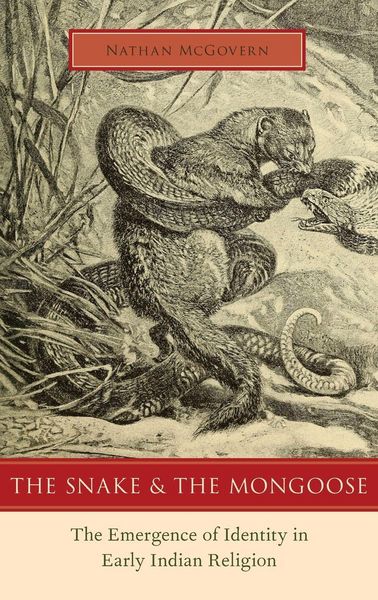
Snake and the Mongoose The Emergence of Identity in Early Indian Religion
176,99 €
inkl. gesetzl. MwSt.,
Beschreibung
Produktdetails
Einband
Gebundene Ausgabe
Erscheinungsdatum
21.11.2018
Verlag
Oxford AcademicSeitenzahl
328
Maße (L/B/H)
24/16,1/2,2 cm
Gewicht
658 g
Sprache
Englisch
ISBN
978-0-19-064079-8
Since the beginning of modern Indology in the 19th century, the relationship between the early Indian religions of Buddhism, Jainism, and Hinduism has been predicated on a perceived dichotomy between two meta-historical identities: "the Brahmans" (purveyors of the ancient Vedic texts and associated ritual system) and the newer "non-Brahmanical" sramana movements from which the Buddhists and Jains emerged. Textbook and scholarly accounts postulate an opposition between these two groups, citing the 2nd-century BCE Sanskrit grammarian Pata�jali, who is often quoted erroneously as likening them to the proverbial enemies snake and mongoose. Scholars continue to privilege Brahmanical Hindu accounts of early Indian history, and further portray Buddhist and Jain deviations from those accounts as evidence of their opposition to a pre-existing Brahmanism. In The Snake and The Mongoose, Nathan McGovern turns this commonly-accepted model of the origins of the early Indian religions on its head. His book seeks to de-center the Hindu Brahman from our understanding of Indian religion by "taming the snake and the mongoose"--that is, by abandoning the anachronistic distinction between "Brahmanical" and "non-Brahmanical." Instead, McGovern allows the earliest articulations of identity in Indian religion to speak for themselves through a comparative reading of texts preserved by the three major groups that emerged from the social, political, cultural, and religious foment of the late first millennium BCE: the Buddhists and Jains as they represented themselves in their earliest sutras, and the Vedic Brahmans as they represented themselves in their Dharma Sutras. The picture that emerges is not of a fundamental dichotomy between Brahmanical and non-Brahmanical, but rather of many different groups who all saw themselves as Brahmanical. Thus, McGovern argues, it was through the contestation between these groups that the distinction between Brahmanical and non-Brahmanical--the snake and the mongoose--emerged.
Noch keine Bewertungen vorhanden
Verfassen Sie die erste Bewertung zu diesem Artikel
Helfen Sie anderen Kundinnen und Kunden durch Ihre Meinung.
Kurze Frage zu unserer Seite
Vielen Dank für dein Feedback
Wir nutzen dein Feedback, um unsere Produktseiten zu verbessern. Bitte habe Verständnis, dass wir dir keine Rückmeldung geben können. Falls du Kontakt mit uns aufnehmen möchtest, kannst du dich aber gerne an unseren Kund*innenservice wenden.
zum Kundenservice