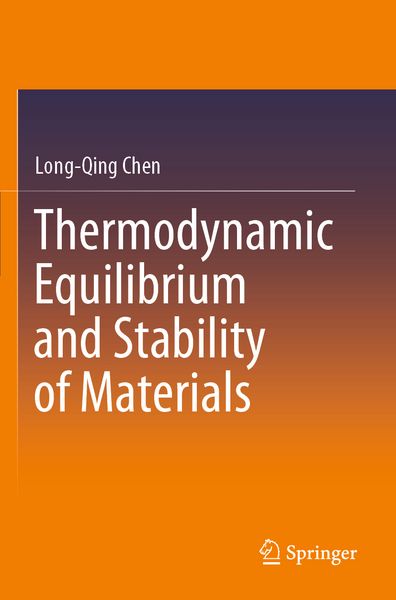
Thermodynamic Equilibrium and Stability of Materials
-
- Hardcover
- Taschenbuch ausgewählt
- eBook
-
Sprache:Englisch
61,99 €
UVP
69,54 €
inkl. gesetzl. MwSt.,
Beschreibung
Produktdetails
Einband
Taschenbuch
Erscheinungsdatum
07.01.2023
Abbildungen
XIX, 455 p. 103 illus., 7 illus. in color.
Verlag
Springer SingaporeSeitenzahl
455
Maße (L/B/H)
23,5/15,5/2,6 cm
Gewicht
715 g
Auflage
1. Auflage
Sprache
Englisch
ISBN
978-981-13-8693-0
This is a textbook on thermodynamics of materials for junior/senior undergraduate students and first-year graduate students as well as a reference book for researchers who would like to refresh their understanding of thermodynamics.
The textbook employs a plain language to explain the thermodynamic concepts and quantities. It embraces the mathematical beauty and rigor of Gibbs thermodynamics through the fundamental equation of thermodynamics from which all thermodynamic properties of a material can be derived. However, a reader with basic first-year undergraduate calculus skills will be able to get through the book without difficulty. One unique feature of this textbook is the descriptions of the step-by-step procedures for computing all the thermodynamic properties from the fundamental equation of thermodynamics and all the thermodynamic energies from a set of common, experimentally measurable thermodynamic properties, supplemented with ample numerical examples.
Another unique feature of this textbook is its emphasis on the concept of chemical potential and its applications to phase equilibria in single component systems and binary solutions, chemical reaction equilibria, and lattice and electronic defects in crystals. The concept of chemical potential is introduced at the very beginning of the book together with temperature and pressure. It avoids or minimizes the use of terms such as molar Gibbs free energy, partial molar Gibbs free energy, or Gibbs potential because molar Gibbs free energy or partial molar Gibbs free energy is precisely the chemical potential of a material or a component. It is the chemical potential that determines the stability of chemical species, compounds, and phases and their tendency to chemically react to form new species, transform to new physical state, and migrate from one spatial location to another. Therefore, it is the chemical potential differences or gradients that driveessentially all materials processes of interest.
A reader after finishing reading the book is expected to not only achieve a high-level fundamental understanding of thermodynamics but also acquire the analytical skills of applying thermodynamics to determining materials equilibrium and driving forces for materials processes.
Noch keine Bewertungen vorhanden
Verfassen Sie die erste Bewertung zu diesem Artikel
Helfen Sie anderen Kundinnen und Kunden durch Ihre Meinung.
Kurze Frage zu unserer Seite
Vielen Dank für dein Feedback
Wir nutzen dein Feedback, um unsere Produktseiten zu verbessern. Bitte habe Verständnis, dass wir dir keine Rückmeldung geben können. Falls du Kontakt mit uns aufnehmen möchtest, kannst du dich aber gerne an unseren Kund*innenservice wenden.
zum Kundenservice