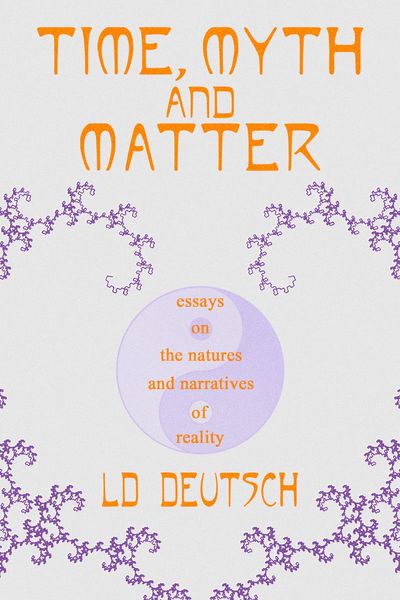
Time, Myth and Matter
24,99 €
UVP
28,00 €
inkl. gesetzl. MwSt.,
Beschreibung
Produktdetails
Einband
Gebundene Ausgabe
Erscheinungsdatum
03.07.2025
Abbildungen
Farb., s/w. Fotos, Abb.
Verlag
Ingram Publishers ServicesSeitenzahl
240
Maße (L/B/H)
21,3/15,9/2,1 cm
Gewicht
450 g
Sprache
Englisch
ISBN
978-1-73614-693-4
What is time? How is consciousness related to the physical world? Why is the simulation hypothesis so popular? These are just some of the questions LD Deutsch tackles in her first collection of essays, Time, Myth and Matter.
This book consists of five long essays, including revised and expanded versions of Deutsch’s highly esteemed zines published by Sacred Bones Books between 2018-2023, and an exclusive, previously unreleased essay, all of which explore the intersections between techno-scientific thinking and mythological narratives as they relate to life’s attempt at self-definition. Known for her ability to render complicated scientific and esoteric subjects accessible to wider audiences, Deutsch deftly traces the relationships between different theories and events in the history of science and technology, and various aspects of mythology, psychology, philosophy, (meta)physics and mysticism—resulting in a riveting inquiry into the nature of the self and the foundations of reality. By treating both science and mythology as serious subjects worthy of respect and rigor, Time, Myth and Matter opens up new avenues of thought and theory as to how the inner world of man and the outer world of Nature intersect and affect each other.
The essays in this book cover:
- The history and cultural synchronicities between the discovery of the planet Pluto and the discovery of the element plutonium and development of the atomic bomb
- Different scientific and philosophical theories about time and how these relate to mythological models of time and the psychological experience of synchronicity
- The prevalence and popularity of the simulation hypothesis, and how it may be viewed as an actively operating mythological model
- The quantum history of matter and the metaphors we use to discuss how and from where matter emerges into the physical universe
- The relationship between consciousness and the material world and how this relationship has been expressed in science, philosophy and mythology
Time, Myth and Matter covers the theories and ideas of world-renowned philosophers, scientists and psychologists such as Carl Jung, Marie-Louise von Franz, Carlo Rovelli, Brian Greene, Nick Bostrom, Bernardo Kastrup, Ruth Kastner, Jacques Vallée, Jeffrey Kripal, Hans-Peter Dürr, Albert Einstein, and more.
Noch keine Bewertungen vorhanden
Verfassen Sie die erste Bewertung zu diesem Artikel
Helfen Sie anderen Kundinnen und Kunden durch Ihre Meinung.
Kurze Frage zu unserer Seite
Vielen Dank für dein Feedback
Wir nutzen dein Feedback, um unsere Produktseiten zu verbessern. Bitte habe Verständnis, dass wir dir keine Rückmeldung geben können. Falls du Kontakt mit uns aufnehmen möchtest, kannst du dich aber gerne an unseren Kund*innenservice wenden.
zum Kundenservice