KI-Beratung Beta

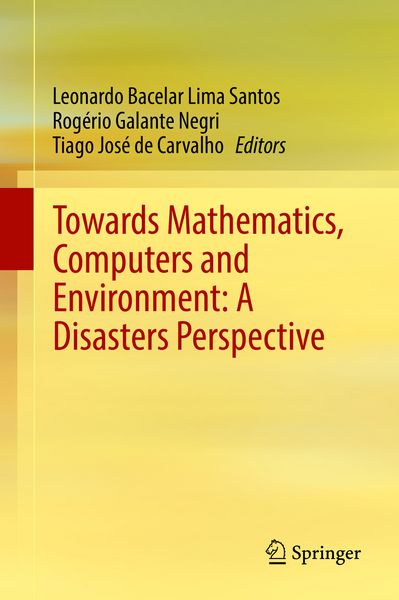
Produktbild: Towards Mathematics, Computers and Environment: A Disasters Perspective

Towards Mathematics, Computers and Environment: A Disasters Perspective

97,99 €

inkl. gesetzl. MwSt., Versandkostenfrei


Beschreibung

Produktdetails

Einband

Gebundene Ausgabe

Erscheinungsdatum

05.08.2019

Abbildungen

XIX, 258 p. 74 illus., 61 illus. in color.

Herausgeber

Leonardo Bacelar Lima Santos + weitere

Verlag

Springer

Seitenzahl

258

Maße (L/B/H)

24,1/16/2,1 cm

Gewicht

588 g

Auflage

1st ed. 2019

Sprache

Englisch

ISBN

978-3-030-21204-9

Beschreibung

Rezension

“The book provides a good selection of valuable papers in the area of environmental research. The main research methods used to study complex and multiscale systems are clearly presented. The target audience includes students of sustainable development, researchers, and even science enthusiasts.” (Alexander Tzanov, Computing Reviews, February 16, 2021)

Portrait


Leonardo B. L. Santos is an adjunct researcher at the National Center for Early Warning of Natural Disasters (Cemaden), Brazil. He holds a PhD in Computing from the National Institute of Space Research (INPE, 2014) and a Bachelor’s degree in Physics from the Federal University of Bahia (UFBA, 2009). He received an honorable mention for a talk at the Institute for Pure and Applied Mathematics (IMPA, 2008) and twice as supervisor of best research (INPE, 2015 and 2016), having published more than 25 papers in journals and book chapters. He is the principal investigator of the Brazilian Society of Computational and Applied Mathematics (SBMAC) research group “Mathematics and Natural Disasters.”


Rogério G. Negri completed his Major’s degree in Mathematics (2006) at the São Paulo State University (UNESP), and his Master (2009) and PhD(2013) in Applied Computation at the Brazilian National Institute for Space Research (INPE), Brazil. He has experience in pattern recognition, radar image processing, geostatistics, and GIS. His recent research focuses on the development of image classification, segmentation, and change detection algorithms with applications on remote sensing data. He is currently a professor at Institute of Science and Technology, UNESP, Brazil.


Tiago Carvalho received his Bachelor’s degree in Computer Science from the Federal University of Juiz de Fora (UFJF), Brazil (2008). He holds a Master (2010) and a PhD (2014) degree, both in Computer Science, from the University of Campinas (Unicamp), Brazil. During his PhD he developed digital forensics methods for detecting image splicing in cooperation with some leading international research teams, including those led by Dr Hany Farid (Dartmouth College, USA) and by Dr Elli Angelopoulo (University of Erlangen-Nuremberg, Germany).


Produktdetails

Einband

Gebundene Ausgabe

Erscheinungsdatum

05.08.2019

Abbildungen

XIX, 258 p. 74 illus., 61 illus. in color.

Herausgeber

Verlag

Springer

Seitenzahl

258

Maße (L/B/H)

24,1/16/2,1 cm

Gewicht

588 g

Auflage

1st ed. 2019

Sprache

Englisch

ISBN

978-3-030-21204-9

Herstelleradresse

Springer-Verlag KG
Sachsenplatz 4-6
1201 Wien
AT

Email: ProductSafety@springernature.com

Noch keine Bewertungen vorhanden

Verfassen Sie die erste Bewertung zu diesem Artikel

Helfen Sie anderen Kundinnen und Kunden durch Ihre Meinung.

Kundinnen und Kunden meinen

Bewertungen (0)

  • Produktbild: Towards Mathematics, Computers and Environment: A Disasters Perspective

  • Preface.- Numerical atmospheric modelling.- An overview of the El Niño, La Niña and the Southern Oscillation phenomena: theory, observations and modeling links.- Mathematical homogenization and integral transform-based multilayer methods.- The earthquake's mathematics.- Waves propagation and flood by tsunami.- From complex systems theory to disasters risk reduction management.- Bayesian analysis for natural threats and hazards.- Time series analysis applied to disaster risk reduction data.- Data mining approaches to the real-time monitoring and early warning of convective weather using lightning data.- Detection of forest burn stages using remote sensing Images and stochastic distances.- Digital humanities and big microdata: new approaches for demographic research.- Modelling and predicting social and geopolitical disasters as extreme events: A case study considering the dynamics of international armed conflicts.