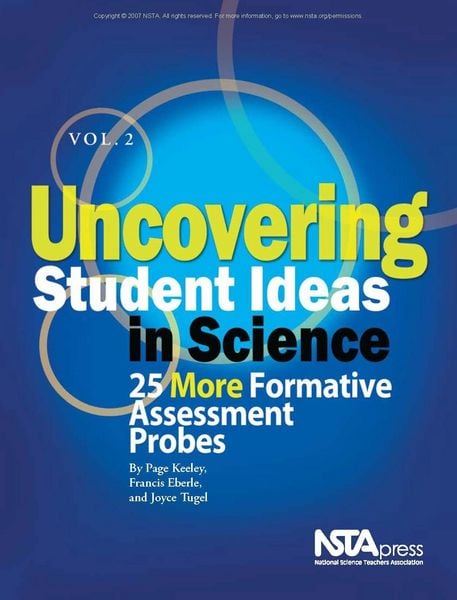
Uncovering Student Ideas in Science, Volume 2 25 More Formative Assessment Probes
-
- Englisch ausgewählt
47,99 €
inkl. gesetzl. MwSt.,
Beschreibung
Produktdetails
Einband
Taschenbuch
Erscheinungsdatum
01.03.2021
Verlag
Nsta - National Science Teaching AssociationSeitenzahl
200
Maße (L/B/H)
27,2/21,1/1,3 cm
Gewicht
590 g
Sprache
Englisch
ISBN
978-1-68140-832-3
"Leave no alternative science idea unchallenged!" could be the slogan of this second edition of Uncovering Student Ideas in Science, Volume 2. Like the others in the bestselling series, this book is loaded with classroom-friendly features to pinpoint what your students know (or think they know) so you can adjust your teaching accordingly. At the book's heart are 25 "probes" to use before you start a topic or unit. These short, easily administered formative assessments will determine your students' thinking on core science concepts in physical science, life science, and Earth and space science. Each section includes a matrix of key concepts and the suggested grade level for each probe. In this new second edition, the probes appear in both English and Spanish. In addition, each probe links to related disciplinary core ideas from A Framework for K-12 Science Education and the Next Generation Science Standards. The teacher-friendly features are updated too. The accompanying Teacher Notes sections include current research summaries, revised instructional suggestions, and new NSTA resources. As before, these teacher materials also explain science content, present developmental considerations, and suggest instructional approaches for elementary, middle, and high school students. Other books discuss students' general misconceptions. Only this one provides reproducible pages you can use to challenge student thinking on everything from characteristic properties of matter to habitat change to objects in the sky. Each probe-field-tested across multiple grade levels-can be used at any point in an instructional cycle to help your students reveal, re-examine, and further develop their understanding of science concepts. Rather than assessments of learning, think of these probes as assessments for learning.
Noch keine Bewertungen vorhanden
Verfassen Sie die erste Bewertung zu diesem Artikel
Helfen Sie anderen Kundinnen und Kunden durch Ihre Meinung.
Kurze Frage zu unserer Seite
Vielen Dank für dein Feedback
Wir nutzen dein Feedback, um unsere Produktseiten zu verbessern. Bitte habe Verständnis, dass wir dir keine Rückmeldung geben können. Falls du Kontakt mit uns aufnehmen möchtest, kannst du dich aber gerne an unseren Kund*innenservice wenden.
zum Kundenservice