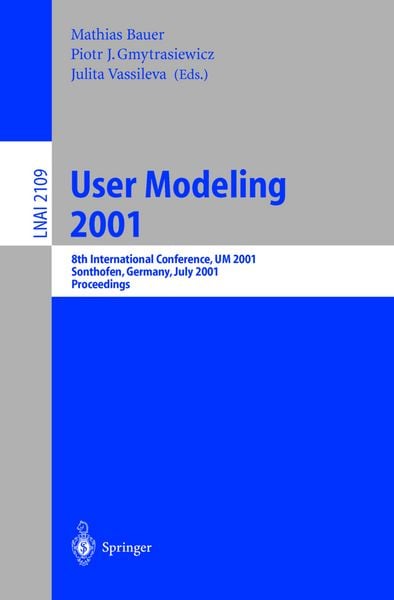
Produktbild: User Modeling 2001
Band 2109

User Modeling 2001 8th International Conference, UM 2001, Sonthofen, Germany, July 13-17, 2001. Proceedings

49,99 €

inkl. gesetzl. MwSt., Versandkostenfrei


Beschreibung

Produktdetails

Einband

Taschenbuch

Erscheinungsdatum

27.06.2001

Abbildungen

XIV, 326 p.

Herausgeber

Mathias Bauer + weitere

Verlag

Springer Berlin

Seitenzahl

326

Maße (L/B/H)

23,5/15,5/1,9 cm

Gewicht

517 g

Auflage

2001

Sprache

Englisch

ISBN

978-3-540-42325-6

Beschreibung

Produktdetails

Einband

Taschenbuch

Erscheinungsdatum

27.06.2001

Abbildungen

XIV, 326 p.

Herausgeber

Verlag

Springer Berlin

Seitenzahl

326

Maße (L/B/H)

23,5/15,5/1,9 cm

Gewicht

517 g

Auflage

2001

Sprache

Englisch

ISBN

978-3-540-42325-6

Herstelleradresse

Springer-Verlag KG
Sachsenplatz 4-6
1201 Wien
AT

Email: ProductSafety@springernature.com

Noch keine Bewertungen vorhanden

Verfassen Sie die erste Bewertung zu diesem Artikel

Helfen Sie anderen Kundinnen und Kunden durch Ihre Meinung.

Kundinnen und Kunden meinen

Bewertungen (0)

  • Produktbild: User Modeling 2001
  • Full Papers.- Harnessing Models of Users’ Goals to Mediate Clarification Dialog in Spoken Language Systems.- Modeling the Acquisition of English: An Intelligent CALL Approach ?.- Recognizing Time Pressure and Cognitive Load on the Basis of Speech: An Experimental Study.- The Learning Shell: Automated Macro Construction.- Learning Interaction Models in a Digital Library Service.- A User Modeling Approach to Determining System Initiative in Mixed-Initiative AI Systems.- Collaborating with Focused and Unfocused Users under Imperfect Communication.- Improving User Modelling with Content-Based Techniques.- An Integrated Approach for Generating Arguments and Rebuttals and Understanding Rejoinders.- Acquiring User Preferences for Product Customization.- Utility-Based Decision Tree Optimization: A Framework for Adaptive Interviewing.- User Modelling in I-Help: What, Why, When and How.- An Adaptive User-Interface-Agent Modeling Communication Availability.- Cognitive Computer Tutors: Solving the Two-Sigma Problem.- Applying Interactive Open Learner Models to Learning Technical Terminology.- Student and Instructor Models: Two Kinds of User Model and Their Interaction in an ITS Authoring Tool.- METIORE: A Personalized Information Retrieval System.- Personalizing Delivered Information in a Software Reuse Environment.- Automating Personal Categorization Using Artificial Neural Networks.- Posters.- User Modelling as an Aid for Human Web Assistants.- Modelling the Interests of a News Service User.- Category Based Customization Approach for Information Retrieval.- Using Rollouts to Induce a Policy from a User Model.- Tailoring the Content of Dynamically Generated Explanations.- A User Model Based on Content Analysis for the Intelligent Personalization of a News Service.- ModelingExploratory Behaviour.- Ascribing and Weighting Beliefs in Deceptive Information Exchanges.- Visual Search and Background Complexity: Does the Forest Hide the Trees?.- Characterizing Sequences of User Actions for Access Logs Analysis.- Modeling Literary Style for Semi-automatic Generation of Poetry.- Perceptual Considerations for Quality of Service Management: An Integrated Architecture.- Emotions and Personality in Agent Design and Modeling.- Using Document Structures for Personal Ontologies and User Modeling*.- User-Tailored Plan Presentation.- Investigating Students’ Self-Assessment Skills.- Generating Personal Travel Guides - And Who Wants Them?.- Inspectability and User Controlled Revision on Long Term User Models.- Getting the Right Information to the Right Person.- Goals, Tasks and Application Domains as the Guidelines for Defining a Framework for User Modelling.- Doctoral Consortium.- Improving Student Models by Reasoning about Cognitive Ability, Emotions and Gender.- Integrating Multilingual Text Classification Tasks and User Modeling in Personalized Newspaper Services.- Enhancing Embodied Intelligent Agents with Affective User Modelling.- Designing TV Viewer Stereotypes for an Electronic Program Guide.- AGENDA CULTUREL An Adaptive Cultural Information Service.- Ubiquitous User Modeling for Situated Interaction.- An Intelligent Pedagogical Agent in CALL.- How to Learn More about Users from Implicit Observations1.- Student Modelling for CALL Based on Pedagogical Standards.- Evaluation of Adaptive Systems.- Supporting Negotiated Assessment Using Open Student Models.- Using Markov Chains for Structural Link Prediction in Adaptive Web Sites.- Invited Talks.- Tailoring Privacy to Users’ Needs 1.- Heavyweight Applications of Lightweight User Models: A Look atCollaborative Filtering, Recommender Systems, and Real-Time Personalization.- Eye Tracking: A Rich Source of Information for User Modeling.