
What We Are: The Evolutionary Roots of Our Future
-
- Hardcover
- Taschenbuch ausgewählt
- eBook
-
Sprache:Englisch
35,99 €
UVP
40,65 €
inkl. gesetzl. MwSt.,
Beschreibung
Produktdetails
Einband
Taschenbuch
Erscheinungsdatum
06.07.2023
Abbildungen
XIX, 196 p. 42 illus., 34 illus. in color.
Verlag
SpringerSeitenzahl
196
Maße (L/B/H)
23,5/15,5/1,2 cm
Gewicht
335 g
Sprache
Englisch
ISBN
978-3-031-05881-3
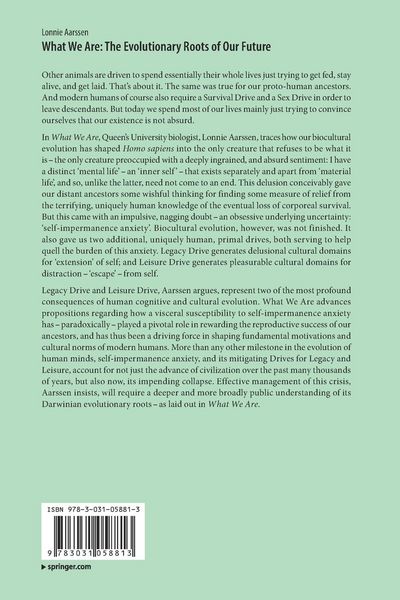
Other animals are driven to spend essentially their whole lives just trying to get fed, stay alive, and get laid. That’s about it. The same was true for our proto-human ancestors. And modern humans of course also require a Survival Drive and a Sex Drive in order to leave descendants. But today we spend most of our lives mainly just trying to convince ourselves that our existence is not absurd.
In What We Are, Queen’s University biologist, Lonnie Aarssen, traces how our biocultural evolution has shaped Homo sapiens into the only creature that refuses to be what it is — the only creature preoccupied with a deeply ingrained, and absurd sentiment: I have a distinct ‘mental life’—an ‘inner self’—that exists separately and apart from ‘material life’, and so, unlike the latter, need not come to an end. This delusion conceivably gave our distant ancestors some wishful thinking for finding some measure of relief from the terrifying, uniquely human knowledge of the eventual loss of corporeal survival. But this came with an impulsive, nagging doubt — an obsessive underlying uncertainty: ‘self-impermanence anxiety’. Biocultural evolution, however, was not finished. It also gave us two additional, uniquely human, primal drives, both serving to help quell the burden of this anxiety. Legacy Drive generates delusional cultural domains for ‘extension’ of self; and Leisure Drive generates pleasurable cultural domains for distraction – ‘escape’ – from self.
Legacy Drive and Leisure Drive, Aarssen argues, represent two of the most profound consequences of human cognitive and cultural evolution. What We Are advances propositions regarding how a visceral susceptibility to self-impermanence anxiety has — paradoxically — played a pivotal role in rewarding the reproductive success of our ancestors, and has thus been a driving force in shaping fundamental motivations and cultural norms of modern humans. More than any other milestone in the evolution of human minds, self-impermanence anxiety, and its mitigating Drives for Legacy and Leisure, account for not just the advance of civilization over the past many thousands of years, but also now, its impending collapse. Effective management of this crisis, Aarssen insists, will require a deeper and more broadly public understanding of its Darwinian evolutionary roots — as laid out in What We Are.
Noch keine Bewertungen vorhanden
Verfassen Sie die erste Bewertung zu diesem Artikel
Helfen Sie anderen Kundinnen und Kunden durch Ihre Meinung.
Kurze Frage zu unserer Seite
Vielen Dank für dein Feedback
Wir nutzen dein Feedback, um unsere Produktseiten zu verbessern. Bitte habe Verständnis, dass wir dir keine Rückmeldung geben können. Falls du Kontakt mit uns aufnehmen möchtest, kannst du dich aber gerne an unseren Kund*innenservice wenden.
zum Kundenservice