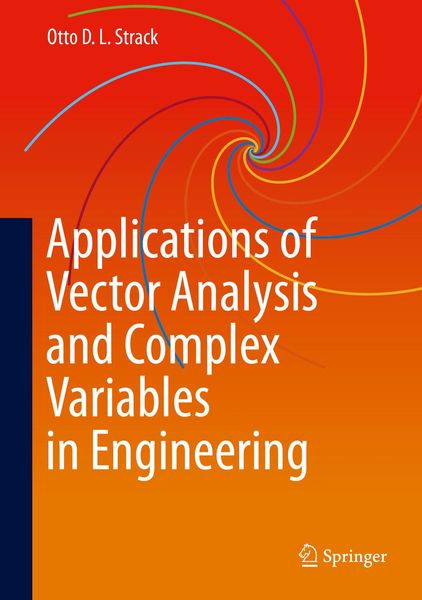
Applications of Vector Analysis and Complex Variables in Engineering
-
- Hardcover
- Taschenbuch
- eBook ausgewählt
-
Form:Einzelkauf Download
-
Sprache:Englisch
62,99 €
inkl. gesetzl. MwSt.Beschreibung
Produktdetails
Format
Kopierschutz
Nein
Family Sharing
Nein
Text-to-Speech
Nein
Erscheinungsdatum
18.04.2020
Verlag
SpringerSeitenzahl
216 (Printausgabe)
Dateigröße
2958 KB
Sprache
Englisch
EAN
9783030411688
The defining properties of vector fields, the divergence and curl, are introduced in terms of fluid mechanics. The integral theorems of Gauss (the divergence theorem), Stokes, and Green are introduced also in the context of fluid mechanics. The final application of vector analysis consists of the introduction of non-Cartesian coordinate systems with straight axes, the formal definition of vectors and tensors. The stress and strain tensors are defined as an application.
Partial differential equations of the first and second order are discussed. Two-dimensional linear partial differential equations of the second order are covered, emphasizing the three types of equation: hyperbolic, parabolic, and elliptic. The hyperbolic partial differential equations have two real characteristic directions, and writing the equations along these directions simplifies the solution process. The parabolic partial differential equations have two coinciding characteristics; this gives useful information regarding the character of the equation, but does not help in solving problems. The elliptic partial differential equations do not have real characteristics. In contrast to most texts, rather than abandoning the idea of using characteristics, here the complex characteristics are determined, and the differential equations are written along these characteristics. This leads to a generalized complex variable system, introduced by Wirtinger. The vector field is written in terms of a complex velocity, and the divergence and the curl of the vector field is written in complex form, reducing both equations to a single one.
Complex variable methods are applied to elliptical problems in fluid mechanics, and linear elasticity.
The techniques presented for solving parabolic problems are the Laplace transform and separation of variables, illustrated for problems of heat flow and soil mechanics. Hyperbolic problems of vibrating strings and bars, governed by the wave equation are solved by the method of characteristics as well as by Laplace transform.
The method of characteristics for quasi-linear hyperbolic partial differential equations is illustrated for the case of a failing granular material, such as sand, underneath a strip footing.
The Navier Stokes equations are derived and discussed in the final chapter as an illustration of a highly non-linear set of partial differential equations and the solutions are interpreted by illustrating the role of rotation (curl) in energy transfer of a fluid.
Noch keine Bewertungen vorhanden
Verfassen Sie die erste Bewertung zu diesem Artikel
Helfen Sie anderen Kundinnen und Kunden durch Ihre Meinung.
Kurze Frage zu unserer Seite
Vielen Dank für dein Feedback
Wir nutzen dein Feedback, um unsere Produktseiten zu verbessern. Bitte habe Verständnis, dass wir dir keine Rückmeldung geben können. Falls du Kontakt mit uns aufnehmen möchtest, kannst du dich aber gerne an unseren Kund*innenservice wenden.
zum Kundenservice